INDIA’s Constitution guarantees citizens the right to freedom of speech and expression and the right to assemble peacefully without arms under Articles 19(1)(a) and 19(1)(b). These provisions embody the spirit of democracy by ensuring that people can express their views, raise concerns and come together on public issues in a lawful and peaceful manner.
It was 8 am on Sunday, the eighth of February. A group of young men and women were standing in the Drop Gate area of Agartala. Most of them were wearing white T-shirts bearing the slogan “Save the Generation” on the front and back. The scene felt somewhat different and striking. As one moved closer, prominent Left youth leaders came into view — DYFI State Secretary Nabarun Deb, State President Palash Bhowmik, TYF General Secretary Kumud Debbarma, President Kaushik Roy Debbarma, among others.
THE current state of Regional Rural Banks (RRBs) serves as a stark example of how neoliberal policies are weakening public sector institutions in India. Established to cater to the financial needs of the rural population, these banks are now being steered toward a model that prioritises corporate interests and profit over social welfare. In this race for profitability, the foundational goal of "social banking" is being systematically eroded.
The India-US trade negotiations expressed in the joint statement have reached a framework of an interim agreement as an expression of commitment to broader India-US Bilateral Trade Agreements. The US President Trump seems to be committed to reducing trade deficits with countries like China, the EU, Vietnam, Japan, India and Canada pursuing his ‘America First’ policy.
In January 2026, US President Donald Trump declared Cuba to be an ‘unusual and extraordinary threat’ to US security – a designation that allows the United States government to use sweeping economic restrictions traditionally reserved for national security adversaries. The US blockade against Cuba began in the 1960s, right after the Cuban Revolution of 1959 but has tightened over the years.
The long wait is over. After eighteen months of mass uprising, elections have finally been held in Bangladesh. The people have delivered a decisive verdict. By resisting fundamentalism, they have secured a victory of relief.
MANUFACTURING in the aviation sector is going through quite a boom in India, in both military and civil aircraft. In military aircraft, there has of late been a pronounced emphasis on manufacturing indigenously designed and developed platforms. After decades of sharp preference for foreign equipment and doubts about domestic public sector manufacturers, the armed forces appear to have finally decided to put their weight behind self-reliance out of a practical need to reduce external dependence, especially during times of conflict.
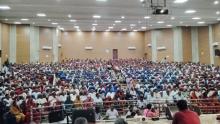
On 14 February, at a seminar organised by Jan Vichar Manch, Lucknow, the packed audience at the Kaifi Azmi Auditorium listened intently for nearly two hours to renowned journalist and writer P. Sainath. Prof. Nadeem Hasnain, the founder of Jan Vichar Manch, introduced Sainath and spoke about his books, especially ‘Everyone Loves a Good Drought’, which has a Hindi translation titled ‘Teesri Fasal’. Pratul Joshi conducted the program.
Nobel laureate and renowned economist Dr. Amartya Sen stated that Kerala has transformed into one of the highest-income states in the country. Speaking virtually at the 'Vision 2031' international conference, he noted that the astonishing achievements in education, health, and social security are a victory for the state's developmental vision. He added that Kerala has become a model for the nation in poverty alleviation, life expectancy, and per capita income.