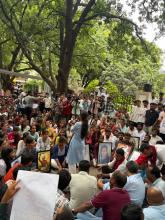
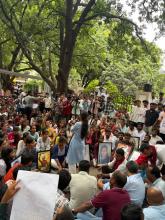
THE Central Government has used its majority in Parliament to scrap the Mahatma Gandhi Rural Employment Guarantee Act (MGNREGA). The new law that replaces it is a law for outright “adhikar chori” (rights theft). It has changed the very nature of MGNREGA. While it is a direct assault on the rights of the rural working poor, it should be seen in the framework of an attack on the Constitution of India.
The Mahatma Gandhi Rural Employment Guarantee (MGNREGA or NREGA) is the largest rights-based public employment programme in the world, signed into law in 2005. It faces imminent repeal by the Indian government, which intends to replace it with the Viksit Bharat – Guarantee for Rozgar and Ajeevika Mission (Gramin) VB – G RAM G Bill (2025).
THIS being the year end issue, People’s Democracy greets all our readers for the coming year. For us, reviewing the year gone by is important, as the past gives us the wherewithal to understand the present and step into the future with all our energy and purpose.
The Supreme Court’s Centre for Research and Planning has released an important document — the Report on Judicial Conceptions of Caste (2025) — examining how India’s highest court has historically understood caste. While the report is institutionally framed as a self-reflective exercise, a close reading reveals something far more significant: a decades-long ideological struggle within the judiciary, between the transformative, egalitarian mandate of the Constitution and the deeply embedded worldview of the upper-caste social order.
BANGLADESH is in a state of unrest. It burns with hatred. One horrifying incident after another is being manufactured by violent, ultra-fundamentalist, fanatic extremism. Anti-India rhetoric is escalating at an alarming pace and anti-India slogans are being raised across Bangladesh.
The Save Bengal Journey, which began on November 29 from the Char of Raidak (the Dol Mela ground in Tufanganj), witnessed 19 sunrises and traversed 11 districts before concluding at BT Road in Belgharia. Even before independence, Belgharia witnessed the labour movement of 1938 and saw the red flag at the gates of the jute mills. The struggle to save Bengal today is the inheritor of that flowing stream of the communist movement. Now the industrial belt has been fragmented into pieces.
SEVERAL employment schemes, each limited in scope and constrained by the availability of fiscal resources, had existed in different states of the country earlier; what the Mahatma Gandhi National Rural Employment Guarantee Scheme enacted in 2005 did was to introduce a uniform, nation-wide, essentially centrally-funded, demand-driven scheme: one person per rural household could get up to a hundred days of employment on demand, failing which the person demanding work would have t
“IN Kerala, I can breathe,” said Seema Chishti, senior journalist and editor of The Wire. She was talking not only about the contrast between the toxic air in Delhi and the fresh breeze from the Arabian Sea that was wafting across the open-air stage she was on in Kochi as she spoke in a session as part of the first Indian Cultural Congress (ICC). Chishti was also talking about the toxicity of the politics and culture being propagated by those in power in Delhi.
AN ironic but unsurprising coincidence marked the beginning of the winter session of Parliament. The Modi government decided to have a long discussion on ‘Vande Mataram’, which PM Modi, Amit Shah and others from the government side used to sing paeans of fulsome praise for the nationalism and sacrifice of freedom fighters inspired by the National Song, A few days later, the Modi Cabinet announced that 100 per cent Foreign Direct Investment (FDI) would be allowed in the insurance sector, up from the current 74 per cent.