Samprikta Bose
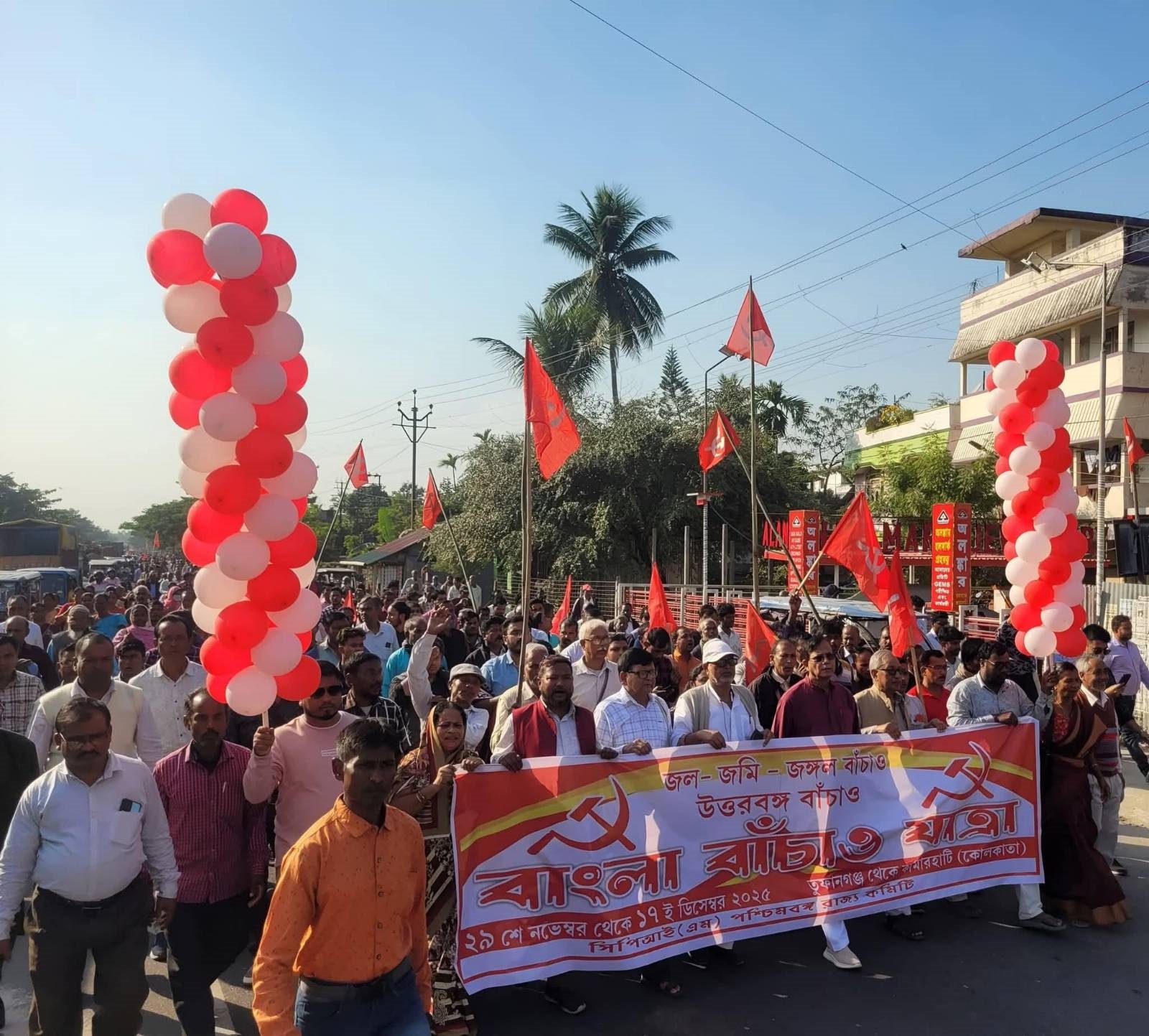
The CPI (M)'s 'Bangla Banchao' (Save Bengal) Yatra, launched on November 29, is proving to be a significant political event that is altering the political agenda of West Bengal. The campaign has fundamentally redirected the state's political discourse by focusing on the crucial issues of corruption and division. The yatra, which began in Tufanganj, Cooch Behar, is scheduled to span 19 days and cover at least 65 kilometres across North Bengal. This first phase has already generated a strong public response.
Suffering and Resistance
The first segment of the journey, which ran from Tufanganj's farmlands to Falakata's worker settlements, articulated a "new lexicon" of opposition. The significant participation of farmers, banbasti residents, and tea plantation workers highlighted a deep-seated dissatisfaction with the existing circumstances. The launch event in Tufanganj's Dolmela ground clearly demonstrated the strong desire for change, marked by the powerful testimonies of attendees. Zahiruddin Mia risked threats to attend, expressing the despair of losing Rs 3,600 on one bigha of potatoes and the necessity for his three sons to migrate for manual labour.Gobinda Pal, a 60-year-old whose REGA (Rural Employment Guarantee Act) work has stopped, passionately stated that the indignities suffered from ruling party agents must be answered "through the Red Flag."The campaign successfully brought long-neglected issues to the forefront, including corruption in pest control and the systematic erosion of the NBSTC (North Bengal State Transport Corporation) workforce.
CPI (M) leader Minakshi Mukherjee emphatically raised the "loot" of the state's resources and future as the core issue, setting the agenda for the movement. She asserted that with "no work in Bengal, only raw money from loot," lakhs of young people are forced to migrate for employment.
Mukherjee presented stark statistics to illustrate state mismanagement, noting that 3,822 primary schools have closed down while 22,000 liquor shops have opened. Furthermore, she criticized the ruling party, labelling them as "traitors to the people," for the abrupt increase of Rs. 11.33 per sack in potato storage charges.
Concluding with a clear political directive, she argued that the ruling parties are united in their desire to tackle these systemic issues. "If the Trinamool must be overthrown, then the CPI (M) must be strengthened," she asserted.
Laying the Groundwork
In an exclusive interview, CPI(M) State Secretary Mohammad Salim outlined the party's strategic approach, framing the current campaign as the foundational preparation for the 2026 Assembly elections. Salim criticized the two ruling parties (TMC and BJP) for attempting to distract the public with a manufactured "climate of fear" and focusing on divisive issues like "temples and mosques." The Left's response is a clear counter-narrative: the election must be centered on fundamental issues of "livelihoods and the people's right to survive." The ongoing yatra is specifically designed to highlight grassroots concerns — including the collapse of employment, industry, healthcare, and women's security — and bring them to the forefront.
Emphasizing the movement's commitment to political independence, Salim stressed its financing exclusively through "small savings and small collections," rejecting corporate funding. The campaign is leveraging technology, utilizing QR codes for public donations, which have already successfully raised over Rs. 2.5 lakh. This financial self-reliance is positioned as a principled stand against the politics funded by corporate exploitation.
A core component of the 'Bangla Banchao' initiative is the struggle for democratic rights. Salim noted that the yatra was specifically postponed until late November to align with the publication of the draft voter list, allowing the journey to serve as a "consciousness campaign for the protection of voting rights." He linked the fight against the terror created by the SIR (Special Intensive Revision of electoral rolls) process — which both TMC and BJP exploit — to the broader struggle to restore democracy.
The Road Ahead
The momentum of the movement is undeniable. Workers from 64 tea gardens and 44 forest settlements in Alipurduar have lent their support. The symbolic passing of the red flag from the Cooch Behar District Secretary, Ananta Roy, to the Alipurduar District Secretary, Kishore Das, cemented the campaign's transition.
At the Falakata night assembly, Mohammad Salim pledged that the attack on workers on the very first day would not deter them. He issued a firm warning to the ruling powers: "The terror of the BJP, RSS, and their Durga, Mamata Banerjee, will no longer work. The people are ready for retaliation."
The 'Bangla Banchao' Yatra, led by Salim, Mukherjee, and a host of young comrades, promises to sideline the "shadow wars and fake battles," escalating the struggle to restore the political narrative to the common person's language, and fulfilling the essential condition for the resurgence of the Left in Bengal.


