S Shilpa
For over 22 lakh students who appeared for the National Entrance-cum-Eligibility Test - Under Graduate (NEET-UG) on May 3, 2026, across India, the decision by the National Testing Agency (NTA) to cancel the examination came as a traumatic turn. Through years and months of preparation, depriving themselves of entertainment, social life and relationships, the aspirants readily dedicated themselves to fulfilling their dream of becoming doctors. For many, this dream carried greater weight, deeply associated with their generational pride in joining one of the most respectable professions, while for others, becoming a doctor meant conquering a summit historically far beyond their reach. NTA has announced the re-examination date for NEET as June 21, 2026. However, the damage done has already taken a severe toll on the aspirants, highlighting some major systemic concerns.
The Narendra Modi government’s desperate moves to centralise key areas have pushed the country into a deeper pit of chaos, uncertainty and growing social disparities. Under the idea of “One Nation, One Exam”, the diversities and contextual specificities in conducting entrance examinations for higher education and professional institutions across the nation are disregarded. The NTA, which is accountable for conducting major entrance and eligibility tests nationwide, has already been in the headlines for its continuous incompetence and irregularities in successfully conducting the examinations. Despite recurring controversies over the leakage of question papers, cancellation of examinations, and inaccuracies in the declaration of results, the NTA continues to function as the primary monitoring agency for examinations, neglecting any need for a serious probe or structural reformation.
Centralised entrance exams and their patterns demand a “smart” approach to finding answers, along with effective time management, where coaching centres step in, offering concise methods to crack the codes. For tests like NEET-UG, where the proportion of aspirants appearing for the examination is much higher than the number of seats scattered across the nation, an individual is forced to dedicate themselves fully to the preparation with the help of every means available in order to face the competition. The huge industry of examination coaching centres in India assumes the role of a mafia by placing their primary interest in exploiting this need for professional guidance. A hefty fee is charged for coaching, further alienating aspirants from socially and economically marginalised sections from their dream of securing a seat in a medical college. Additionally, economic disparities are widening, forcing families to seek ways to escape the vicious web of banks and moneylenders in their attempts to cover the fees and other expenses. This aligns with the union government's centralisation and commercialisation agenda, as projected through the National Education Policy 2020. Students who lack the necessary infrastructural facilities have been systematically excluded from education in India for a long time, a situation legitimised by the NEP 2020.
While the broader impact of such mishaps would be a deterioration in the quality of higher education and professional courses and the widening of socio-economic polarisation in the country, the Students’ Federation of India has been raising key concerns. The past week has been eventful, with militant protests and movements against NTA across the nation, as students flooded the streets of the nation’s major education centres. SFI raised the demand for an immediate judicial probe by a Supreme Court monitored committee into the repeated paper leaks and exam irregularities by NTA. A major demand is the rolling back of the unscientific “One Nation, One Exam” policy and the immediate scrapping of NTA. There have been proposed measures to implement the Computer-Based Test (CBT) mode for NEET. This has been observed to further polarise students, resulting in a digital divide. SFI opposes this proposal and strongly demands a structural reform of the monitoring body. The education sector in India has faced severe setbacks since the beginning of the NDA regime. SFI demands the immediate resignation of the Union Education Minister, Dharmendra Pradhan, and concerned officials from their positions.
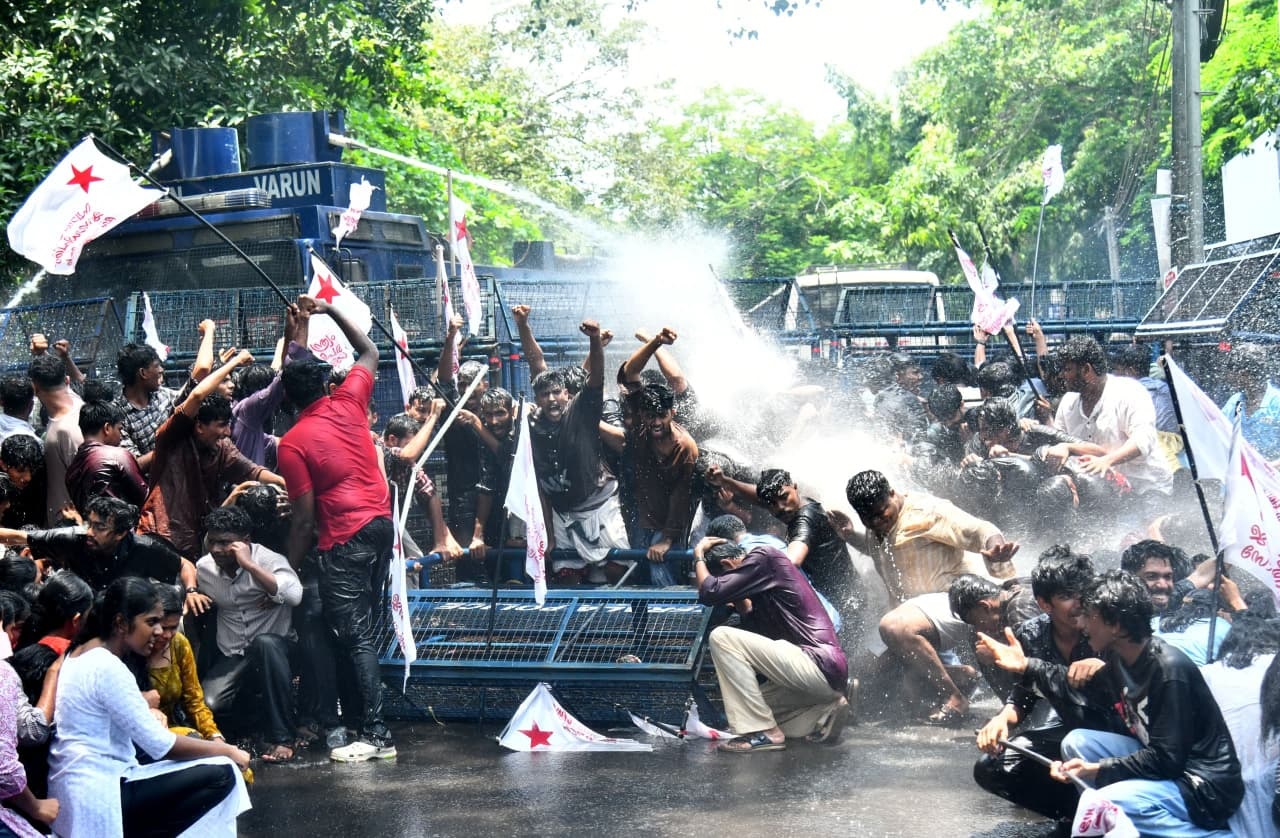
On May 12, 2026, SFI organised a protest at Shastri Bhawan, Delhi, against the cancellation of the NEET exam and the continuous mismanagement of the central government in conducting national-level examinations. The peaceful protest gathering was disrupted by the police force, brutally detaining the leadership of the movement, including SFI All India President Com. Adarsh M. Saji, All India Joint Secretary Com. Aishe Ghosh, SFI Delhi State President Com. Sooraj Elamon and other activists. Followed by the detention of student activists at the national capital, strong protests erupted across the nation immediately demanding the scrapping of NTA and a transparent, time-bound probe into the issue. The Kerala state committee of SFI staged a massive protest march in front of the AG’s office in Thiruvananthapuram, where the students were met with water cannons and other adverse measures. Students under the banner of SFI took to the streets across Kerala, forging a broader resistance against attempts to destroy the higher education sector in India, where student leaders from Kottayam district were remanded. The states of Telangana, Karnataka, Rajasthan, West Bengal, Haryana, Uttar Pradesh, Andhra Pradesh, Tamil Nadu, Odisha, Jharkhand and other states joined the mass mobilisation against the issue, turning the campuses and streets into spaces of louder resistance. The answer to the burning question of incompetence, corruption and irregularities in the Indian education sector is nothing but organised resistance led by the student masses!


