
Subinoy Moulik
THE dreaded political apparatus known colloquially as “bulldozer justice” — the extrajudicial demolition of property via executive fiat — has officially arrived in West Bengal. For years, political observers watched the deployment of heavy earthmoving machinery as a tool of state intimidation across BJP-ruled northern and central India, often dismissing it as a phenomenon entirely alien to the unique socio-political fabric of Bengal. That illusion has now been completely shattered. Before the newly elected BJP administration could even finalise its full cabinet portfolios, the yellow arm of the excavator became the definitive symbol of its governance style.

The immediate casualty of this shift is not merely a handful of unauthorised brick-and-mortar structures; it is the fragile sense of economic security held by millions of workers within the state’s massive informal sector. What is currently unfolding across the metropolitan landscape of Kolkata and its surrounding districts is a highly calculated, state-sponsored campaign designed to induce raw vulnerability and institutional helplessness among the working poor. By systematically bypassing established statutory procedures, judicial oversight, and municipal notice periods, the current administration has delivered an unambiguous opening salvo: in the consolidation of this new regime, no historical or regional exceptionalism will be tolerated.
THE OMINOUS PRELUDE
The institutionalisation of the bulldozer did not begin quietly with municipal notices; it was preceded by a systematic campaign of symbolic and physical violence explicitly targeting the state’s traditional political opposition -- the Left. Even as the final rounds of the Assembly election results were being tabulated, triumphant BJP workers moved swiftly to dismantle the visual and physical architecture of the Left. The first major flashpoint occurred in South Kolkata, near the Jadavpur 8B auto stand. Riding on early favourable electoral trends, a mobilised crowd of saffron-clad activists attempted to deface the statue of Vladimir Lenin located directly opposite Jadavpur University. Under the guise of celebratory orange gulal smearing, the assembly actively moved to structurally compromise the statue. The provocation met immediate, organised pushback from local activists. Alerted to the unfolding vandalism, SFI all-India Secretary Srijan Bhattacharya, alongside local CPI(M) members, rushed to the intersection to form a protective human perimeter around the monument. While this specific attempt was thwarted — with Bhattacharya manually cleaning the defaced statue to restore its physical integrity — the broader intent of the crowd was unmistakable. As Bhattacharya noted at the scene: “They came under the pretext of smearing gulal on Lenin’s statue, but their real plan was to demolish it. For fascist, communal forces, the Left remains enemy number one. That is why their very first attack was directed at our symbolic spaces.”
The anti-Left violence quickly decentralised and spread into the districts. In the northern district of Cooch Behar, an ambush-style assault was launched against the CPI(M) office in Dinhata, leaving the building heavily vandalized and multiple party workers injured. In the rural tracts of Hooghly’s Khanakul, veteran Left leaders Kajal Ghoshal and Ziaul Chowdhury were targeted and physically assaulted. By the following midnight, the architectural assault found its mark in Jiaganj, Murshidabad. Located opposite Sripat Singh College, a two-decade-old statue of Lenin was completely uprooted from its concrete pedestal by a mobilised mob chanting fanatic slogans under the cover of darkness.
Ground-level reports indicate these mobs included opportunistic TMC operatives and local musclemen who defected to the ruling party as the electoral scales tipped, rather than just veteran RSS loyalists. These political neo-converts spearheaded a violent raid on Left supporter Sanju Majumdar’s residence near Garia station. This post-poll retaliatory friction claimed at least seven lives across the state, signalling an immediate breakdown of law and order.
BULLDOZER CAMPAIGN BEGINS
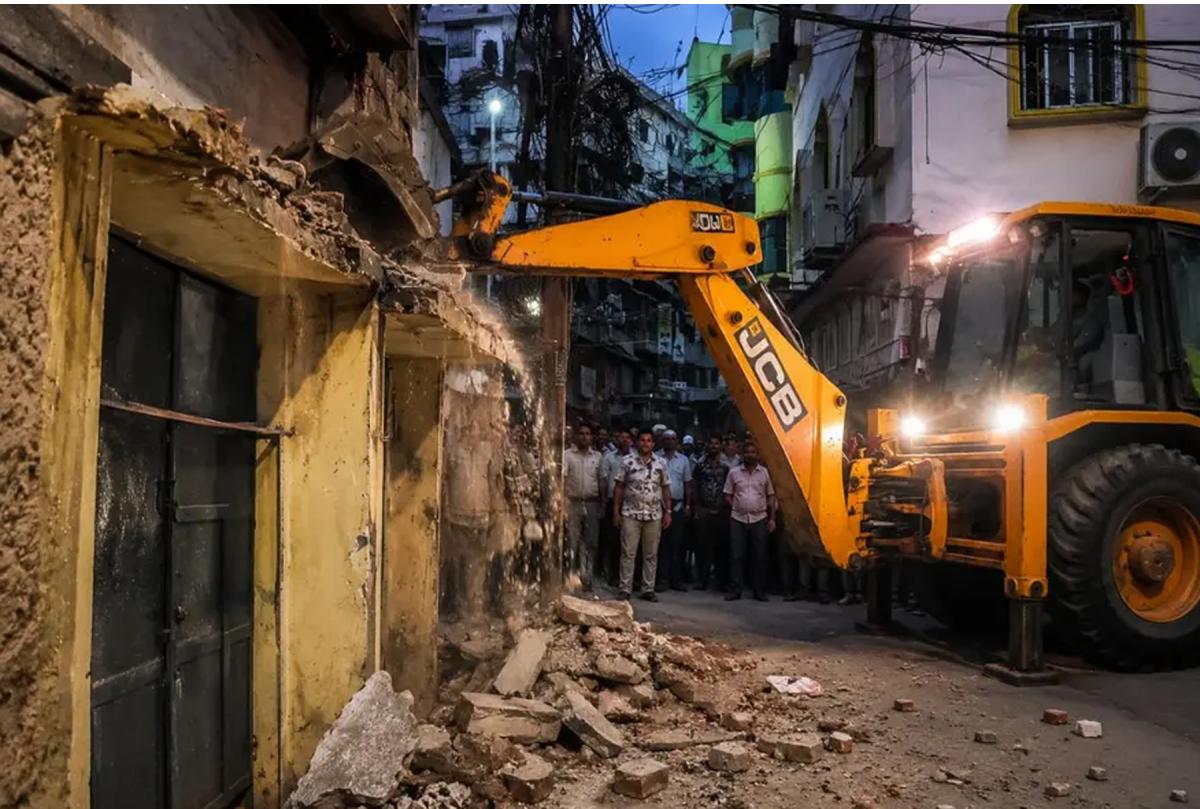
Less than a day into the regime’s tenure, a heavy earthmover —backed by BJP workers — rolled into New Market and ruthlessly flattened pavement stalls and wooden kiosks before low-income vendors could salvage their merchandise. This physical destruction was matched by verbal decrees warning that rebuilding without explicit party permission would lead to immediate arrest and further property loss. Throughout the operation, local police stood by as passive spectators, ignoring the blatant property damage and rampant lawlessness. This was not simple hooliganism or muscle-flexing, but the planned execution of a broader governance model. Throughout the election campaign, saffron-painted bulldozers were displayed as ideological props alongside stages at major BJP rallies — most notably during visits by Uttar Pradesh Chief Minister Yogi Adityanath — serving as visual promises of upcoming structural enforcement.
THE CHIEF MINISTER’S DIRECTIVE
Street-level party vigilantism rapidly transitioned into institutional state action with formal executive validation from Nabanna. Invoking a "zero tolerance" policy towards urban irregularities, Chief Minister Suvendu Adhikari issued a direct order for large-scale demolitions, using a tragic fire at an unauthorised Tiljala leather factory — which caused two fatalities and three severe injuries — as immediate administrative justification. While public safety concerns were valid, the state's response was characteristically asymmetrical. Within hours, a joint task force of the KMC, KMDA, and Rapid Action Force (RAF) cordoned off the Tiljala neighbourhood and demolished the structure. Simultaneously, the power secretary and CESC were directed to audit and disconnect utilities from any buildings lacking formally approved architectural plans.
However, the geographic focus of these directives revealed an ideological bias. The administrative machinery specifically targeted minority-dominated, working-class areas. As a veteran Topsia resident noted, the enforcement singled out specific neighbourhoods based on demographics rather than structural safety. Furthermore, the directives failed to address systemic corruption within the KMC or Fire Services; the bureaucratic nexus that had profited from these informal structures for almost a decade remained untouched, shifting the entire burden of displacement onto the most economically vulnerable.
THE RAILWAY DRIVES
The urban restructuring campaign quickly expanded to Bengal's massive railway transit network, which historically serves as a vital economic hub for hundreds of thousands of suburban station vendors and hawkers. In mid-May, the railway administration —operating in direct alignment with the new state government —launched a massive hawker eviction drive. This blitzkrieg began on May 7 with short-notice eviction slips at Bidhannagar Road station and rapidly escalated across the Howrah and Sealdah divisions, summarily removing over a thousand temporary shops without any rehabilitation plans.
The execution was marked by a complete disregard for humanitarian transitions. On Saturday night, May 16, a heavy force of state police, GRP, and RPF utilised heavy machinery to systematically demolish dozens of long-standing stalls outside Howrah station. Aggrieved vendors who formed human chains were met with physical force; traders revealed that notices served that morning resulted in their livelihoods becoming broken debris by midnight.
The destruction was even larger within the Sealdah station precinct, where the RPF razed at least 600 shops overnight, loading everything from tea stalls to newspaper kiosks into municipal dump trucks amidst reports of women vendors being dragged and assaulted. While similar eviction notices are now active at key transit nodes like Kalyani, Birati, Titagarh, Ranaghat, and Krishnanagar, the only successful check on this momentum occurred back at Bidhannagar station, where a unified physical resistance by hawkers, commuters, and residents forced demolition squads to temporarily retreat.
EXTRAJUDICIAL MANIPULATION
To sustain the political momentum necessary for such sweeping economic displacement, the administration has simultaneously deployed a series of sensitive socio-religious interventions explicitly designed to fragment working-people solidarity and prevent inter-community alliances. Parallel to the bulldozer drives, the Home Department released a sweeping notification strictly enforcing the West Bengal Animal Slaughter Control Act of 1950. The directive introduced a string of highly restrictive legal conditions and punitive measures on the sacrifice of cattle, including cows, buffaloes, oxen, and calves. Coming directly on the eve of the major Islamic festival of Bakrid, the timing of this bureaucratic intervention was clearly intended to create an atmosphere of extreme legal vulnerability and social anxiety within the state’s minority communities. Simultaneously, aggressive noise-control mandates were enacted. Police now maintain strict surveillance over religious institutions to enforce decibel limits on loudspeakers. While addressing noise pollution is valid, the selective enforcement — alongside rumours of an impending ban on the Azan — suggests a sophisticated strategy of social engineering.
By keeping the public discourse continuously centred on highly emotive, religious issues, the state government has effectively sought an advance endorsement to intensify a majoritarian consensus. This presents its aggressive urban cleansing as a triumph of secular law and order rather than a direct structural assault on the livelihoods of the poor.
THE PARADOX OF THE MANDATE
The ‘Bulldozer Raj’ in West Bengal is tragic because its victims are the very people who enabled it. Desperate to escape TMC syndicate extortion, many urban and suburban hawkers had abandoned the Left to embrace “Modi’s Guarantee”. These voters chose the BJP, hoping a “double-engine government” would provide stability and investment. Instead, they faced economic ruin within two weeks of the regime change. The irony lies in the drive’s indiscriminate impact. While initial demolitions in New Market utilised anti-minority rhetoric, subsequent railway drives decimated livelihoods regardless of identity. In suburban towns and districts, Hindu hawkers — the new government’s so-called electoral bedrock — have received no mercy. Vast numbers of Hindus have seen their stalls smashed and families impoverished. By falling for a polarising narrative, Bengal’s working populace inadvertently sanctioned the machine now destroying their own livelihoods.
THE RESISTANCE
The unchecked momentum of the "Bulldozer Raj" in West Bengal has finally collided with an organised, strategic counter-offensive. As the newly installed BJP administration continues to deploy heavy machinery to bypass due process and displace the working poor, a multi-layered resistance has emerged. Orchestrated by Left parties, mass organisations, and dedicated civil rights lawyers, this pushback is actively challenging the regime’s extrajudicial manoeuvres, both on the volatile streets of Kolkata and within the halls of the judiciary.
STREET MOBILISATION
Immediately following the unprovoked bulldozer assault on minority-owned stalls in New Market, the Left Front launched its formal public resistance. On Friday, May 8, a massive protest march cut through the heart of Central Kolkata’s commercial district. Initiated from the iconic Lenin statue at Dharmatala, the procession traversed Chowringhee Road, Lenin Sarani, and S N Banerjee Road, circling the New Market perimeter before returning to its starting point.
The rally served as a powerful unified front, drawing senior leadership from across the Left political spectrum. Notable attendees included Left Front Chairman Biman Basu, CPI(M) Polit Bureau members Srideep Bhattacharya and Surjya Mishra, senior leader Sujan Chakraborty, CPI State Secretary Swapan Banerjee, and leaders from the RSP, Forward Bloc, and CPI(ML) Liberation.
Addressing the surging crowd, Biman Basu observed that the post-victory structural violence targeting hawkers' stalls and educational campuses was a direct attempt to dismantle core democratic values. Left leaders collectively warned the administration that arbitrary state actions executed under the cover of victory celebrations would face unrelenting, continuous street-level resistance.
THE TAPSIA STAY ORDER
The street-level resistance achieved a critical breakthrough in the legal arena on Thursday, May 14. Reviewing the abrupt demolition drive in Tiljala's Tapsia locality — initiated by the state executive following the tragic leather factory fire — the Calcutta High Court intervened directly to halt the administrative overreach.
Representing local residents, veteran advocate Bikash Ranjan Bhattacharya, assisted by Samim Ahmed, argued convincingly before the bench that using bulldozers to flatten occupied structures without prior statutory notice fundamentally violated constitutional protections. Ahmed explicitly cited a 2025 Supreme Court precedent establishing that demolitions engineered to induce state-sponsored fear are inherently incompatible with a democratic welfare state.
The court issued an interim order staying all further demolitions in the area until May 22, ruling that any structural clearance must comply strictly with established statutory frameworks and municipal laws. Furthermore, the court observed that creating an atmosphere of terror through sudden executive drives subverts basic democratic norms.
The judicial victory triggered widespread celebrations throughout the Tapsia neighbourhood. A mass solidarity rally organized by the CPI(M) successfully mobilised hundreds of local residents. Holding physical copies of the High Court order aloft, the leadership issued a direct, unyielding warning to the authorities at Nabanna: "Bulldozer rule will not be tolerated on the soil of West Bengal."
THE SEALDAH RALLY
The third major front of the organised resistance consolidated on Friday, May 22, at Sealdah station, the major transit hub where the RPF had previously razed 600 stalls in an overnight operation. Organised jointly by the West Bengal Railway Hawkers’ Union and the Centre of Indian Trade Unions (CITU), thousands of transport vendors staged a massive demonstration, putting forward a non-negotiable demand: No eviction without comprehensive rehabilitation.
CITU State President Anadi Sahu fiercely criticised the rapid escalation of bulldozer operations under the new administration, pointing out the blatant hypocrisy of current political leaders who had previously claimed to protect informal workers during their election campaigns. Union President Alokesh Das and Secretary Dipankar Shil revealed to the press that despite prior administrative assurances from the Divisional Railway Manager (DRM), coordinated evictions were being aggressively pushed through in Krishnanagar, Dum Dum, Belgharia, and Sonarpur.
Amidst reports of railway police baton-charging hawkers and active bulldozers at the terminal, CITU leader Gargi Chatterjee condemned state coercion, emphasizing that informal hawkers are vital to the commuter economy.
The speakers announced an escalation plan, including a deputation to the Howrah DRM and a statewide Rail Roko (railway blockade) if the policy of arbitrary evictions and displacement continues.


