Jai Bhagwan
RECENTLY, large-scale demolitions of residential settlements have been underway in cities like Faridabad and Gurgaon in Haryana, bordering the national capital, Delhi. These actions are being carried out through the Municipal Corporation administration and the Country Town Planning Department, under the leadership of the ruling BJP party. The colonies, inhabited for 60-70 years, are being demolished, leaving lakhs of people homeless and pushing them into poverty. There seems to be only one motive behind all this: to wipe out these settlements located in the heart of these cities so that the thousands of acres of prime land can be exploited by big builders and those in power to maximise their profits.
FARIDABAD'S NEHRU COLONY
The Faridabad Municipal Corporation and the district administration bulldozed hundreds of homes and religious places of worship in Nehru Colony, inhabited for over 70 years. This action took place on the night of May 29-30, 2026, while residents were asleep. No prior notice was issued to the owners to vacate their homes. While 300 homes were demolished, thousands of other homeowners were verbally threatened and illegally ordered to vacate. This trend has spread to dozens of colonies. Nehru Colony is spread over 100 acres hosting approximately 10,000 homes and a population of over 100,000. Residents of the colony possess ration cards, Aadhaar cards, electricity meters, voter cards, and family IDs. Generations of families have lived here for years. The majority of families living in Nehru Colony and dozens of other colonies like it are labourers. This population is the lifeline of Faridabad's industries, construction, transport, the unorganised sector, shops/shopping malls, and homes in middle-class colonies, from large housing societies to large companies, providing staff for cleaning and security. A significant portion of temporary/contract workers from government departments responsible for the sanitation and sewerage systems of the city reside in these colonies. Most of the population belongs to the poor and marginalised sections of society, whose ancestors migrated from rural areas of Haryana and other states in search of employment. These populations have played a significant role in the beautification of cities like Faridabad and Gurgaon, and in the development of Haryana and these cities. But now the ruling party seems determined to take over their valuable lands by running bulldozers on their houses.
CITIES AS INDUSTRIAL CITIES AND LARGE SETTLEMENTS
At the time of India's independence, Faridabad was a small village. However, today it has a population of about 21 lakh. During the horrific communal riots that erupted during the partition of the country in 1947, hundreds of thousands of people were killed, leading to the displacement of large populations. At that time, approximately 26,000 refugees from Pakistan's North-Western Province (Khyber Pakhtunkhwa) and West Punjab were relocated to tented camps on the Delhi-Mathura Road near this village. The Faridabad Development Board was formed on June 10, 1949, under the chairmanship of India's first President, Dr. Rajendra Prasad. On October 17, 1949, the foundation stone of the National Industrial Township (NIT) was laid in this new industrial city to rehabilitate the refugees. This was part of the country's first Prime Minister, Jawaharlal Nehru, and his government's larger project to develop industry in the country. This industrial hub, adjacent to the capital Delhi, was the country's first industrial hub developed after independence. People from various regions were encouraged to move here, and the then-state governments also launched campaigns to promote this. This settlement, divided into five clusters, is known as NIT 1, 2, 3, 4 and 5. Today, it lies at the heart of Faridabad, a city with a population of millions. It is a hub of small and micro-industrial units, employing hundreds of thousands of workers. This entire area belongs to the Rehabilitation Department, housing everything from the Municipal Commissioner's office to the offices of major companies. Located on this same land are Nehru Colony, Indira Colony, Kalyan Nagar, Adarsh Nagar, Rahul Colony, AC Nagar, and dozens of other similar settlements, which have existed since the 1950s and are now being razed under BJP rule.
ILLEGAL DEMOLITION PROCESS
The demolition began on the night of May 29-30, 2026, in Nehru Colony, Faridabad. However, a notice to vacate the settlement was issued by the Municipal Corporation of Faridabad on June 2, 2026. The notice stated that the area needed to be cleared for Metro Railway infrastructure development. The letter clearly stated that the area, from 120 feet from the culvert to 160 feet from the mosque, needed to be vacated. Furthermore, any residential or other premises within this area should be vacated within the next week. This space will be used for the Metro station project. The same notice also clearly states that the action will be carried out in accordance with the Land Acquisition, Rehabilitation, and Resettlement Act, 2013. Affected families will be compensated and relocated.
The question is, why was this notice not issued before demolishing the houses and other settlements? Is the time limit for such a notice only one week? The second question is that this notice only mentions evacuating a part of the settlement. Then why are people being forced to vacate their houses and why are the houses being demolished by giving verbal orders to vacate and demolish the entire colony? Without any written order, the water and electricity supply in Nehru Colony was stopped. Not only this, but there is also a ban on gathering of people by invoking Section 163 of BNS.
SUPPRESSION OF THE CONSTITUTIONAL AND DEMOCRATIC SYSTEM
India is a democratic country. Here, the Constitution and the law rule. If the central or state government acquires land for a project, a settled procedure has to be followed. Notices are sent in due course, compensation amounts are determined, and an agreement is reached through discussions with all stakeholders. If residential settlements or colonies fall within the project area, homeowners receive compensation and arrangements are made for the rehabilitation of their families. Only after this, will demolition proceedings proceed further. However, Nehru Colony in Faridabad, where bulldozers are being used to demolish houses and religious sites, is a case of blatant disregard for such legal norms. Why was this done?
There is widespread talk in Faridabad that these actions are being taken to provide this valuable land to certain leaders and property dealers of the ruling party. Millions of people are being evicted from their homes. Thousands of families' homes, built with their hard-earned money, are being destroyed. Religious places of worship have also been razed. These are completely illegal actions. This is extremely concerning and condemnable. Furthermore, in dozens of other colonies, people are being threatened with similar threats and forced to vacate their homes.
COMMUNAL FACE OF BULLDOZER POLITICS
The bulldozer politics initiated by the BJP's Yogi government in Uttar Pradesh is not only anti-constitutional, oppressive, and an attack on the rule of law, but also deeply communal, anti-Muslim and anti-poor. It is also an open declaration of land grabbing. In Haryana, its use is now being seen in major cities as well. The BJP-RSS gang, using communal polarisation, escalated this action to demolish Nehru Colony in Faridabad. A 55-year-old mosque stood at the main intersection in the colony. The intersection here is known as Masjid Chowk, and the Muslim population lives nearby. The main road housed large shops and businesses belonging to the Muslim minority. There was a substantial meat and fish trade. Before demolishing the entire colony, the mosque and shops were targeted, and propaganda was spread that the Azaan (call to prayer) was being recited there, causing noise, and that animals and birds were slaughtered, and that illegal drugs were being traded there. This propaganda, which had already created a groundswell of anti-Muslim sentiment among the public, created acceptance among the majority population. On the night of May 29, all roads were barricaded for several kilometres before the mosque and 30 prominent shops were demolished. Police forces were deployed across the entire area. The reason for this was not explained. At midnight, after speaking with the mosque's cleric, the mosque was evacuated. Adjacent houses were also evacuated. In the nearby village of Badkhal, where the Muslim population is in majority, police were deployed and movement was restricted to prevent people from protesting. Within 24 hours, the mosque and 30 shops were demolished, and a road was prepared by clearing the debris. A small temple was also demolished and cleared. Subsequently, on June 1 and 3, over 300 houses were razed, most of which belonged to the majority community or Hindus.
PROTESTS AND RELIEF BY CITU
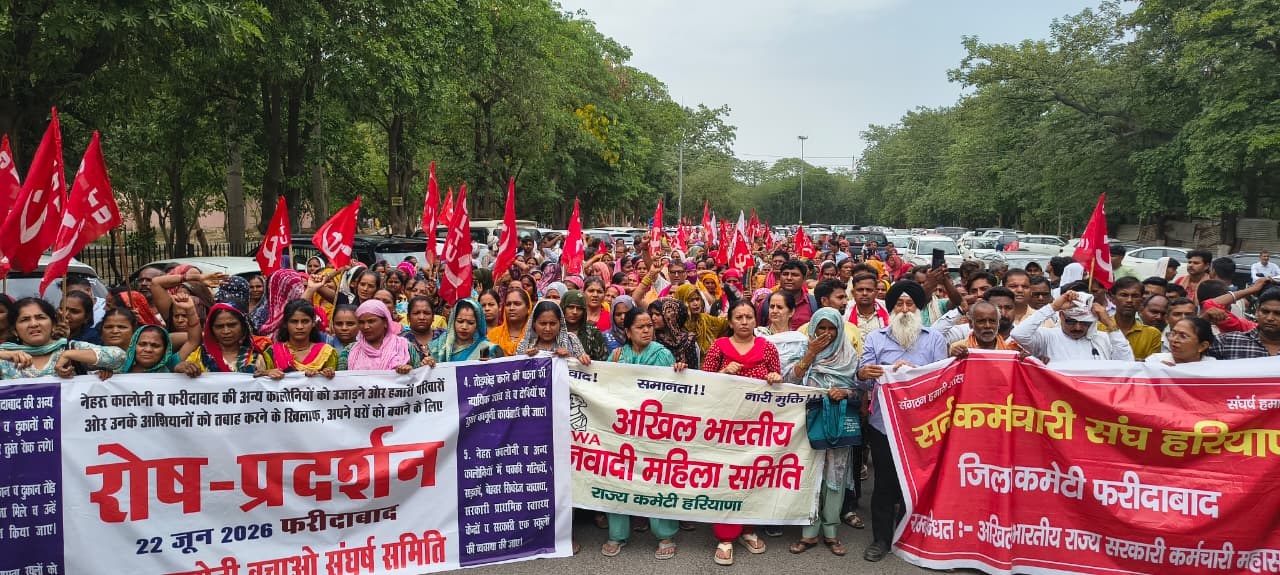
Serious efforts were made to intervene in this matter through a meeting of the CITU Faridabad district committee and led by the local leadership of the Janwadi Mahila Samiti. Representatives spoke out against the demolition from June 4, standing with the affected people, and the demolition process was halted from that day. The local Balmiki Temple Trust also organized a panchayat on June 7, in which CITU and the party actively participated. Due to Section 163 of the BNSS prohibiting gatherings in the colony and the area, no one was able to intervene. In this situation, a CITU district meeting was held to formulate a plan for intervention. Through outreach in the area, the trust of some local citizens was built. A meeting was convened in a park near the colony. This meeting, too, was attempted to be disrupted by agents of the BJP and contractors, but they were unsuccessful. The next day, the state and district leadership of CITU and the Janwadi Mahila Samiti went door-to-door in the colony, speaking to people, and gathered them in the colony for a meeting. The police created an atmosphere of fear, but the people remained steadfast. On June 15, a protest was called for at the Municipal Commissioner's office. This led to the formation of the Nehru Colony Bachao Sangharsh Samiti, Faridabad. Representatives from various organizations and affected individuals joined the Sangharsh Samiti, and it was decided to continue the protest under its banner. A massive protest was also decided on June 22 at the District Deputy Commissioner's office. In preparation for this, handbills were printed, and thousands of them were distributed by teams in Nehru Colony and 12 other similar colonies. Announcements were made. Videos were released on social media, and publicity was promoted through posters and stickers. Continuous news coverage was provided in the print media, and press conferences were held.
DC OFFICE GHERAO
The June 22, protest was quite effective. In addition to thousands of affected people, various employee organizations and prominent citizens participated. The meeting before the protest was addressed by CITU National Vice President and former MP Tapan Sen, All India State Employees Union Chairman Subhash Lamba, CITU State General Secretary Jai Bhagwan, Secretary Sudha, District President Nirantar Parashar, Secretary Virendra Dhangwal, Janwadi Mahila Samiti State President Savita, General Secretary Usha Saroha, Committee member Sabita Malik, Sarva Karamchari Sangh State President Naresh Shastri, District President Kartar Singh, Secretary Balbir Singh Balguher, Retired Employees Union's Naval Singh and Lajja Ram, Sangharsh Samiti leaders Bijendra Singh, Poonam, Rajendra, Balbir, Devki, Rajendra, and Naresh, Sultan, and Sandeep, along with dozens of others from other organisations. The protesters surrounded the Deputy Commissioner's office. A memorandum was sent to the Chief Minister through the SDM. The siege continued for an hour demanding the restoration of electricity and water. Electricity was restored, and the administration assured that water would be restored by evening. The following demands were made to the government:
1. The demolition of houses, shops, other residential buildings, religious places of worship, and all settlements in Nehru Colony and other Faridabad colonies should be immediately stopped.
2. Families whose houses, shops, and other settlements were demolished in Nehru Colony and other Faridabad colonies should receive compensation and be rehabilitated.
3. Religious places of worship that were demolished should also be compensated and rehabilitated.
4. A judicial inquiry should be conducted into the bulldozer demolitions in Nehru Colony and other Faridabad colonies, and immediate legal action should be taken against all those responsible for carrying out and directing these actions.
5. Water and electricity supply should be restored immediately in Nehru Colony, Faridabad.
6. Improved public amenities, including paved streets, roads, improved sewerage systems, primary health centres and government schools, should be provided in Nehru Colony and other Faridabad colonies.
STRUGGLE CONTINUES
Almost the entire colony's residents had been evacuated. However, due to the pressure of the movement, the bulldozer operation has been suspended since June 3. Under pressure from the movement, Faridabad MP and Union Minister Krishn Pal Gujjar issued a statement on June 12 that there would be no demolitions and that those whose homes were destroyed would receive compensation. Some residents of the colony appealed to the High Court against the demolition. The court stayed the demolition proceedings on June 22. The Sangharsh Samiti, continuing its protest, has made extensive preparations and announced a siege of the house of a BJP Union Minister on June 27. The police are continuously trying to remove the protest site, which has been ongoing since June 15. Due to this movement, thousands of families and lakhs of people living in dozens of colonies are seeing a ray of hope. The atmosphere of fear and intimidation has eased, and there is hope that their homes, built over the years, will remain intact. The district administration has asked those whose homes were destroyed to fill out forms for compensation. The struggle committee is primarily led by 65-year-old Bijendra Singh, a victim of this action who was born in this colony, and Poonam, an Asha Union worker. The 21-member committee is working day and night to save dozens of colonies.


