B Prasad
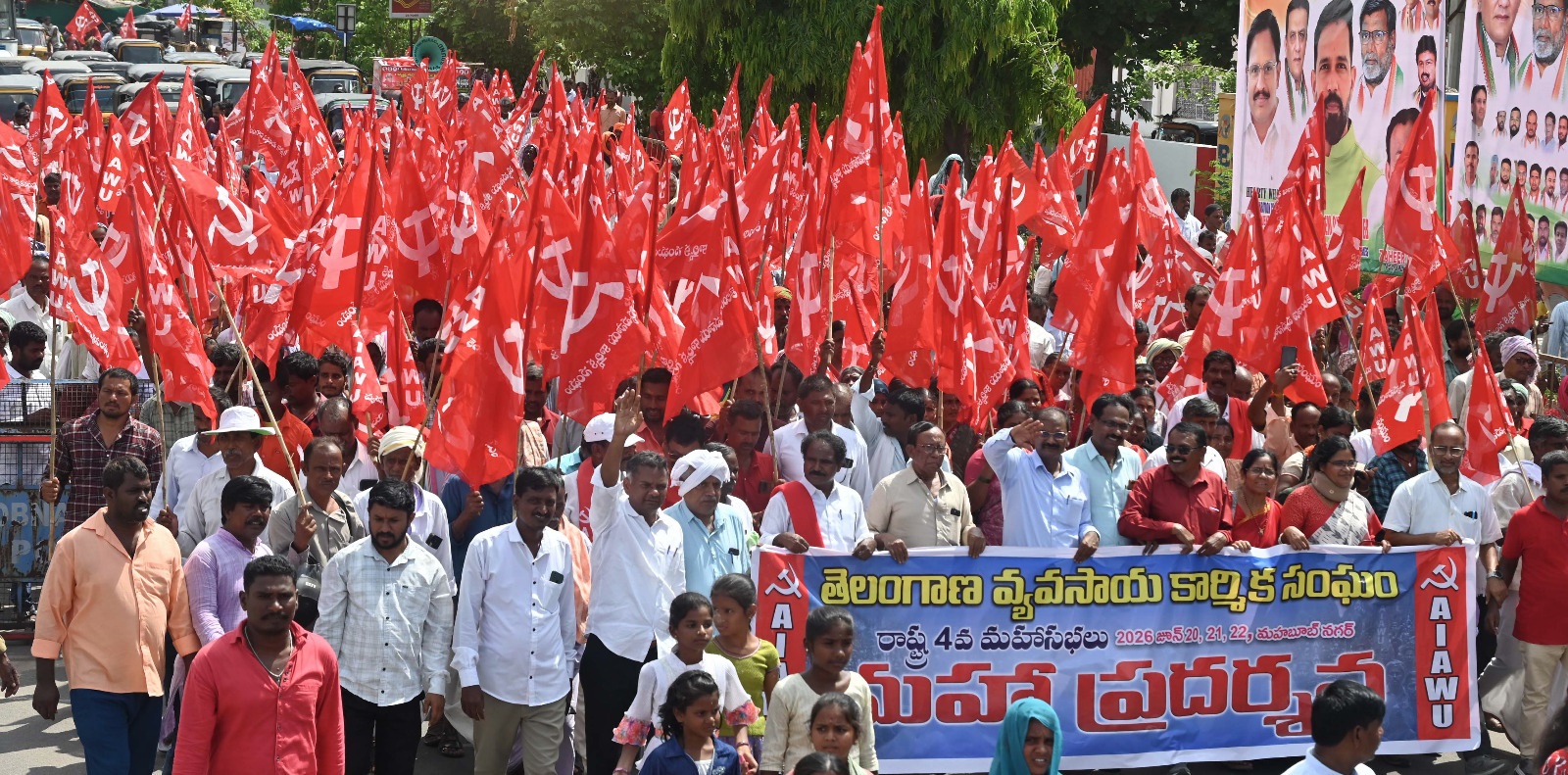
THE 4th conference of the Telangana Agricultural Workers Union (TAWU) was held with great enthusiasm in Mahabubnagar from January 20 to 22. Although Mahabubnagar is not among the stronger districts of the organisation, a massive rally and public meeting, attended by thousands of agricultural workers, rural poor and women, reflected the growing fighting spirit of the rural masses.
The conference commenced with a welcome address by Madhusudan, chairman of the reception committee, who welcomed the delegates and guests. He appreciated the dedicated efforts of the Mahabubnagar district organisation and the reception committee in successfully hosting the state conference and called upon all delegates to make the conference a success.
The inaugural public meeting was presided over by state president G Nagaiah. Addressing the gathering, former Tripura chief minister Manik Sarkar said that the BJP-led central government, through its pro-corporate policies, is concentrating the country’s wealth in the hands of a tiny minority while pushing the overwhelming majority into poverty. He pointed out that, in addition to the traditional landlord class, a new alliance of the new rural rich, contractors and investors has emerged in the countryside and is intensifying the exploitation of agricultural workers and poor peasants. He called upon the organisation to unite the rural poor and strengthen class struggles against this emerging exploiting class. He also warned that under the Modi government, democracy, secularism and the constitutional rights of the people are under serious attack, with constitutional institutions being systematically weakened to sustain divisive politics.
Former MP P Madhu and state general secretary R Venkat Ramulu also addressed the public meeting. They exposed the anti-worker, anti-peasant and pro-corporate policies of the BJP-led central government and called upon agricultural workers and the rural poor to strengthen united struggles for land, employment, higher wages, social justice and the protection of constitutional rights.
Former MP and state vice-president Tammineni Veerabhadram questioned why Parliament has failed to enact a comprehensive law guaranteeing social security for agricultural workers who feed the nation. He demanded legislation ensuring old-age pensions, health security, family livelihood support, maternity benefits for women workers, equal wage for equal work, accident insurance, ex gratia compensation and a separate Labour Department for agricultural workers.
AIAWU general secretary B Venkat sharply criticised the Congress government in Telangana for failing to implement its election promises. He said that the government now owes the people nearly Rs 1.25 lakh crore. He explained that around 40 lakh pensioners have been denied the promised pension enhancement for nearly two and a half years, amounting to Rs 24,000 crore, with each beneficiary losing nearly Rs 60,000. Nearly one crore women have not received the promised monthly assistance of Rs 2,500, resulting in arrears of about Rs 75,000 crore, with each woman losing approximately Rs 75,000. Failure to implement the promised Kooli Bandhu scheme for agricultural workers has created an additional liability of around Rs 25,000 crore.
DELEGATE SESSIONS AND ORGANISATIONAL RESOLUTIONS
Inaugurating the delegates’ session, AIAWU president A Vijayaraghavan called for strengthening class struggles across the country. He criticised the central government for undermining democratic rights and misusing constitutional institutions such as the ED, CBI, governors and the Election Commission for political purposes. He also condemned the handing over of natural resources to corporate companies and called upon agricultural workers to intensify struggles on all livelihood issues.
The organisational report presented by state general secretary R Venkat Ramulu was discussed extensively by the delegates. Through criticism and self-criticism, the conference concluded that while the organisation’s membership has been steadily increasing, its mass base and mobilisation capacity have not expanded proportionately. The conference identified weak struggles on class issues, inadequate resistance against the growing exploitation by the new rural rich at the village level, and weaknesses in the functioning of village committees as the principal reasons. It resolved to strengthen village committees and intensify struggles on land, wages, employment and other social issues.
Rajya Sabha member Sivadasan criticised the BJP-RSS attempt to saffronise education through the National Education Policy and warned against the growing communalisation of education.
KVPS state president John Wesley called for statewide struggles against the anti-worker and anti-agricultural worker policies of both the central and state governments. He also demanded the implementation of welfare measures for the poor, distribution of surplus land, house sites and effective enforcement of minimum wages.
Fraternal delegates from the southern states — N Chandran (Kerala), Putt Madhu (Karnataka), K Amirthalingam (Tamil Nadu) and Lokanatham (Andhra Pradesh) — extended solidarity greetings and shared the experiences of struggles in their respective states. Representatives of AIKS, CITU, AIDWA, KVPS, DBF, PMC and Telangana Vrittidarula Union, along with other mass organisations, also greeted the conference.
The conference called for building sustained village-level struggles around land, wages, employment and social justice. It resolved to launch statewide agitations to compel the Congress government to fulfil its election promises. It also called upon all units to organise the “Chalo Dalitwada” campaign from June 25 to July 25, mobilising Dalits, landless labourers and agricultural workers in every village. The conference further resolved to reach six lakh rural families and expand the organisation’s membership to twelve lakh.
The conference adopted 21 resolutions on the major issues confronting agricultural workers and the rural poor. As many as 450 delegates, representing 12 lakh members from across Telangana, participated in the conference. A new 95-member State Committee and a 31-member Office Bearers’ Committee were unanimously elected. G Nagaiah was re-elected as state president and R Venkat Ramulu as state general secretary.
The 4th conference concluded with the delegates reaffirming their commitment to strengthen the organisation and intensify struggles against exploitation, for land, employment, dignity and social justice.


