Sudhanva Deshpande
A ninety-four-year-old man in Chandigarh asks his driver to take him to Sargodha, near Lahore. The driver is stumped. He tries to explain to the old man that this is not possible. They can’t just casually drive into another country. The old man will have none of it. He is old and frail, but no less a tyrant for that. At the border, the BSF officer is amused, but equally at a loss. He has no idea how to bring a senile, delusional man stuck in the past back into the present.
Seventy-six years ago, when the country was partitioned, he was eighteen years old and experiencing the euphoria of first love. He couldn’t understand why he couldn’t just continue staying in Sargodha. He couldn’t understand why elders were opposed to his love. Slowly reality sank in. He was Sikh. She was Muslim. Their union, difficult even in normal times, was impossible now. Communal violence had gripped the land. Hindus and Sikhs on one side, Muslims on the other. Killing, raping, pillaging everywhere. As violence gripped the country, it was impossible for him and his family to stay on. Because the land he knew as his home, now had a new name – Pakistan.
But the old man has no sense of any of this. His mind, ravaged by senility and dementia, has obliterated history. The girl he left behind is in front of him, within touching distance, real as only a hallucination can be. Mind imprisoned in the past, body shackled to the present, he suffers a stroke.
In faraway London, his grandson has his own problems. He keeps quitting one IT job after another, does hopelessly unfunny standup comedy, while also struggling with commitment issues in a romantic relationship. Back home, his father, uncle and aunt are waiting – wishing, in fact – for the old man to die. In fact, the grandson is even told by his father not to bother coming back because the old man may not survive that long. When that happens, they will heave a sigh of relief, relieved finally of the burden of the patriarch’s tyranny.
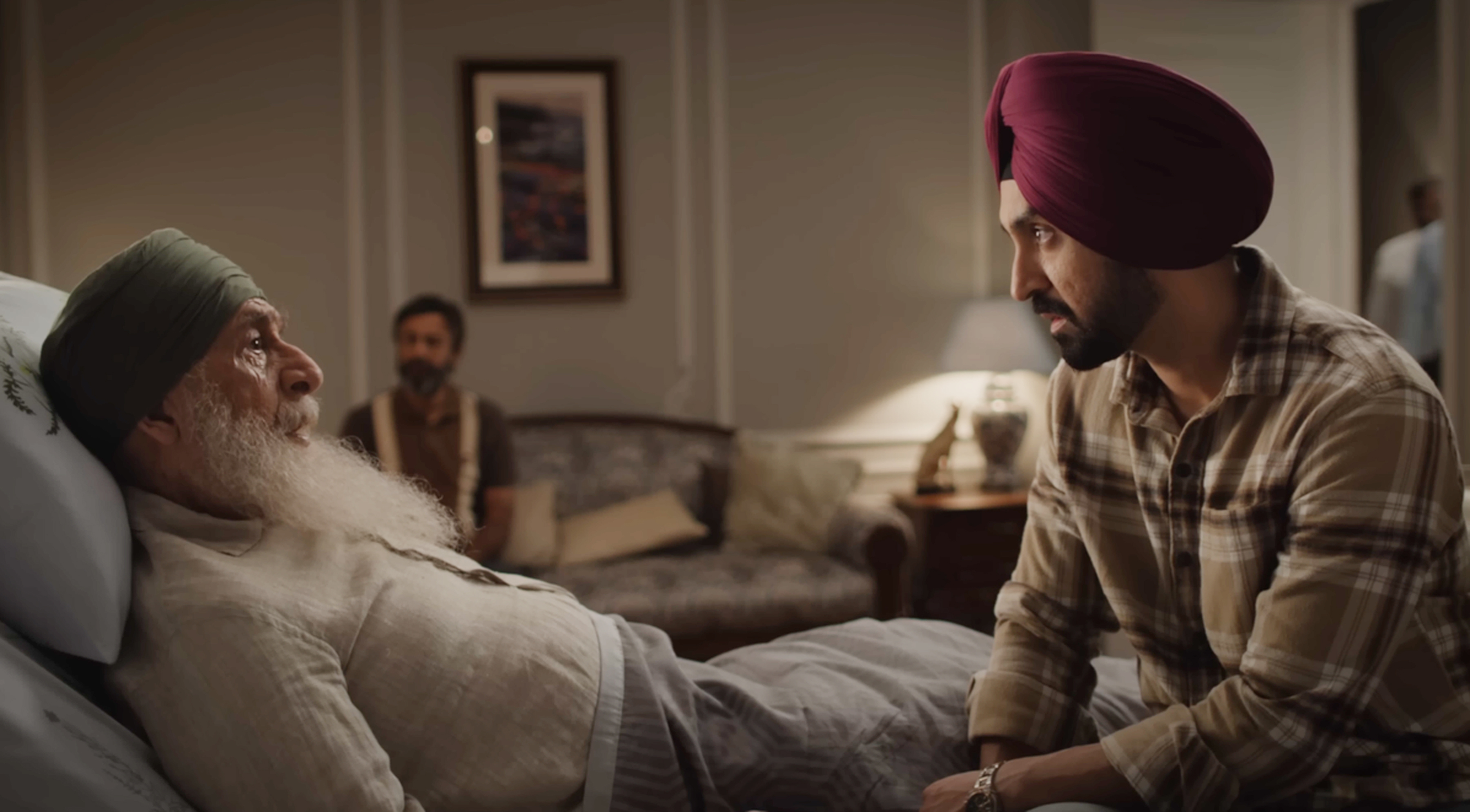
The grandson, though, does come back. He shares a special bond with the grandfather. Miraculously, the grandson’s presence stirs something in the old man’s brain. He starts to revive. He is still confused, delirious, and hallucinatory, but he is able to speak. The grandson figures that the old man is holding on to life, not letting go, because there is some unfulfilled desire that is keeping his life tied to his body.
The family has no idea of the old man’s past love. They only know him as a hard taskmaster, who built a life from scratch after migrating to India. We can see that it is a wealthy life. The joint family live together in a palatial house. They drive expensive foreign cars. There are servants at hand.
The grandson pieces together the old man’s past, bit by bit. In the process, he learns about the Partition. He discovers the horrors of the time. He educates himself, reading books and visiting the Partition Museum in Amritsar. As the grandson learns about history, he also discovers himself. He turns the Partition material into a standup routine that finally makes people laugh. He learns of the problems facing his people and decides to do something about it.
It is now a race against time. As the grandfather’s health sinks, the grandson has to somehow find a way to reunite him with his memories. If the grandfather doesn’t get closure before he dies, the family will be haunted by this for the rest of their lives. As it is, the elders in the family are racked by guilt because they left the women behind, imagining them to be safer in Sargodha. They aren’t, and when they are found out by rioters, they are all killed, one by one, by the matriarch. It is a chilling sequence.
A recurring theme in the films of Imtiaz Ali, director and co-writer of Main Vaapas Aaunga, is that of a drifting, purposeless youth finding himself. Here, that youth is the grandson. As he pieces together the jigsaw of his grandfather’s love story, he finds that he is also capable of commitment in love.
The romance in Imtiaz Ali’s films tends to be somewhat old-world, charming, poetic, and gradual. In the love story set on the cusp of Independence and Partition, it is the girl who nudges things alone. If she hadn’t, the 18-year-old younger self of the dying old man would never even have had the courage to speak to her, let alone declare undying love.
Yet, even as the setting and pace of the love story is old world, it is treated with a modern sensibility. After Partition, the young man manages to go back to Sargodha to meet his love. He discovers that she’s now married. Her husband, who knows they knew each other earlier, wants him to meet her. He doesn’t, heartbroken, but the husband’s attitude is strikingly modern.
Decades later, when the family discover this love story, their acceptance of it is matter of fact, without judgement. Not only is there no comment on the fact that the patriarch continued to cherish his youthful love even after getting married and raising a family, but the inter-religious relationship also goes uncommented upon. It doesn’t seem to matter to anyone that the old man, a Sikh, was in love with a Muslim girl, and that he continued to love her all along. At a time when love has become such a polarising factor in India, this treatment is refreshing. Parenthetically, I should also add that no character in the film, whether Sikh, Hindu or Muslim, is shown praying, nor are there any religious symbols or images in any of the houses we enter, either in the past, in Sargodha, or in the present, in Chandigarh.
Main Vaapas Aaunga has some terrific performances. In his second film with Imtiaz Ali, the singer-actor Diljit Dosanjh carries the film. There’s a lovely arc to his character: he goes from being confused, somewhat petulant, goofy and self-centered in the beginning to becoming an understanding, responsible, but still goofy young man at the end. Diljit Dosanjh brings out the nuances and contradictions of his character admirably.
The veteran Naseeruddin Shah is outstanding as the delirious patriarch. For most of the film, he is seen lying in bed. But he inhabits the truth of his character so convincingly that you don’t notice that he hardly uses his body. And then there are the little gestures that bring his character alive – hitting the driver’s seat with his walking stick to shut him up early in the film, or a quick straightening of the beard to make himself presentable to his love even as he knows he’s dying, at the end of the film.
Vedang Raina as his younger self gives an assured performance, combining shyness and vulnerability with grit and determination. There’s a softness to his face which is the opposite of the macho hero of today’s cinema. Sharvari as his love shines. She is strong, playful, determined, mature and utterly charming. Rajat Kapoor as the patriarch’s elder son is superb. Resentful and angry at his father at the beginning, he allows the softness of his character to gradually reveal itself, without letting go of his hard shell.
These days, Hindi cinema is churning out one toxic film after another. Our minds and hearts are being poisoned by the Dhurandhars, the Kerala Stories, the this or that Files, and film after film that portrays Kashmiris antagonistically. These films are putting out a revised, invented history, teaching us to hate Muslims, branding any questioning voices as anti-national, and projecting a hyper-masculinist, supremacist, majoritarian identity as the only authentic national identity. In this septic climate of hate, this tender love story is an antidote to the mind, balm to the soul.


