Ravishankar Mishra
IN ancient times, when Gargi questioned Yajnavalkya, he warned her that if she continued asking questions, he would curse her and her head would be severed from her body. Even then, those in authority were afraid of questions. When Buddhist monks were attacked and the ancient university of Nalanda, one of the world's oldest centres of learning, was destroyed, the same fear was at work. The forces driven by that fear in those times are once again raising their heads today, seeking to repeat what was done centuries ago.
Today again, as questions are being raised in the spirit of the Buddhist era, those who have no answers want to crush those who ask them. As the number of people raising questions has grown significantly, they want to shut down or destroy the very educational institutions that create the foundation for critical inquiry. If some mentors seek to teach ordinary people how to question, they want to eliminate those teachers themselves. It is often said that even the walls of a school educate. Perhaps that is why they have decided to destroy those schools and universities that teach ordinary people how to challenge those in power. They are willing to do whatever it takes to achieve this. Once again, the same forces that have long regarded education as their enemy have taken it upon themselves to dismantle the culture of teaching and learning across the country.
In recent years, nearly 94,000 primary educational institutions have been closed across the country. In Uttar Pradesh alone, 27,000 primary schools have either been merged or shut down. Nearly 500 secondary schools have also been closed during the current academic session for various reasons. On the one hand, our literacy rate shows that we lag behind many countries in the field of education. To educate everyone, we need more educational institutions as well as more teachers. We still do not have enough universities to provide quality education because our system itself after 2014 has never wanted that. In contrast, the closure and merger of schools clearly demonstrate that we are not serious about education.
This indifference repeatedly compels us to ask: why do we hate education so much?
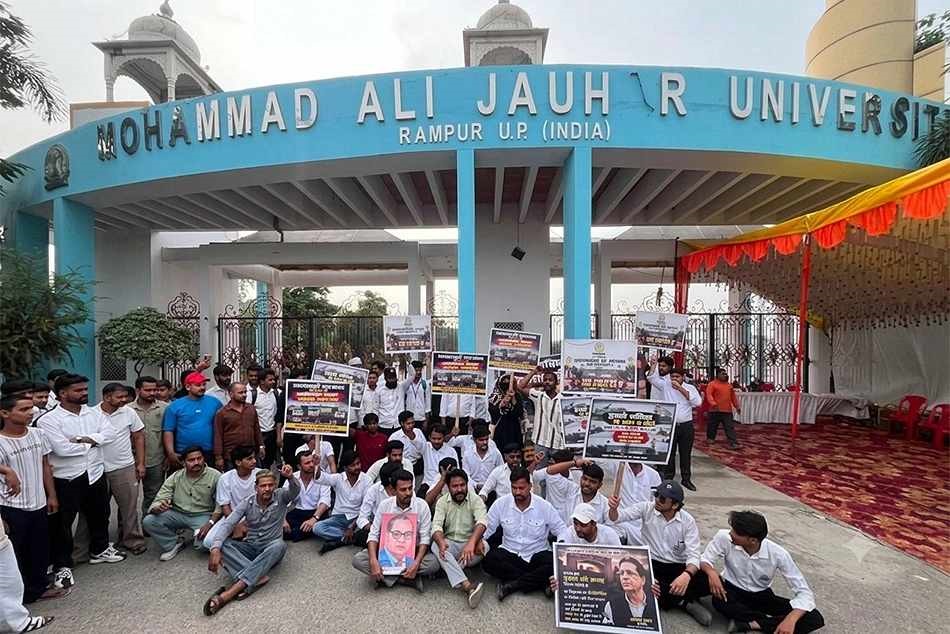
A striking example of this hostility towards education is that we have now moved towards the attempts to bulldoze an entire university. The proposed demolition of Mohammad Ali Jauhar University in Rampur district of Uttar Pradesh has become a subject of widespread criticism. The Rampur Development Authority has issued orders to demolish 95 percent of the university's buildings. According to the Authority, the building plans were never formally approved, and therefore the structures must be demolished. A similar argument is being advanced by supporters of the BJP. According to them, only members of a particular community receive education at this university, and therefore it does not serve the interests of the general student population and should be demolished.
Protests against the proposed demolition have been organised in several cities. Students and teachers of the university have been continuously holding demonstrations, and an indefinite sit-in protest is underway on the campus. Meanwhile, Members of Parliament and leaders of various political parties have also visited the university. Owing to the pressure created by the student movement, the Divisional Commissioner of Moradabad Division has, for the time being, stayed the demolition until the next hearing. However, the government's agenda appears clear. It seems so consumed by the politics of hatred that it is eager to employ every possible means to demolish the university.
I do not know how much those influenced by the RSS ideology actually know about this university. The first important point is that the perception on which they base their arguments is itself the result of the sustained communal propaganda spread by them. Seventy-eight per cent of the students at Mohammad Ali Jauhar University are Hindus. The university's buildings have been designed with inspiration from some of the world's most renowned architectural landmarks. The entire campus spreads over nearly 450 hectares. Around Rs 300 crore and years of dedicated effort have gone into its construction.
Can the mere fact that these beautiful buildings were constructed without obtaining formal approval of the building plans from the Development Authority or the District Panchayat justify their demolition? Such a course of action hardly appears reasonable. To begin with, nearly 80 per cent of the buildings in various cities of Uttar Pradesh have been constructed without formally approved plans. In such cases, the established practice has been to regularise these structures by levying a compounding or regularisation fee. If those buildings can be regularised, why cannot a university of a public character be regularised as well? Even if the State Government or the Authority believes that the ownership ultimately rests with a private individual, there are other possible remedies. The institution's legal status can be altered, or it can be nationalised or acquired by the government.
Another important question also deserves attention. Most universities in the state, many of which were built before or around the time of India's independence, were constructed long before the present regulatory framework existed. Which authority approved their building plans? I personally know of dozens of universities whose buildings are hundreds of years old. Their plans were never formally approved, yet they continue to function without interruption. I deliberately refrain from naming them because I would not want similar proceedings to be initiated against them. The point is simple: if those universities can continue to function, what great calamity would arise if Mohammad Ali Jauhar University were also allowed to continue?
One more significant issue has been raised. The Rampur Development Authority itself did not even exist when this university was constructed. This clearly indicates that both the Authority and the State Government have several legal and administrative options available if they genuinely wish to allow the university to continue functioning. However, if the real objective is to demolish the university and deprive those studying there of educational opportunities, then the matter is altogether different, and that appears to be a more plausible explanation.
Mohammad Ali Jauhar University offers postgraduate degrees in 98 disciplines in addition to medicine and engineering. If the government were asked to establish another university of the same scale and standard, it would find the task extremely difficult. Bulldozing, however, is an area in which the Uttar Pradesh Government has undoubtedly acquired considerable experience. Whether in the name of the Kashi Vishwanath Corridor, where residential localities, Dalmandi, and centuries-old mosques have been demolished; or in the name of the Mahakumbh, during which several residential settlements in Prayagraj were razed; or in Lucknow's Akbarnagar, where thousands of houses were demolished, allegedly to benefit real estate developers; or under road-widening projects that have reduced countless homes to rubble, the government has repeatedly demonstrated its expertise in demolition. It can certainly demolish structures with ease. But if it were asked to first build another university in Rampur before demolishing this one, so that the education of its students would not be disrupted, that is when the Uttar Pradesh BJP government would find itself at a loss.


