Nepal Flash Flood & Disasters around the Third Pole
Raghu
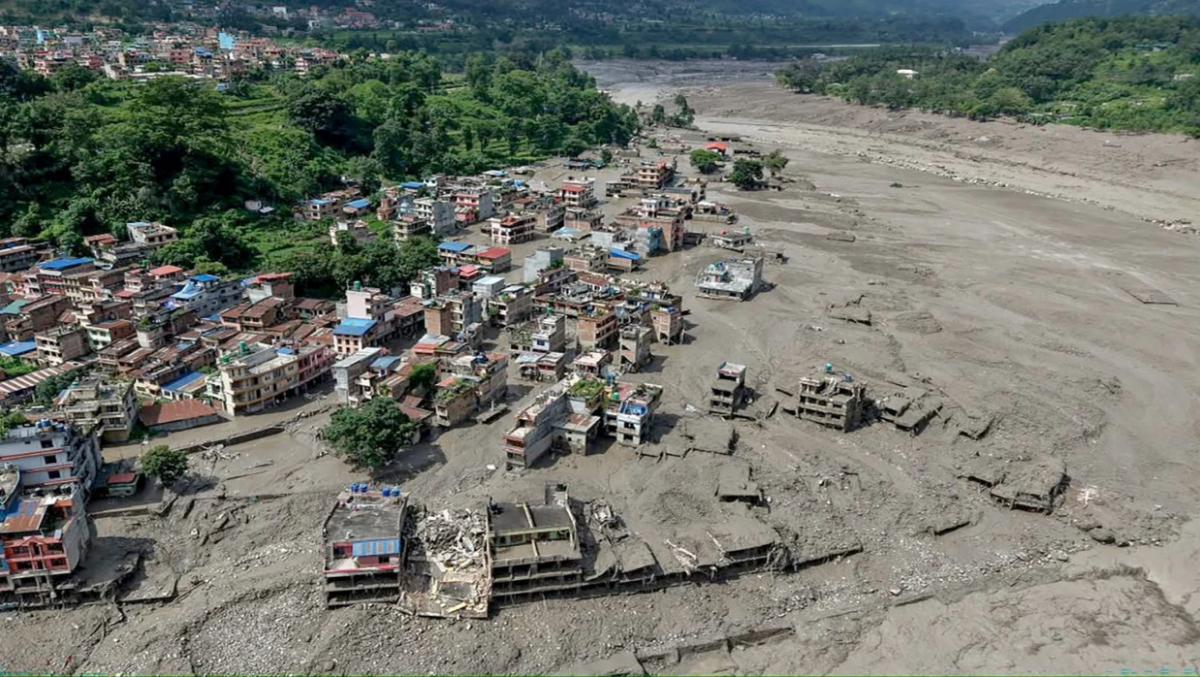
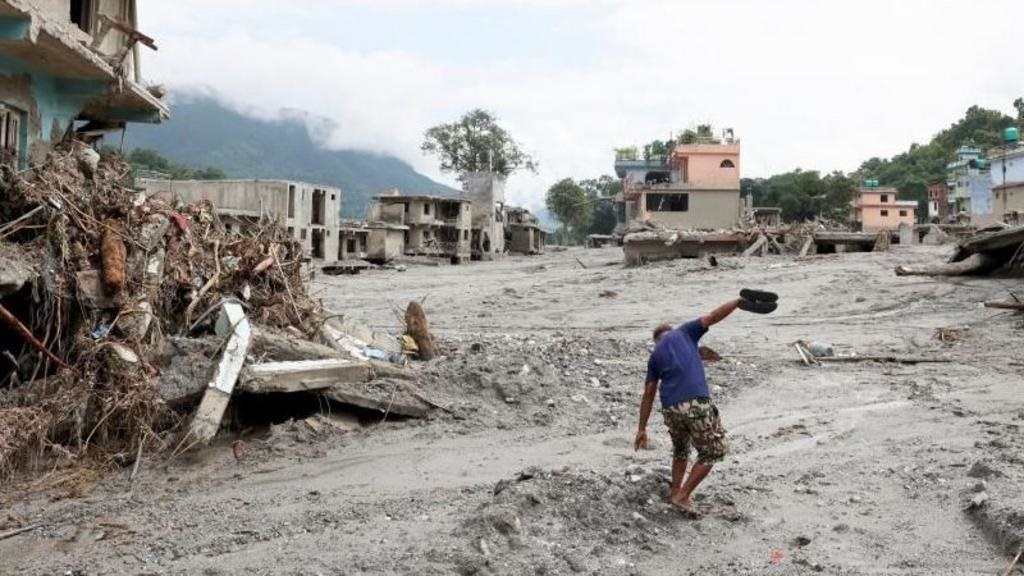
THE sudden and catastrophic flash flood that hit Nepal near its border with Tibet-China on 26 August has claimed at least 1200 lives at the time of writing, with an estimated 3900-4800 people still unaccounted for. Indians form the largest national cohort of victims, chiefly due to the on-going pilgrimage to Kailash-Mansarovar in Tibet. Horrifying videos of the floods hitting what appears to be a large and sturdy border post at Gyirong on the Chinese side of the border with Nepal, and from a little further downstream, show a massive and fast moving volume of muddy waters rushing past, sweeping aside everything in its path including multi-storied buildings, steel bridges, roads, vehicles and, unfortunately, people.
Given the remoteness of the area and the total destruction of infrastructure, it took several days for rescue and relief teams to even reach the disaster hit locations, and begin the arduous task of reaching and rescuing survivors, locating the missing, and the grim task of recovering bodies of the dead, all of which are continuing. It took several days for international rescue teams to reach the disaster zone after roads were at least partially cleared, and authorities in Nepal organized coordination of these efforts. Major rescue operations are currently underway to try to locate, and then rescue, around 900 missing hydro-electric power project workers who might still be alive and trapped in project tunnels now buried under rocks and mud. Latest reports suggest that the Nepalese government is preparing to shift much of its efforts to rehabilitation, even while most rescue efforts wind down and relief continues to be provided to the thousands displaced from their homes and work.
PRESSING QUESTIONS
The disaster raises very disturbing questions and poses major challenges for governments, policy makers, academic and research institutions, think tanks and civil society in Tibet-China and South Asian countries around the Hindukush-Himalaya all the way from Afghanistan and Pakistan in the west to Nepal, Bhutan and India and its North-Eastern regions with impacts in Bangladesh and Myanmar.
This disaster in Nepal, believed to be the worst flooding event in over a generation, albeit dwarfed by the magnitude of the 2015 earthquake that took over 9,000 lives, may indeed be unprecedented in scale but lists among an increasing number and rising frequency of similar events in the region. What caused this particular event? To what extent do these events and their rising frequency result from climate change, and what do answers to that question tell us about future actions and response?
Could the Nepal disaster have been predicted? More generally, to what extent can early warning systems assist in saving lives and minimizing damage, as has been put in place or attempted in other types of disasters? What are the potentialities and limitations?
And finally, what can we learn about reducing the risks and damage caused to life, livelihoods, habitats, infrastructure and the economy as a whole?
CAUSES OF NEPAL DISASTER
Compilation of all relevant data and analysis by scientists and experts, as well as peer review, leading to definitive pronouncement of causes would take more time. As of now, some preliminary conclusions may be arrived at based on available information.
Preliminary assessment by most geologists is that the floods were caused by a dual high-altitude glacier and rock failure, and fall of the massive ice and rock chunks over several thousand feet to the river below. The collapse occurred on the north face of Langtang Lirung on the Nepal-Tibet border at around 5200 metres. As of now, it may not be possible to state unambiguously whether the glacier collapsed and took a big chunk of the bedrock with it or the other way around. With rising temperatures, glacier melts have become quite common in the Himalayas and can cause large pieces to breakaway, or alternatively melting of ice in the permafrost can weaken the hold of the bedrock leading to its break-up under stress taking pieces of the glacier with it.
Either way, a study in Nepal is reported to have concluded that huge masses of ice, rocks and debris fell from 5200 metres down to the Lhende river at around 3000 metres and then traveled down through the Bhotekoshi and then the Trishuli rivers making a massive and debris-laden flood moving rapidly downstream. Satellite imagery seems to show geographical changes over around 10 sq.km at the peak, and that about 0.56 sq.km or 50 hectares of glacier and rock had broken away.
Time stamped flood sensors and other indicators show that the flood wave traveled extremely fast. It covered around 22 km to Rasuwagadhi in about 7 minutes at an estimated average speed of 167 kmph, dropping to about 22kmph further downstream but still carrying massive quantities of rock, ice and mud.
Satellite images do not show any new glacial lake formation in the upper reaches, ruling out that early speculation. Seismic records showing tremors of 5.2 on the Richter scale also do not appear an earthquake but rather reflect the rock-glacier failute and collapse, putting to rest another plausible explanation.
However, river flow readings before Rasuwa show levels dropping several hours before the flood wave arrived, indicating a possible damning of the river upstream by falling boulders from above, presaging the glacier-rock collapse to follow.
These conclusions should surprise no one since such glacier-rock collapses have become common in the era of climate change, not only in the Himalayas but also in Norway, Iceland, Switzerland and other places in Europe, in Chile, Alaska, new Zealand and elsewhere.
CLIMATE IMPACTS AND RISKS
Are all such disasters caused by climate change? Science is all about what can be said with certainty, or can be said with a specified probability or degree of certainty. So it is not possible to state definitively that an individual instance of extreme rainfall or glacier melt is caused by climate change, there is a very high probability that it is. It is well established that global average temperatures are continuing to rise as predicted by climate science.
It is also well established, including by compilation of peer-reviewed scientific findings in the IPCC Special Report on the Ocean and Cryosphere in a Changing Climate ( IPCC/SROCC), that ice in the poles and in high mountain regions especially the Himalayas, is melting rapidly. The Hindukush-Himalayas holds the largest volume of ice outside the polar region, and is hence often called ‘the third pole,’ and feeds 10 major Asian river systems. Unfortunately. it is melting faster than the global average.
The prognosis is therefore not good. IPCC/SROCC says that polar ice and glaciers will continue to melt till 2050 given the current level of global emissions. Even after that, and only if accelerated emissions reduction are achieved, there is some prospect of checking that trend by the end of this century. Regrettably, this means that humanity and countries will have to live with glacier melts and its consequences as witnessed in Nepal and elsewhere, including in India.
The urgent need, therefore, is to reduce the risks and extent of damage that is likely to result from glacier-rock failures, glacier lake outbursts and similar catastrophic events.
The first line of defence is early warning. Some limited early warning systems have been developed and put in place mostly for glacial lake outburst floods (GLOF) in the form of satellite-based surveillance and ground-based sensors. But the difficulty may well be imagined from the fact that India itself has over 7,000 glacial lakes which are caused by glacier melt, blocking of water flow by rockslides or re-frozen ice, with risk of flash floods by sudden collapse of these temporary dams. These locations are remote and at high altitude making installation and maintenance of ground-based sensors extremely difficult. The trans-boundary nature of these glaciers, lakes and water flows pose further difficulties.
Early warning for disasters like the glacier-rock failure in Nepal poses even more difficulties. Not only must satellite surveillance by intensified over vast areas, ground sensors must also be installed, monitored and maintained in remote, high altitude, often trans-boundary locations. It is also difficult to predict a glacier or permafrost rock failure or its precise time, without which an early warning system would not serve its purpose. Further, as the unfolding events in the Nepal tragedy showed, even if warning had been sounded, it may leave little time to evacuate the likely affected population.
DEVELOPMENT PATH
Ultimately however, the very path of development currently being adopted, certainly in India and South Asia, is increasing rather than reducing the risks. It has been reported, based on official data from Nepal, that the population in the districts most affected by the present Nepal disaster has increased by about 1 million in the past few decades. Tourism has increased substantially. Increasing settlements and related infrastructure, mostly on or near the narrow floodplains, vastly increase the risks to life, livelihoods and property. The videos of the floods in Nepal showed buildings, roads, bridges etc crumbling in the face of the flood fury. Over 14 hydro-power projects have effectively been buried. Economic losses have been estimated at close to 10% of Nepal’s GDP.
In India too, similar destruction was witnessed in 2021 when a part of the Nanda Devi glacier collapsed and caused flooding in several rivers downstream in Chamoli District, destroying the Tapovan-Vishnugarh hydro-power projects. The 2013 Uttarakhand floods caused immense damage to settlements along river floodplains.
The trajectory set by climate change, and the likelihood of extreme weather events and related or other glacier-related disasters, are now clear. Business as usual is no longer possible. A major re-think of development patterns in these fragile mountain areas is clearly required, certainly in India.


