Samprikta Bose
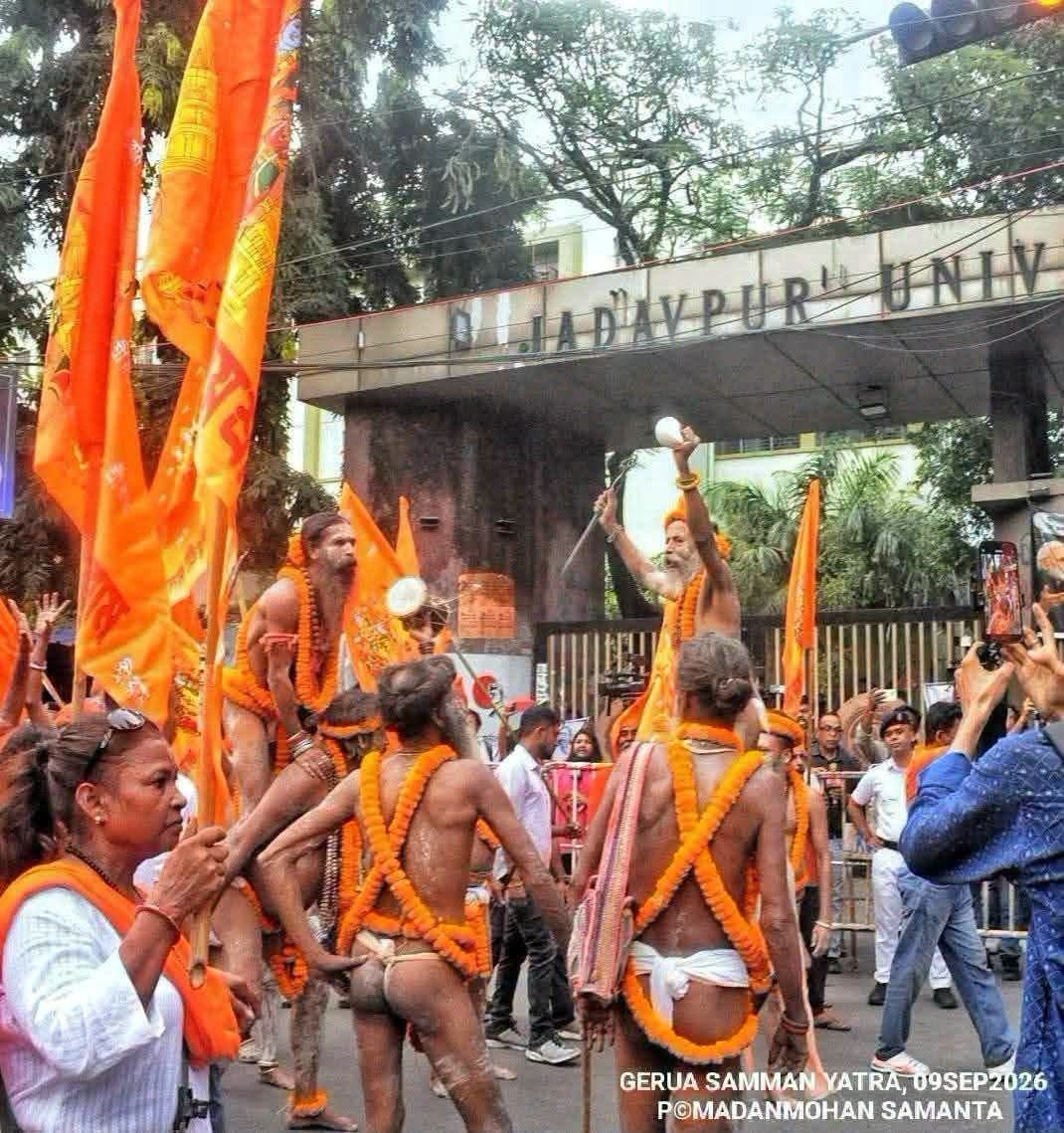
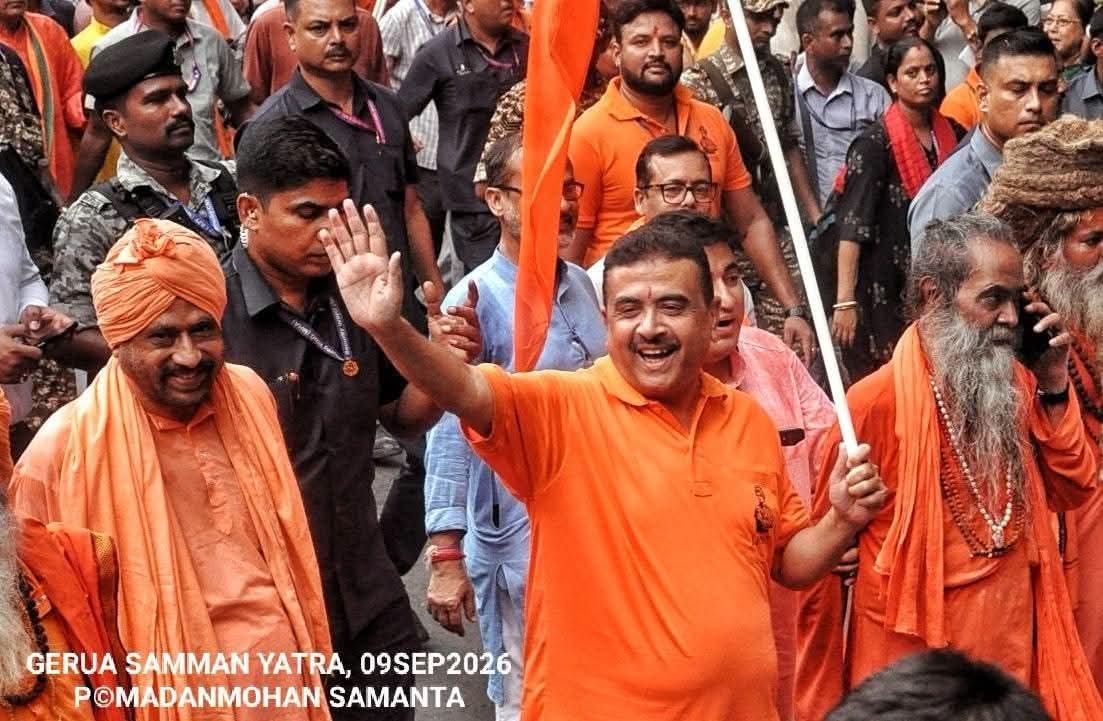
The ‘Gerua Samman Yatra’ from Golpark to Jadavpur’s 8B bus stand on September 9, brought the politics of communal mobilisation directly to the perimeter of Jadavpur University. Led by Chief Minister Suvendu Adhikari, the procession featured large contingents of BJP cadres, saffron-clad sadhus and Naga sanyasis. While nominally organised under the banner of defending the “dignity” of saffron, the rally marched with saffron banners, provocative posturing and slogans of ‘Jai Shri Ram’. The transparently partisan and aggressive nature of the march became impossible to conceal once the Chief Minister addressed the rally right outside the gates of the premier institution.
The march unfolded in an atmosphere of deliberate campus provocation, marked by scuffles, duelling slogans, and a wall-graffiti contest between Left student organisations and the RSS-affiliated ABVP. Sensing an escalating security situation, university authorities were compelled to shut Gates 2, 3, 4, and 5 after 4 p.m., citing the administrative closure of Raja Subodh Chandra Mallick Road for the rally.
COERCIVE MOBILISATION
A striking feature of the procession was the calculated deployment of Naga sanyasis to create an intimidating spectacle. Historically affiliated with the Dashanami orders founded by Adi Shankaracharya, sections of the Naga tradition historically organised armed akharas that underwent martial training. Across various epochs of political upheaval, these groups engaged in warfare and, especially during the disintegration of Mughal hegemony, functioned as armed mercenary bodies for regional warlords and wealthy interests.
While the historical past cannot be crudely transplanted onto modern conditions, the political utility of parading a monastic order before a public university campus is glaring. By bringing such figures to a partisan demonstration outside an academic centre, the ruling establishment deliberately placed militarised religious symbolism at the centre of an aggressive political confrontation designed to intimidate democratic dissent.
"CLEARING OUT" CAMPUS DISSENT
Addressing the assembly outside the campus gates, Adhikari explicitly pivoted from devotional rhetoric to an ideological crusade. Referring to slogans such as “Free Palestine”, he declared that he possessed the power to “uproot” and “clear out” those associated with such voices from Jadavpur. He then asked the mobilised crowd whether they were prepared to “clear them out,” drawing an enthusiastic assent from the gathering. To seal this ideological offensive, he announced plans to stage public recitations of the Bhagavad Gita, the Hanuman Chalisa, and Vedic verses right at Jadavpur.
The political agenda was unmistakable: the pretext of protesting an alleged “insult” to saffron was swiftly abandoned. Instead, the demonstration revealed an unabashed campaign aimed at silencing independent intellectual inquiry, progressive activism and critical pedagogy within the university.
A scathing campus rejoinder exposed the fundamental gulf separating the street-theatre outside from the academic culture within. The contrast could not be sharper. A university is defined neither by majoritarian posturing nor by aggressive processions at its gates; its lifeblood is intellectual labour, rigorous scientific inquiry, critical research and the constitutional right to contest, question, and debate.
EXECUTIVE AUTHORITARIANISM
The political theatre outside Jadavpur’s gates was intrinsically linked to a legislative offensive against higher education. Addressing the gathering, the Chief Minister proudly announced that the "historic" West Bengal Universities and Colleges (Administration and Regulation) (Amendment) Bill, 2026, would be brought before the Assembly the very next day. This proposed enactment centralises power in the hands of the state executive to transfer university teachers and non-teaching employees across institutions.
The timing could hardly be coincidental. A head of government threatening to “uproot” ideological adversaries from Jadavpur simultaneously introduced a law arming the state apparatus with the authority to summarily uproot and relocate university personnel. Taken together, the street mobilisation and the legislative fiat reflect a coordinated assault aimed at subordinating university autonomy to centralised bureaucratic and political coercion.
DIVISIVE ASSAULT
Speaking at a mass gathering in Barrackpore on September 9, CPI(M) West Bengal State Secretary Mohammad Salim situated the developments at Jadavpur within a wider, systematic attack on democratic dissent, free thought, and progressive spaces. Denouncing the intimidation directed at the university as well as coordinated attacks on CPI(M) offices, Salim asserted that no amount of manufactured fear or violence could suppress popular resistance. Emphasising that Jadavpur has long stood as an unyielding fortress of free thought, he reminded the ruling dispensation that entering this academic space requires academic merit and intellectual qualification, not political muscle.
Salim sharply criticised the weaponisation of Naga sanyasis for partisan intimidation outside educational institutions, stating that religious identity was being cynically deployed to inject communal fissures into society and subvert the pluralistic, secular fabric of the country. He called upon the democratic public to mount a resolute defence of academic freedom, institutional autonomy, and constitutional rights against this reactionary assault.
DEFENDING ACADEMIC AUTONOMY
The ‘Gerua Samman Yatra’ represents far more than an ordinary street march. Cloaked in the language of defending religious honour, it functioned as an overt assault against Jadavpur University’s progressive traditions. Slogans smearing critical thinkers as "anti-national" and "Naxals" were fused with displays of monastic authority and executive threats of punitive state control.
While every citizen possesses the constitutional freedom of religious practice, the weaponisation of religious identity as a battering ram against democratic and secular academic institutions cannot be tolerated. Jadavpur University’s legacy has been carved through world-class research, scientific rationalism, robust debate, and unwavering democratic spirit. That heritage will not be surrendered to coercive spectacles, open threats, or saffron intimidation at its gates. The democratic academic community, backed by the working people of Bengal, will fiercely defend the university’s institutional independence and constitutional traditions against every attempt at authoritarian subjugation.


