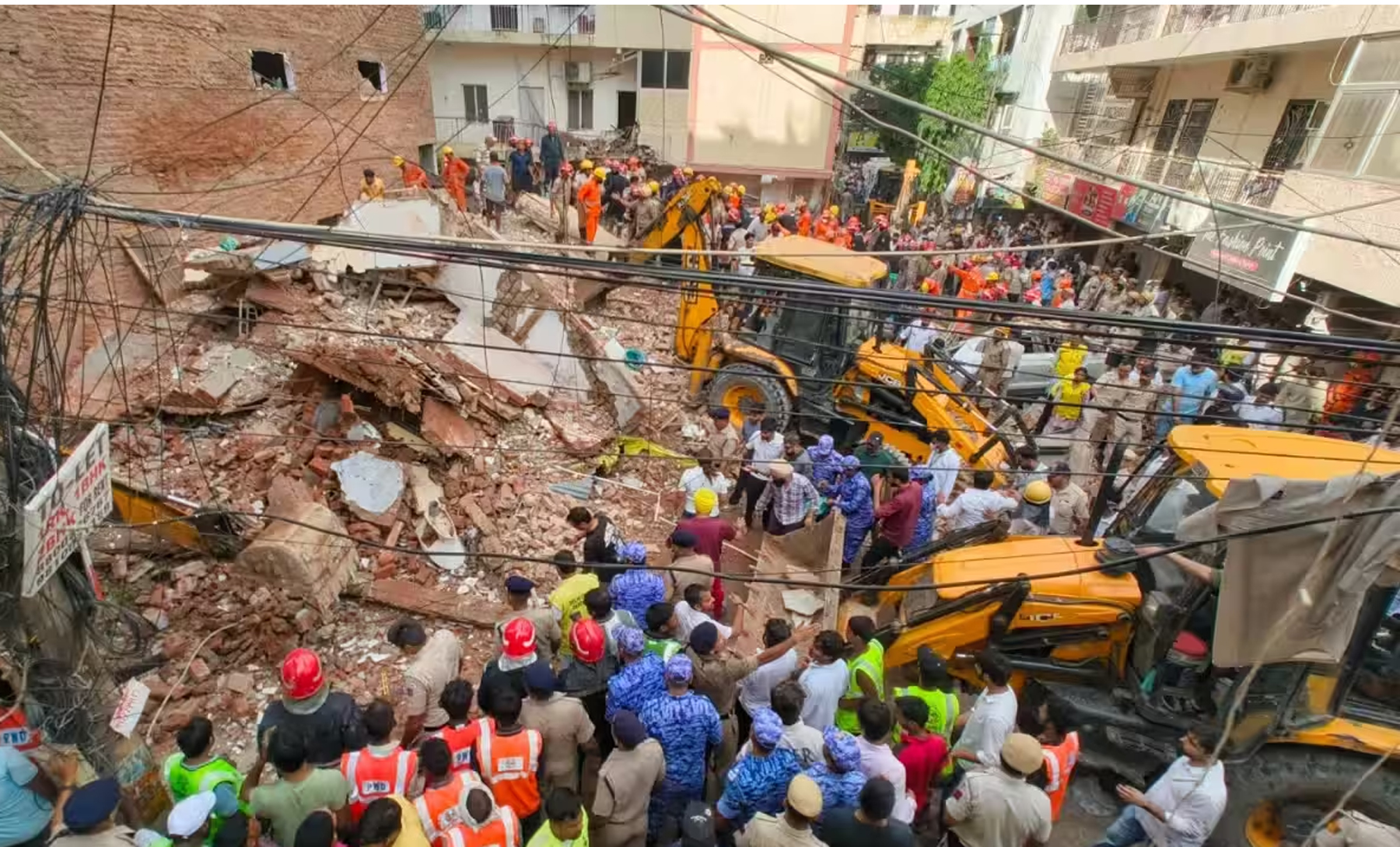
Mass organisations such as the SFI, DYFI, Democratic Teachers Front (DTF), AIDWA and the CITU have called for structural changes to prevent recurrence of an incident like the collapse of a student accommodation in Delhi on September 6 that killed seven people and injured a dozen others. In a statement, the organisations said the deaths of students caused by the collapse of the five-storey building housing a paying guest (PG) accommodation for boys in Satya Niketan in Delhi are neither an isolated nor a sudden accident. This is a serious consequence of the rapidly expanding unregulated, profit-driven student housing market in Delhi that operates outside government oversight. It is the result of the failure of the education and student welfare policies of the central and state governments in Delhi, which have worsened the student housing crisis. In successive years, government funding and grants for higher education have been cut. Instead of providing universities with adequate budgetary support, they have been pushed towards debt-based models such as the Higher Education Funding Agency (HEFA). When universities do not have adequate resources, how will new hostels be built? The result is that thousands of students coming to Delhi from across the country, deprived of safe university hostels, are dependent on the unregulated market of private PGs and rented accommodation. Following the Satya Niketan incident, the Delhi High Court has also directed a comprehensive inspection of PG hostels, an investigation into building permissions and violations of regulations, and fixing accountability of the responsible officials.
Today, representatives of student, teacher, youth, women’s and workers’ organisations have gathered among us because the deaths of students caused by the collapse of a PG building in Satya Niketan cannot be viewed merely as a building accident. After the accident, SFI, DYFI, DTF, AIDWA, CITU conducted a survey with 117 students living in PGs in Satya Niketan, South Delhi.
The survey of 117 students in Satya Niketan has brought to light the horrifying picture of this crisis. These students have come from at least 15 states and Union territories and are mainly studying at colleges in Delhi University’s South Campus and nearby areas. The survey also revealed that the colleges concerned do not have adequate hostel facilities.
Key findings of the survey are:
• The average rent for a double-sharing room including food is around ₹14,000. Maximum PG rent is ₹30,000 per month.
• There is no effective regulation of rent, and owners set rents arbitrarily.
• Security deposits range from one to three months’ rent and, in some cases, are as high as around ₹50,000.
• At least 31 per cent of students obtained accommodation through brokers and had to pay an additional commission.
• Regular repairs are not carried out. Students complained of cracks in walls, faulty cooling systems, and repairs not being carried out for months.
• Water supply is unsafe and irregular; several students complained of dirty, brown water.
• There are complaints that students are charged ₹11-15 per unit for electricity, while the survey compared this with Delhi’s domestic tariff.
• Sixty-six per cent of students said they would prefer university/college hostels to PGs for accommodation.
• After the building collapse, 79 per cent of students expressed fear about continuing to live in Satya Niketan.
Therefore, the question is not only why a building collapsed! The question is why thousands of students in Delhi are being forced to live in such unsafe and expensive buildings?
Incident a Failure of Govt Policies
Students come from across the country to central universities like Delhi University, but there are not enough hostels. The result is that the private PG market outside the university takes advantage of students' helplessness.
The conclusion of our survey is also clear — students are choosing the private PG market not by choice, but out of compulsion. The fact that 66 per cent of students prefer hostels is direct evidence of this.
Even after Satya Niketan, the questions in Delhi have not ended. Similar crises also exist in student areas such as Munirka, G. T. B. Nagar, Mukherjee Nagar, Katwaria Sarai and Laxmi Nagar. The survey report also identifies these areas as a matter of concern.
And a recent survey by the Municipal Corporation of Delhi (MCD) has revealed that 99 per cent of PGs in Delhi do not have fire safety clearance and more than 70 per cent do not have approval for the required layout plan.
This is not only the fault of the owners. The continuation of violations of rules on such a large scale for years also shows the failure of government oversight and enforcement of regulations.
Call for Permanent Regulatory System
Sealing some PGs after an accident is not enough. Evicting students from there and leaving them on the streets is not a solution either. What is needed is a system in which every PG is registered, its safety is regularly inspected and monitored, information is made public, students' complaints are addressed and accountability is fixed when rules are violated.
The Delhi government has proposed regulating PGs through licensing, registration and a public portal. The proposal talks about assigning each PG a unique registration number and listing it on a public portal, as well as arrangements such as structural and fire safety approvals.
We demand that this not be made merely a law on paper, but that an independent and transparent regulatory system be created with the participation of student representatives. Our suggestion is that Delhi University study the models of universities around the world, including Oxford, where student housing is not treated merely as a private matter between landlord and tenant.
For example, at Oxford, the Supervisory Committee for the university’s private residential institutions has clear regulatory, monitoring and reporting functions. It monitors compliance with regulations and receives regular information.
At Oxford, there is also a central accommodation system for student housing, as well as institutional arrangements for student support and complaints. The university’s official student guidance provides information on safety, repairs, contracts and complaint-related rights for students living in private accommodation.
We suggest that a student accommodation monitoring model be created in line with Delhi’s circumstances, in which the university, government, local bodies and most importantly — students — all participate.
Key Demands:
1. Compensation of Rs 1 crore should be provided to the kin of the deceased and compensation of Rs 2 to 5 lakh should be provided to the injured.
2. Adequate and affordable public student hostels should be constructed. All universities, including the central government, UGC, Delhi government and Delhi University, should be provided with adequate budgetary resources. Grants for education should be increased and dependence on debt-based models such as HEFA should be reduced. Hostel capacity in universities should be increased in phases in proportion to the number of students.
3. An effective law for the regulation of student accommodation and PGs in Delhi should be enacted and implemented immediately. Mandatory registration and licensing of all PG/student accommodations should be required. Clear standards should be established for structural safety of buildings, fire safety, sanitation, water, electricity, maximum capacity, rent and security deposits, etc.
4. All student accommodations should undergo regular and transparent inspections. Time-bound safety audits and at least annual inspections should be conducted by the MCD, Fire Department and concerned universities. Action should be taken against illegal construction, housing students beyond capacity and violations of safety rules, and accountability should also be fixed for the concerned officials who are negligent.
5. A public student accommodation monitoring system should be created. The safety status, approved capacity and other necessary information of each registered PG should be publicly available online. There should be an independent and effective grievance redressal mechanism and helpline for students' complaints.
6. Students should not be rendered homeless by shutting down unsafe PGs. In the event of vacating unsafe or unauthorised accommodation, immediate safe and affordable alternative accommodation should be arranged for students. Arbitrary rent, security deposits, brokerage and unfair charges for electricity and water should be prohibited.
7. An independent mechanism like the Delhi student accommodation monitoring and regulatory authority should be created, including representatives of the Delhi government, MCD, universities, UGC/Ministry of Education, fire department, experts, as well as students, teachers, youth and workers' organisations. This institution should ensure registration, safety inspections, regular monitoring, grievance redressal and public reporting.
8. Learning from the institutional monitoring systems of universities like Oxford, a student accommodation model should be developed for Delhi, in which universities should also be responsible for monitoring private student accommodations around them and providing students with information about safe accommodation.
Overall, student accommodation cannot be left at the mercy of an unregulated private market. Safe, affordable and dignified accommodation is an integral part of every student’s right to education. It is wrong to view student accommodation merely as a real estate or rental market issue. It is a question of the right to education, social justice, public safety and the city’s civic responsibility.


