Samprikta Bose
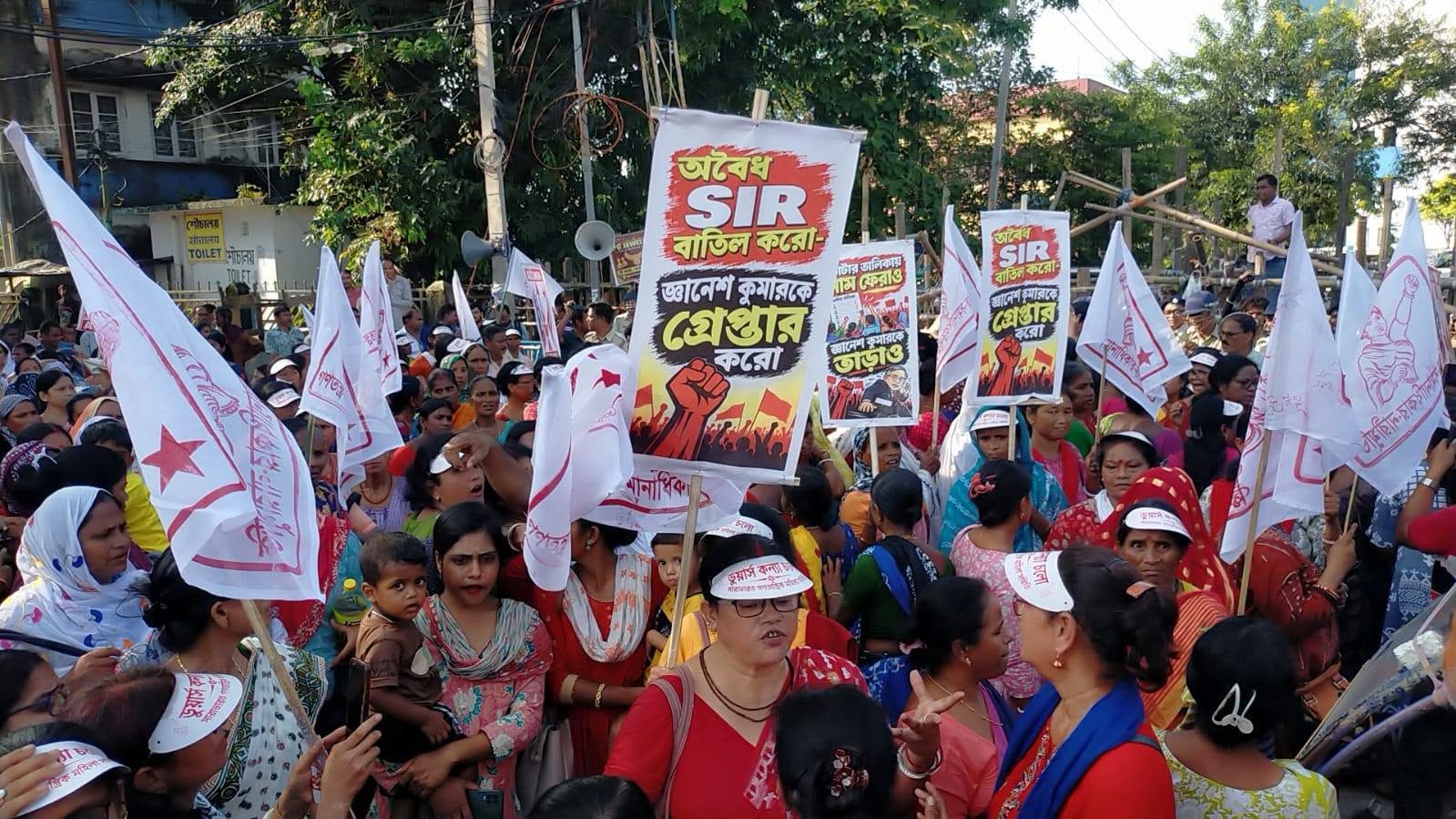
THE contest over electoral enfranchisement took a confrontational turn on the thoroughfares of central Kolkata as hundreds of women, alongside students, youth, and civil society activists, marched toward the office of the Chief Electoral Officer (CEO) on Friday September 25. Demonstrators demanded the immediate, unconditional restoration of an estimated 27 lakh names struck off the electoral rolls during the contentious Special Intensive Revision (SIR) exercise.
Organised by the West Bengal State Committee of the All-India Democratic Women’s Association (AIDWA), the rally breached initial police barricades near Ganesh Chandra Avenue before authorities halted the marchers at B B Ganguly Street, where the standoff transformed into an impromptu sit-in and public meeting.
BREACHING THE CORDONS
The mobilisation commenced at the historic Lenin statue in Esplanade (Dharmatala), where a sea of flags, placards and banners set the stage for an unyielding march toward the CEO’s headquarters. Moving through Chittaranjan Avenue, the procession was met with heavy police deployment and iron guardrails designed to prevent the marchers from reaching their destination.
Tension escalated rapidly as demonstrators refused to turn back. Frontline protesters pushed against the barriers, successfully tearing down the initial police blockade. In response, law enforcement reinforced the route with heavy iron tiers and baton-wielding personnel. Organisers alleged that women demonstrators faced severe administrative pushback, including instances of physical manhandling and intimidation.
To prevent further physical escalation while maintaining their advance, organisers redirected the march through B B Ganguly Street, only to find the arterial route choked by an even larger contingent of police barricades. Confronted with a fortified barrier, several protesters attempted to scale the guardrails, while the main body of the procession sat in a road-blockade protest.
While the general assembly maintained the sit-in, a five-member delegation comprising Kaninika Ghosh, Monalisa Sinha, Jahanara Khan, Mustari Banu, and advocate Sayan Banerjee was escorted under administrative watch to present a formal memorandum to the CEO.
“CITIZENSHIP IS NON-NEGOTIABLE”
Addressing the surging assembly at B B Ganguly Street, Minakshi Mukherjee challenged the constitutional validity of wholesale deletions.
"How can bona fide citizens who have lived in their communities for decades and possess foundational state-issued documentation be casually wiped off the voter rolls?" Mukherjee questioned. "The Election Commission owes the working people an explanation. This process has weaponised administrative complexity to breed systemic anxiety among the poorest segments of society."
Mukherjee warned against using electoral disenfranchisement as a backdoor pretext to strip vulnerable families of public distribution food grains and social welfare entitlements.
AIDWA leader Kaninika Ghosh laid bare the double-edged political manoeuvre behind the revision drive, asserting that the bureaucratic hurdles disproportionately target women, daily-wage labourers, and rural households.
"Voters who have cast ballots across successive elections are being treated as doubtful entities without due process," Ghosh stated. "This is an existential struggle for the women especially the working women to defend their voice in a constitutional democracy. The burden of administrative verification cannot be arbitrarily shifted onto the shoulders of the poor."
The presence of Mustari Banu, prime petitioner in the legal challenges mounted against the SIR process, underscored the strategic convergence between street mobilisations and courtroom battles currently underway in higher judicial forums.
22 LAKH APPEALS IN LIMBO
At the core of the widespread unrest lies the scale of deletions reported across the state during the SIR drive. Official disclosures submitted before the Supreme Court confirmed the staggering magnitude of the crisis: out of approximately 38.2 lakh total appeals filed before designated appellate tribunals, a staggering 22.2 lakh (roughly 82 percent) originated from citizens whose names had been unilaterally struck from the electoral rolls.
While the Election Commission has stated that additional tribunals may be constituted to manage the backlog, ground-level activists pointed out that the complex, quasi-judicial appeal mechanism creates an insurmountable hurdle for marginalised citizens, effectively disenfranchising them through bureaucratic attrition and procedural delay.
ECHOES ACROSS THE STATE
The momentum of the Kolkata protest immediately reverberated in North Bengal. On September 28, hundreds of women organised under the AIDWA banner assembled at the BM Club grounds in Alipurduar, marching toward Duars Kanya, the district administrative headquarters.
Reiterating the demands raised in the capital, Minakshi Mukherjee linked the deletion controversy directly to regional distress. Demonstrators highlighted that disenfranchisement in the tea-garden belts of the Dooars threatens to compromise tea-garden subsidised rations, wage claims, and rural healthcare access. She emphasised that the battle against the SIR drive is fundamentally intertwined with the escalating cost-of-living crisis, unchecked food inflation, rural joblessness, and women's safety.
By turning individual administrative grievances into a coordinated mass movement, the state's democratic and women's organisations have served clear notice: the struggle to defend fundamental voting rights will remain front and centre—both in the courts of law and on the streets—until every legitimate name is restored to the voter registers.


