U Vasuki
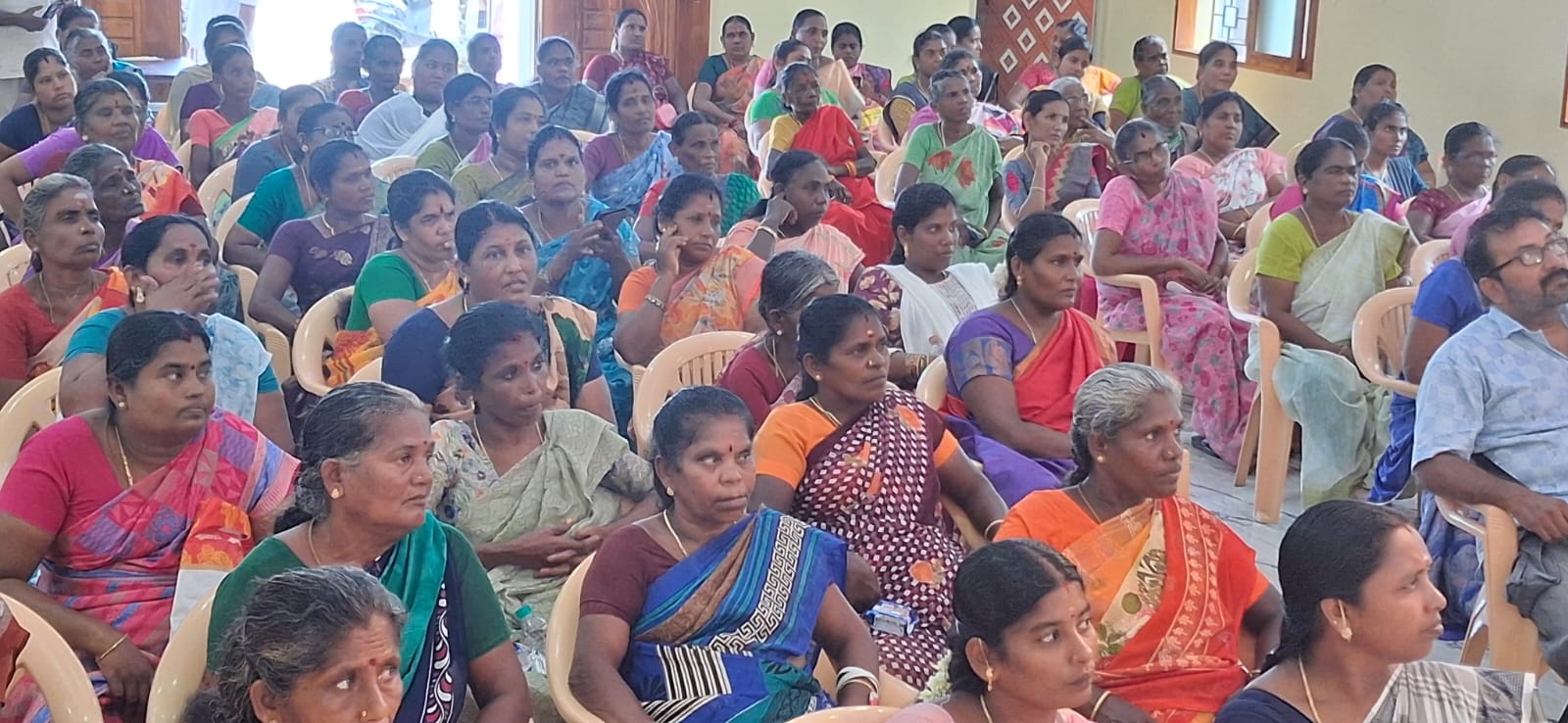
THE demand that fisherwomen must be fully recognised as fishers by both society and the government resonated strongly at the Fisherwomen's Conference organised by the All India Democratic Women's Association in Rameswaram. Pamban bridge connects this beautiful island to the mainland. Just as women's domestic work is unrecognised and invisible, women's work in the fishing industry is regarded merely as 'assistance.' In other words, women's labour is undervalued.
The fundamental problem is that the definition of a fisher is determined on the basis of going to sea to catch fish. Mostly men are doing it. Patriarchy is accused number one here.
Data at both the global and local levels tell a different story. Globally, women engaged in small-scale and artisanal fisheries and marine-related work constitute 55% of the total workforce in that sector. In India, data shows that women's labour accounts for 27% in pre-fishing activities, 18% in actual fishing, and 55% in post-harvest work after the fish reach shore. A study by Sage University notes that women's labour in post-harvest work after the fish reach shore is 62%. In Tamil Nadu, this is said to be 72 per cent.
EXPLOITATION ALL THE WAY
Before men go to sea to fish, women are engaged in tasks including preparing food for them, arranging drinking water, repairing nets, maintaining hooks in traditional fishing, and collecting worms to bait the hooks.
After the fish reach shore, women are engaged in sorting and separating, cleaning the fish, cutting them into pieces, selling them, and drying fish for preservation. In areas including Rameswaram, they dive into the sea to collect seaweed. In ocean-resource-based companies, a large number of women work for very low wages. Women are engaged in difficult tasks like peeling shrimp and cleaning and cutting squid. These cause severe back pain and shoulder pain, with about 12 hours of work, said Sakthikani, who participated in the discussion.
The rate companies pay for seaweed is particularlyy low. But when the company processes and sells it, they get a very high price. The exploitation is openly visible here. Shanthi, who participated in the discussion, alleged that companies that buy seaweed from them at 60 rupees per kilogram sell it for 2000-3000 rupees. One must dive into the sea to collect seaweed. This is dangerous work. They do not have equipment to stay submerged for even a short time. How much breath they can hold, they hold for that long, come back up, dive again and collect seaweed. The women strongly put forward the demand at the conference that the government itself should procure seaweed from women at a fair price.
Women also work extensively in collecting crabs, snails, and shells. When Maria Manohari spoke, she explained that if a stingray's spine pierces the hand, one cannot work for six months. She put forward the demand that doctors and medicines in government hospitals are inadequate and this must be rectified.
Despite doing all this work, that labour is considered not primary work but only secondary work, just because it is done by women. During the fishing ban period or lean fishing season, the Rs 6000 given by the Tamil Nadu government (now raised to Rs 7000 by the TVK government) goes only into men's hands. It mostly circulates around the liquor shops and comes back... but the reality is it doesn't come back. Even the relief received through societies was given only to men 15 years back. Since women are not considered fishers, they cannot become members of the fisher cooperative society, and therefore no relief—such reasons were cited during that time. Through the pressure exerted by the CITU Fisherperson's Association and the All India Democratic Women's Association, and through what CPI(M) MLAs raised in the Legislative Assembly, the demand was fulfilled.
NO CIVIC AMENITIES
At fish selling locations, there are no toilets with water for women. Even drinking water remains a problem. Basic sanitation facilities are absent. There is no drainage for the water used to wash fish. Women are forced to do business in unhygienic conditions. Transportation from where fish is bought to where it is sold remains a problem in various places. Sexual harassment at workplaces continues. There is no proper place to dry fish for preservation. Sea erosion and coastal constructions are shrinking the already existing spaces for parking boats, drying nets, and repairing them.
Women cannot find a place in traditional fisher village panchayats. But this panchayat, convening village assemblies, not only addresses public issues but also gives advice on personal family-related problems. Sometimes it delivers verdicts. It goes without saying that this will be with a patriarchal perspective.
In Tamil literature, according to the nature of the land, it is divided into 5 zones: Kurinji, Mullai, Marutham, Paalai, and Neythal. The sea and sea-related places come under the Neythal category. Literature says that the characteristic themes of the Neythal zone are lamentation and the cause of lamentation. Literature describes waiting for the one who went to sea to return as 'uncertain waiting.' Even though technology has advanced now, sea fury, accidents, attacks by the Sri Lankan navy, and such are reasons for uncertain waiting. The accusation that the use of banned double-fold and purse-seine nets, and trawler usage, are destroying marine resources continues to be placed on the fisherpeople of this region. However, the Sri Lankan navy continues to carry out attacks by seizing boats with equipment, destroying them, and imprisoning fishers. The demand that fishers of both countries must talk and resolve this is prominently emerging.
FIELD STUDY
In connection with the conference, on behalf of AIDWA, a field study was conducted with 110 women in 11 villages, led by Karpagam, one of the state secretaries. Among them, 75 were Muslim women, 25 Dalit women, and 10 others.
10 were widows. When it comes to education, 25 were graduates. All of them have debts. Loans were taken through banks, fish traders, and microfinance institutions.
80 have anemia. 75 stated there is no toilet facility, and 80 stated there is no drinking water facility. 50 said there is impact from sea erosion. 70 said there are family problems, and 70 said they do not receive a share in family property.
Demands emerged including: hospitals must be upgraded, an ambulance must be permanently stationed, government credit facilities must be increased, and women must be given formal employment with dignified wages in ocean-resource-based industries.
BLUE ECONOMY FOR WHOM?
Against this background, in 2019, the Modi government amended and announced the Coastal Regulation Zone rules. This allowed the coastal area to be used for real estate, tourism, industrial development, aquaculture, etc. Large-scale constructions are permitted along the coast. The government has reduced the protected area from 500 meters from the shore to 200 meters. In some places, it has been reduced to 50 meters. This is ostensibly to protect the coast, but it must be understood as being meant to hand it over generously to corporations.
The coast is not just about the shoreline. There are the sea, fishing areas, beaches, areas called estuaries or river mouths, wetlands, mangroves, coral reefs, salt pans and such. Depending on these, there are fisherpeople, farmers, livestock rearers, shell and shrimp and crab collectors, salt workers, boat builders, net weavers, artisans, traders—many sections of people. Their relationship with the Neythal land continues for many generations. Legal documents may not exist. But it is recognised by customary practice and tradition. Since permission to build houses on the coast is not granted, mostly huts and sheds are what one sees. But the Modi government's marine policy creates an insecurity for coastal communities.
The relationship these communities nurtured with the sea has been fundamentally restructured, their authority over coastal areas has been snatched away, and it has gone into the hands of corporations, individuals, real estate agents, and resort owners. This is the central government's Blue Economy policy. This stealing of resources is called 'ocean grabbing.'
The Blue Economy policy released by the Modi government in 2020 proposes legal restructuring as policy to change the view of the coast and sea from being considered production, cultural, and ecologically related public commons to becoming a zone suitable for investments aimed only at profit. Projects including Sagarmala come under this. In short, the Blue Economy attempts to transform coastal and marine public commons into various new resource exploitation related economic activities. The Blue Economy proposes a new governance framework for the sea and coast. This will only cause harm to coastal communities.
Representatives of coastal communities do not find a place in the power centers that make such decisions. For example, in 2024, a scheme called the Neythal Recovery Movement was initiated by the government that was in power then in Tamil Nadu. This is part of the Tamil Nadu Coastal Restoration Project. It is criticised as a scheme that absorbs the union government's bad policies but does not absorb the opinions of the local coastal community.
WAVES ARE THEIR LULLABY
Starting from the coast to outer space, if all land and resources are left to the plunder of private entities and corporations, how will it develop the country? How will it keep people alive? In habitat, workplace, and everywhere, ordinary people are being alienated and removed.
Along with these, rising prices, lack of job security, and economic burdens being piled on more and more are sharpening the crises further. Rajes Mary, who participated in the discussion, raised various problems. At the same time, she also said that the AIDWA conducting such conferences gives hope.
"In the boundless vast ocean
There is fear of death at every moment
Yet the waves are their lullaby
The sea is their mother's home"
With the fragrance of the poem written and read by Karpagam, the conference gave the light of a new spring.


