M A Baby
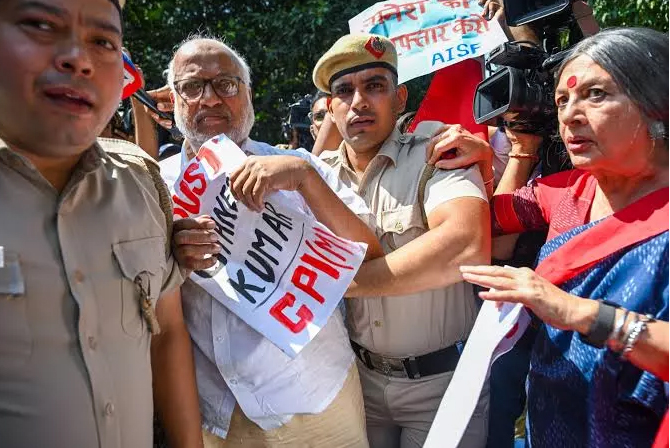
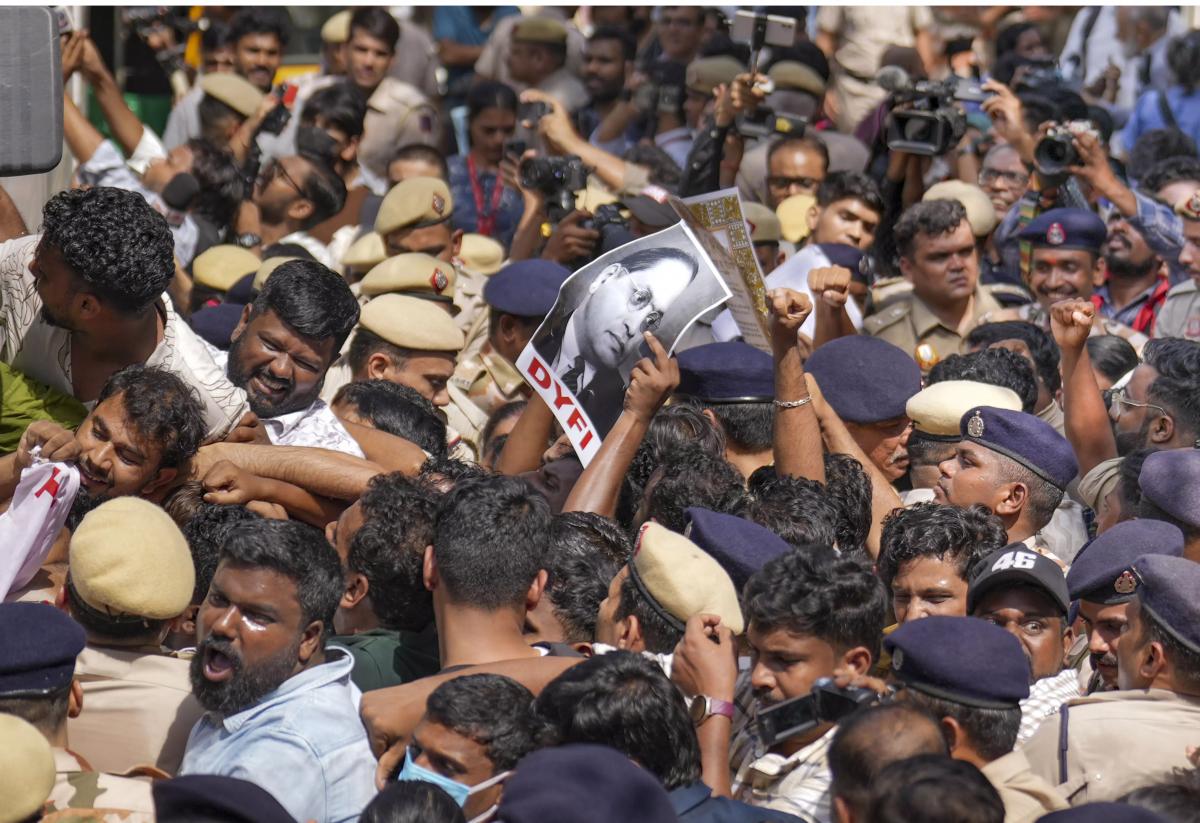
On 2 October 2026, activists and leaders of opposition parties and mass organisations demanding the resignation of Chief Election Commissioner Gyanesh Kumar, following the Indian Express exposé, were detained and not even allowed to assemble at Jantar Mantar, the designated protest site in the national capital. The permission raj of Delhi Police became the pretext of these detentions.
In any democratic society, people should have the freedom and right to express their views, individually and collectively before the powers that be. For any such collective expression, uninterrupted access to public open spaces or large halls is a bare minimum necessity. In any class divided society there are haves and have-nots, and the access to such democratic space is also monopolised by the haves and denied to the have-nots.
Under capitalism, democratic freedoms are formally open to all but practically restricted by those who own the material resources. The working class is overworked, impoverished, and lacks the venues, halls, and fine buildings required to organise. Lenin exposed this hypocrisy brilliantly when addressing the myth of "pure democracy." In his 1919 Theses on Bourgeois Democracy, he wrote: "The working people... are aware that 'freedom of assembly' under bourgeois democracy is a fraud, because the rich have all the best public and private buildings at their disposal, and enough leisure to assemble at meetings, which are protected by the bourgeois machine of power. The rural and urban workers and the small peasants... are denied all these things." Earlier, in The Proletarian Revolution and the Renegade Kautsky (1918), Lenin pointed out that theoretical freedom means nothing without physical control of premises. He noted that the socialist state resolved this by taking "thousands upon thousands of these best buildings from the exploiters at one stroke," which made the right of assembly "a million times more democratic for the masses."
Lenin's insight is that freedom without access is just fiction. The class that owns the venues effectively owns the right to assemble. In India today, over a century later, the working masses face a modified version of the problem Lenin described. Here, the state itself is the gatekeeper of public space, acting as an extension of the corporate-landlord monopoly over private space. Public land, which belongs to the people, is administered as a privilege. The denial of space to the oppressed is the fundamental characteristic of an exploitative regime. Section 163 of the Bhartiya Nagrik Suraksha Sanhita (which replaced the old Section 144 CrPC) and the current permission regime serve as class instruments designed to protect the rule of the corporate-communal alliance under an authoritarian garb with neofascist tendencies.
It was not always so. I still remember September 15, 1981 when a huge youth and students rally took place in the heart of Delhi, at the boat club, overlooking the power centres of the country, the Parliament, South Block, North Block, and Rashtrapati Bhawan. During that decade, many such mammoth rallies of workers, peasants, students and youth took place at the same venue. However, all public gatherings were banned at the boat club from the early nineties. Once boat club access got denied, various other places in New Delhi like Parliament Street and Jantar Mantar were made available for gatherings.
The Jantar Mantar became the designated place of protest demonstrations and assembly in the year 1993. The programmes at Jantar Mantar were generally allowed to start with a procession or march from Mandi house or other nearby points. This allowed organisers to take the demonstration through one of the most important areas of Lutyens’ Delhi, highlighting their demands. However, after the irresponsible lockdown imposed during the covid pandemic, the democratic spaces of the city kept shrinking continuously. The temporary pandemic time restrictions became a permanent state of affairs to deprive the masses of a space to show their democratic aspirations. The traditional march route from Mandi House to Jantar Mantar was made inaccessible to the masses during this period, under the garb of the permission raj that the current government has strengthened for demonstrations in the past decade.
Even so, following the numerous exam leak cases that rocked the country, primarily due to the absolutely irresponsible and hopeless conduct of the National Testing Agency (NTA) of the Modi government, there was widespread anger and frustration among the students, parents and concerned citizens of the country. The three evil Cs of Centralisation, Commercialisation and Communalisation were the primary culprits that led to the destruction of our country’s education system. Centralisation, for instance, meant that the exams that were conducted at the state level were handed over to a newly constituted NTA, which further outsource the work to commercial-private firms. It is heartbreaking that over 20 innocent students had to commit suicide because of the criminally callous manner in which the NEET exams were conducted. Naturally there had to be a massive protest against these policies, which culminated in the gigantic July 20 gathering at Jantar Mantar.
The Modi government is leaving no stone unturned to ensure that the successful struggle conducted at the Jantar Mantar in July becomes the last successful struggle at the protest venue. The Opposition parties’ 2 October protest call for the venue was blocked under the pretext of a law and order situation and denial of permission. More than 1200 protestors were detained and 11 metro stations were shut. At no point of time there was any untoward incident that took place related to protest gatherings at Jantar Mantar. There is therefore no law-and-order case for the ban. It is a political one.
The unequal use of public space is visible not only in the suppression of protests but also in the way the city is cleared for those in power. When the Prime Minister, Home Minister or other leaders of BJP travel, shops on every possible route are shut for long stretches. This affects hundreds of street side shops, hawkers and even the MCD/NDMC-authorised shops which pay hefty rents, especially in areas like Central Secretariat, Udyog Bhawan, and Patel Chowk. These movements happen almost daily, often in the evening peak hours when footfall is highest as offices are closing and employees are going home. Pedestrians are denied footpaths for long periods before and after the convoy passes. Several public roads of the city, including but not limited to roads like Race Course Road, Krishna Menon Marg etc, remain permanently blocked for the masses, the actual owners of these roads. Delhi Police has neither provided a list of who qualifies as a VIP, nor has it written guidelines governing traffic restrictions during such movements.
There are two classes of citizens. One remains protected, with roads cleared and the city frozen on its behalf. The other pays the price, with its livelihood and movement sacrificed. Public space is made available to power and remains closed to the people. The Delhi Police that clears roads for these convoys is the same force, under the Union Home Ministry, that blocks the Jantar Mantar protest. The same logic that bars the worker from Jantar Mantar also shuts the roadside shopkeeper's shutter.
Till now we had one Jantar Mantar; if it is being denied by force, there will be two, three, four Jantar Mantars, not just in cities, but in the remotest of villages too.
The demand for the CEC’s resignation will not be stopped by barricades or Section 163 orders. The countdown has begun, not just for the corrupt Gyanesh Kumar, but also for his criminal masters, the butchers of democracy, the Modi, Shah and Bhagwat trio.


