Prices on Fire While Govt. Sleeps
Savera
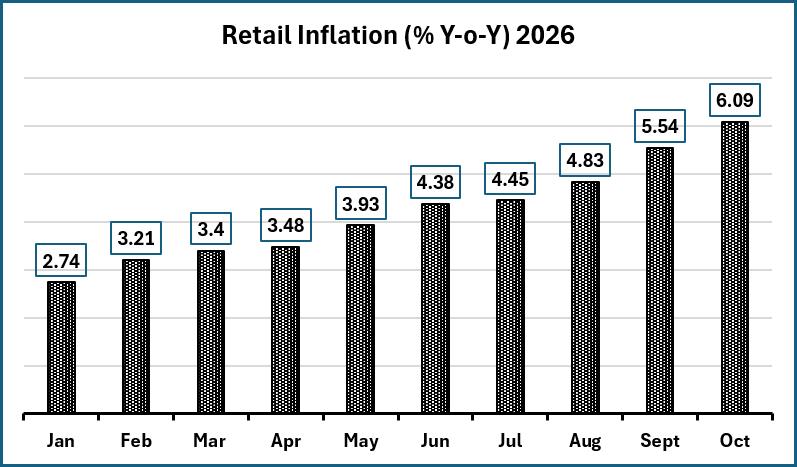
Latest government data confirms what families across the country have known for months – prices have been rising uncontrollably, devastating family budgets and deepening deprivation. Wholesale prices are reported to have jumped by a two-year high of 12.29 per cent in October 2026. In the preceding month of September, the increase was 11.39 per cent. Meanwhile, retail prices increased by 6.09 per cent in October. The increase was 5.54 per cent in September. In fact, prices have been rising inexorably this year – and the Modi government appears to have no clue about what to do about it.
Wholesale price rise is computed based on the Wholesale Price Index (WPI) with 2022-23 as the base year. Data for this is collated and released on a monthly basis by the Office of Economic Adviser in the Ministry of Commerce and Industry. Retail prices are based on the general Consumer Price Index (CPI) with base year 2024, collated and released by the National Statistical Office (NSO) under the Ministry of Statistics & Programme Implementation.
India now has one of the highest inflation rates among all countries. The increase in wholesale inflation will get reflected in retail prices after a lag of a few weeks. In fact, this dragging up is already visible. So, the bad news is that there is likely no chance of prices coming down in the near future.
Steady Price Rise This Year
As the accompanying charts show, both wholesale and retail prices have shown a steady rise since January 2026, especially steeper since the summer.
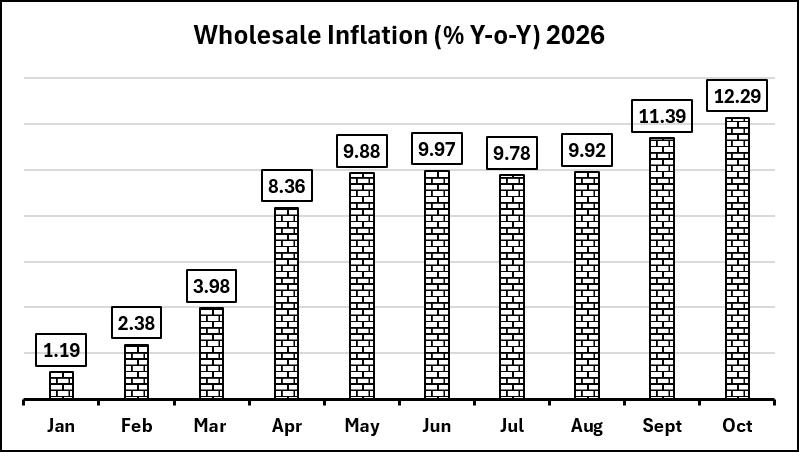
Wholesale prices started climbing in April when the inflation rate crossed 8 per cent. It stayed steady at nearly 10 per cent for the next four months and again started increasing in September, reaching 12.29 per cent in October. These are all year-on-year comparisons.
Retail prices have reflected this rise in wholesale prices as shown in the chart below, although the monthly increase has been steady throughout.
It should be remembered that the commodities covered and weights ascribed are different for these two indices. Retail prices are collected from over 1400 places across the country. There are issues with this methodology and mostly, the actual retail prices are higher than those recorded for computing the Consumer Price Index.
Its Not Just Fuel Prices
The government and its apologists have been lamenting the global spike in prices of crude oil and its products and arguing that this is what is driving prices up in India. This is only partially true. If you look at the breakup of wholesale prices of various groups of commodities in October 2026, you will indeed find that crude oil and petroleum prices have increased by an unthinkable 70.8 per cent over the past year and mineral oils by 45.57 per cent over the same period. But In the basket of commodities whose prices are counted while calculating the average figure, fuel and power make up only about 14 per cent weight.
Other commodities that are big factors in the wholesale price rise include food articles and manufactured food products which together contribute about 25 per cent of weight in overall calculation. Inflation for these stands at 8.58 per cent. Food prices are of utmost importance for the majority of people in the country with the poorer sections spending almost half of their income on food. Months of high prices at the wholesale level are firing up retail prices of such staples as vegetables, flour, eggs, milk etc. Speculators and hoarders are also taking advantage of this situation to make big profits at the cost of people.
Food Prices
The real picture of food prices that affect people directly emerges from looking at retail prices. Food inflation is recorded at an unconscionable 8.94 per cent in the latest October 2026 report. Remember that the average retail inflation was at 6.09 per cent.
While prices of some vegetables like potatoes, cauliflower, brinjal and cabbage have been reported as falling, prices of some other key vegetables like onions, garlic, ginger and lemon have gone through the roof. Onions, one of the important household staples, recorded an inflation rate of an astonishing 116.22 per cent in October 2026 (compared to one year ago).
According to reports quoting government data, in the last one year, arhar/tur dal prices have increased from Rs.110 to Rs.140 per kilogram; chana from Rs.85 to Rs.100; urad from Rs.110 to Rs.130; sugar from Rs.45 to Rs.60; groundnut from Rs.200 to Rs.214; mustard from Rs.198 to Rs.209; soyabean from Rs.143 to Rs.165; sunflower from Rs165 to Rs.192.
Interestingly, food inflation is higher in rural areas than in urban areas. In rural areas, average food inflation was 9.09 per cent while in urban areas it was 8.68 per cent.
The variance between rural and urban areas, and the variance between different kinds of vegetables together indicate what was mentioned above – that the drivers of high prices are not just fuel costs. If that was so, rural areas where production of most of the vegetables takes place would have lower prices because transporting commodities to urban areas would mean higher costs. Similarly, how is it that some vegetables are seeing huge spikes in prices while others do not? High fuel costs will affect everything uniformly.
The only explanation is the old problem of lax regulation of wholesalers and big traders who hoard large volumes of non- (or less-) perishable vegetables in order to cause an artificial scarcity leading to high prices. The governments (centre and states) do not use strict provisions of Essential Commodities Act and other regulations for seizing hoarded stocks of items like onions, facilitating the traders to make super-profits in a few weeks.
Is the Govt. Prepared?
A very strong El Nino is expected this year. It has already caused a shortfall in the south-west monsoon and appears to be affecting the north-east monsoon too. Kharif sowing was affected by it, and rabi sowing is also likely to get hampered. So, it is likely that foodgrain production, and possibly vegetable and fruit production will be negatively affected. Although bumper harvest in the last two years have led to record foodgrain stocks but any reduction in kharif and rabi harvests in coming months will put the country on knife-edge. Prices are already on the upward swing and this could give another fillip to the trend. Fuel prices are unlikely to drop in the coming months even if the war against Iran, and West Asias ramifications were to end soon, which appears unlikely. Ukrainian wheat exports will probably continue to be affected while globally, food prices might increase, including for such Indian imports as pulses and cooking oil. In short, dark clouds are gathering on the horizon – but our government continues to blithely unconcerned. It must put in place a strategy of widening the PDS basket to include pulses, cooking oil and vegetable staples at the least, build up reserves of various essential items and energise the machinery for controlling hoarding. The coming months are going to test and measure Mr.Modi yet again – and if found wanting again, the people will not spare the rulers.


