Sudhanva Deshpande
“IN Kerala, I can breathe,” said Seema Chishti, senior journalist and editor of The Wire. She was talking not only about the contrast between the toxic air in Delhi and the fresh breeze from the Arabian Sea that was wafting across the open-air stage she was on in Kochi as she spoke in a session as part of the first Indian Cultural Congress (ICC). Chishti was also talking about the toxicity of the politics and culture being propagated by those in power in Delhi.
Musician and author T.M. Krishna, from the coastal city of Chennai, also made a similar point, contrasting the states of Kerala and Tamil Nadu from states ruled by the BJP. Speaker after speaker congratulated the Kerala government for having organized the ICC, and underlined, in their own way, the need for more such gatherings all over the country.
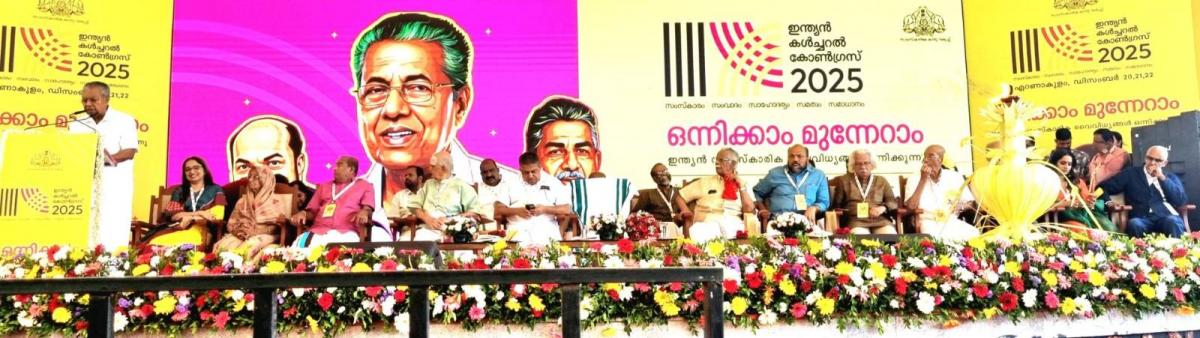
Over the three days of the ICC on December 20-22, 2025, the mood was both combative and reflective. It was clear that all the participants were united in their opposition to the RSS-BJP and determined to fight their pernicious and communal worldview. At the same time, there was honest introspection and an internal critique of secular, progressive and left efforts in the field of culture. There was unity in agreeing that culture is a primary and urgent field of struggle, because it is through cultural work that the RSS has come to occupy the position it does today. As Ganesh Devy pointed out, we’d be making a mistake if we do not pay attention to Mohan Bhagwat’s recent statement that he looks forward to the day when the RSS will become irrelevant because there will no longer any distinction between the Sangh and society. There was also a sense across the board that while we all have our distinct identities and political positions, we have to unite in confronting Hindutva.
A large number of artists, cultural practitioners and intellectuals attended the ICC, including Aadhavan Dheetchanya, Adoor Gopalakrishnan, Asokan Charuvil, Bose Krishnamachari, C. Radhakrishnan, C.S. Meenakshi, Chandradasan, Ganesh Devy, Gauhar Raza, Githa Hariharan, Jharna Areng, K.E.N. Kunjahammed, K.J. Jacob, K.K. Shahina, K.P. Aravindan, Komita Dhanda, M.A. Baby, M.G. Radhakrishnan, Malini Bhattacharya, Moloyashree Hashmi, Murali Cheeroth, N. Ram, P.N. Gopikrishnan, Prabir Purkayastha, Pralayan, Prasanna, R. Rajagopal, Raju Murugan, Rakesh, Rohini, Saeed Mirza, Sashi Kumar, Shubha Prasad Nandi Majumdar, Stanley Mathirappilly, Su Venkatesan, Suddala Ashok Theja, Sumangala Damodaran, Sunil P. Ilayidom, Susie Tharu, T.D. Ramakrishnan, T.K. Meerabai, T.M. Thomas Isaac, T.S. Shyamkumar, Tanweer Akhtar, V. Sivadasan, Varghese K. George, Veda Rakesh, and Vinutha Mallya.
Some artists could not attend at the last minute because of health reasons, or because their flights were cancelled. These included Ashok Vajpayee, K. Satchidanandan and M.K. Raina. Over 150 delegates attended the ICC from all corners of India, including two from Manipur.
The ICC also had a large number of performances, including by Abhyudaya Arts Academy (Telangana), Jana Natya Manch (Delhi), Jatan Natya Kendar (Haryana), Ratna Pathak Shah (Mumbai), and numerous performers from Kerala.
Sajjad Hussain Kargili spoke about the situation in Ladakh and praised the art exhibition on Palestine that was up in Subhash Park. At the inauguration of the ICC on December 20, spectators were treated to a masterful performance on the mridangam by the 91 year-old legend, Umayalpuram K. Sivaraman. Chief Minister Pinarayi Vijayan made a forceful speech underlining the plurality and diversity of Indian culture, and criticising unequivocally the majoritarian, hate-filled and violent ideology of Hindutva propagated by the RSS and the BJP.
Malayalam film actor Mammooty was the chief guest at the closing on December 22. Two messages of solidarity were read out at the closing ceremony: Sudhanva Deshpande read out Anand Patwardhan’s message, and T.M. Krishna read out Romila Thapar’s message. Krishna also sang Faiz Ahmed Faiz’s poem Hum Dekhenge in five languages: Urdu, Malayalam, Telugu, Kannada and Tamil. Ratna Pathak Shah read out the Declaration of the Indian Cultural Congress, which included the appeal to hold such congresses across the country in different states, cities, districts, and villages. Ganesh Devy announced that the next Congress will be held in Dharwad in Karnataka, the city of musicians Gangubai Hangal and Mallikarjun Mansoor, dramatist Girish Karnad, poet D.R. Bendre, and painter K.K. Hebbar.
DECLARATION OF THE FIRST INDIAN CULTURAL CONGRESS, 2025
As forces of darkness and venom gather strength across the world, from the Philippines to India to Israel to the United States to Chile, it enjoins upon artists to give a collective call for humanistic values, for love, kindness and empathy, for justice, equality and accommodation, for peace among peoples and states, and for respect for the earth and everything it carries.
Towards this end, democratic, forward-looking and secular cultural practitioners have come together for the first Indian Cultural Congress in Kochi, Kerala, from December 20th to 22nd, 2025.
This Cultural Congress asserts:
1. The secular principle. In India, as in many other parts of the world, hatred of, and attacks on, minorities have grown. The Cultural Congress takes a firm stand against the othering of people based on their gender, religion, caste, colour, ethnicity, language, nationality, and sexuality.
2. The peace principle. Violence and destruction rage in places as far removed as Palestine, the Sahel, and Ukraine–Russia. In India, too, there are forces that thirst for retribution and war. The Cultural Congress proclaims that war and violence are not any solution, that war harms the poor the most on both sides, and that complex problems need mature efforts towards solutions.
3. The freedom principle. Authoritarian states, corporations, and right-wing organizations attempt to muzzle artists, writers, and intellectuals by censorship of various types. In many instances, simply holding a view contrary to the powers that be results in incarceration or worse. The Cultural Congress asserts the right of artists to think and create freely, to explore and express reality without fear, and to have access and attention. Art and Literature are age-old expressions of freedom, and must remain so.
4. The respect principle. With climate change, rising temperatures, and endangered ecosystems, it is more urgent than ever to emphasize that the fruits of the Earth belong to us all and the Earth itself to none. We can choose respect for nature to benefit all living beings, or we can choose to rapaciously plunder nature for the interests of the rich. The Cultural Congress chooses respect and coexistence over plunder and destruction.
To take forward its mission of promoting these principles, the Indian Cultural Congress will initiate various activities, including bringing out publications, holding seminars and festivals, organising cultural get-togethers, and other such efforts.
The Indian Cultural Congress calls upon artists, intellectuals, and cultural practitioners to organise cultural congresses at state, district, city, town, and village levels. These cultural congresses will seek to disseminate the principles outlined in this Declaration among the people, and equip cultural practitioners to resist and defeat the forces of darkness.
We call upon all citizens of India and the world at large to come together to assert and uphold, and rehabilitate and reinvent the principles of human freedom and dignity, equality, secularism, peace, harmony, and respect – to make the world a better place for all living beings and for the Earth itself.


