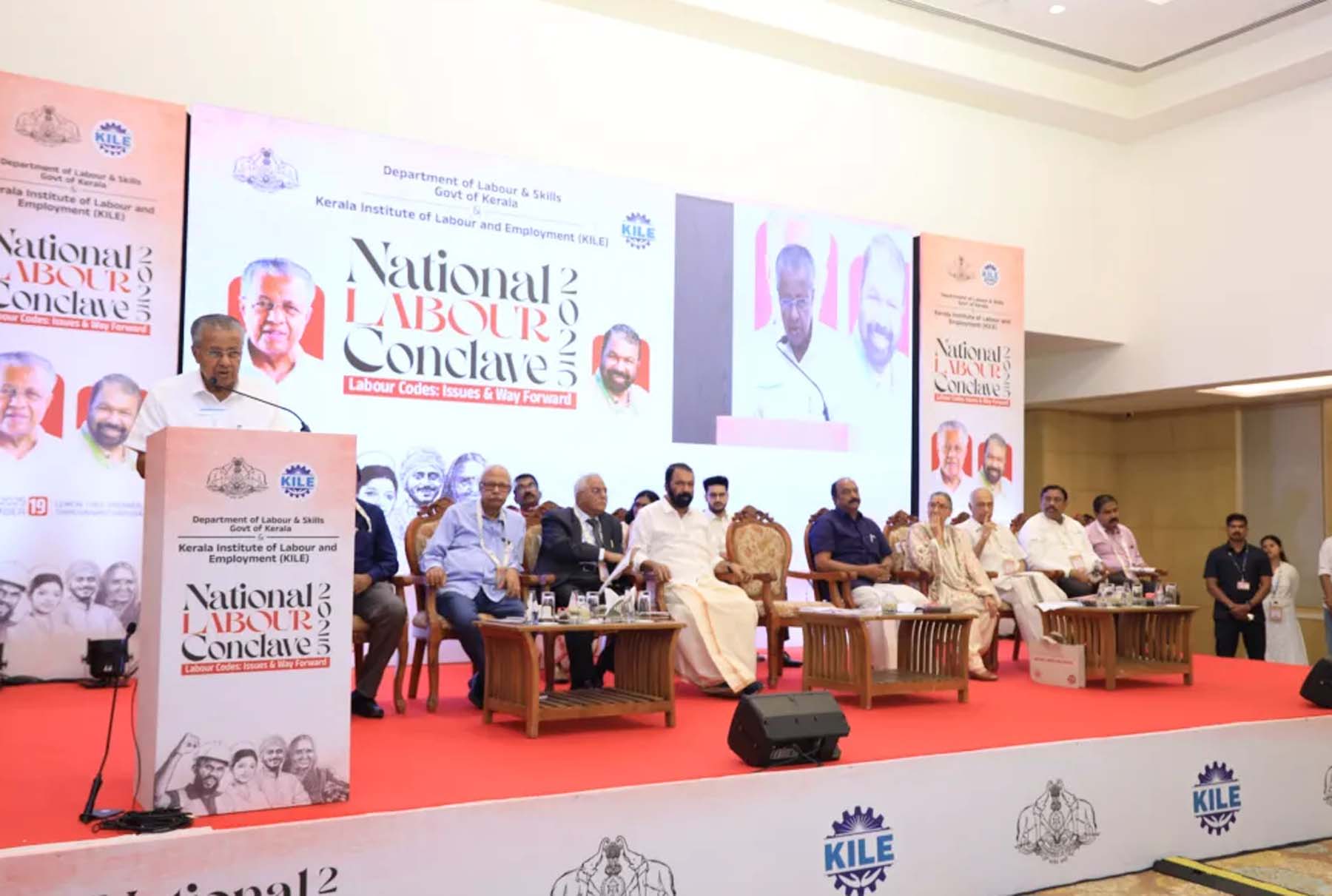
Kerala Chief Minister Pinarayi Vijayan inaugurated the conclave. Addressing the conclave, he said that under the guise of simplifying the country’s labour laws, the central government has consolidated 29 labour laws into four labour codes. These are the codes on wages, industrial relations, social security, and occupational safety. There is currently a widespread concern among the general public that the implementation of these codes will adversely affect the rights of workers. This conclave is a platform to discuss these concerns and seek ways to overcome the impending crisis.
The Indian labour sector is currently passing through a historic and critical phase—perhaps the most challenging period we have witnessed since independence. It is in this grave situation that the state labour department has organised such an extensive conclave. This should not be viewed merely as a routine official event. Instead, it must be seen as a platform for legal, political, and democratic resistance to protect the rights, dignity, and existence of the working class, who form the bedrock of the national economy.
In this current era, where inequality between capital powers and the workforce is increasing on a global scale, it is essential to stand on the side of the working class. It is the political and moral obligation of a democratic government to speak, share the concerns of the people, and stand by them. We have gathered here to fulfil that very responsibility.
The world around us is changing rapidly. Significant shifts are occurring in technology and production methods. However, a pertinent question arises: for whom are these changes intended? Is it to improve the lives of the common majority, or is it merely to multiply the profits of a few corporations?
When policy approaches emerge from the central government that limit the fundamental rights of the workforce and prioritise large corporate interests, it is the duty of a responsible society to record its logical and democratic dissent.
The state government is firmly convinced that development models which do not ensure job security and social welfare are unsustainable. The government defines the term “development” not merely through the lens of gross domestic product (GDP) or corporate profit accounts, but as a qualitative improvement in human standards of living and an economy rooted in social justice.
We must never forget the historical truth that the labour laws and rights we enjoy today are not the charity of ruling regimes. No one handed these to us on a silver platter. Instead, they were fought for and won through blood and toil, as a result of anti-imperialist struggles and subsequent agrarian-industrial agitation.
The historic struggles waged by the working class across the country —including textile workers in Bombay, jute workers in Calcutta, and workers in Kanpur and Ahmedabad — were an inseparable part of the Indian independence movement.
In our own Kerala, struggles such as Punnapra-Vayalar, Kayyur, and Karivellur, involving workers from the coir, cashew, handloom, and plantation sectors, were aimed at securing labour rights and eradicating feudalism. These movements were characterised by their anti-imperialist political content. That historical consciousness must provide us with strength today.
The labour laws formed in post-independence India remained faithful to the concept of “socialism” envisioned in the Preamble of the Indian Constitution and the “welfare state” concept mentioned in the Directive Principles.
Benefits such as the eight-hour workday, minimum wage, bonus, ESI, and PF were achieved through collective bargaining and legal battles. Laws like the Industrial Disputes Act of 1947, the Factories Act of 1948, and the Minimum Wages Act, all recognise that a worker is not merely a tool of production but a citizen with rights. These legislations helped, to an extent, to restrain the excessive greed for profit under capitalism and ensure the equitable distribution of wealth.
However, the neoliberal policies that began in the 1990s paved the way for structural changes in the labour sector. These policies, initiated by Congress governments, were later implemented more intensely and aggressively by BJP governments. We have seen the state’s role shift from being the protector of the citizen to merely being a facilitator for the market. This situation has adversely affected workers’ job security and living conditions.
We are witnessing the disinvestment of shares in public sector undertakings and projects like the National Monetisation Pipeline, which lead to the privatisation of the nation’s public assets. Even institutions operating at a profit are being sold off.
The promotion of contract-based appointments instead of permanent recruitment creates uncertainty in the labour market. The principle of “equal pay for equal work” is being disregarded, and the practice of paying different wages to permanent and contract workers for the same job is becoming widespread. Such actions distance us from the goal of “decent work” and weaken the collective bargaining power of workers.
In continuation of these policies, the central government has introduced four labour codes, claiming to simplify labour laws but there is widespread criticism that these changes are fundamental and regressive, negatively impacting labour security and service conditions. As labour organisations have pointed out, the process of consolidating 29 existing labour laws under the guise of “simplification” is actually removing the legal protections of workers. This requires serious scrutiny.
The fact that these codes were passed in Parliament in the absence of the Opposition and without democratic debate reveals the ulterior motive behind them. This is a planned move to create a corporate-controlled labour market.
The provisions in the new legal code titled the “Industrial Relations Code” seriously affect job security. Most notably, the threshold for establishments requiring prior permission for layoffs, retrenchments, or closures has been raised from 100 workers to 300. This means that in more than 90 per cent of the factories and industrial establishments in the country, employers can now terminate workers without government permission.
Workers can be dismissed at the employer’s whim. This is equivalent to legalising a “hire and fire” policy. Job security will become a thing of the past. Furthermore, “fixed-term employment” or fixed-term labour contracts are being legalised. This will eliminate the very concept of permanent employment.
By allowing contract appointments even for jobs of a permanent nature, workers are kept under constant threat. This effectively distances them from trade union activities. Upon the expiry of a contract period, they can be terminated without any benefits. The fear of losing employment if a contract is not renewed prevents workers from raising their voices against exploitation. For a worker who is uncertain whether they will have a job in a year or two, future planning becomes an impossible task.
Furthermore, this code strictly restricts the right to strike. A mandatory 14-day notice period is required before a strike. Additionally, strikes are prohibited while conciliation proceedings are ongoing or while a case is pending before a tribunal. Even a scenario where more than 50% of workers take leave simultaneously is classified as a strike. In effect, the legal right to strike is being rendered impossible to exercise.
The restriction of the “right to strike” — the primary weapon of the working class — is a violation of democratic rights. Those working in a supervisory capacity and earning above ₹18,000 are excluded from the definition of a “worker.” This exclusion results in the denial of protection under the Industrial Relations Code.
The proposals put forward by the Wage Code are equally alarming. The “floor wage” system introduced by this code has the potential to undermine the scientific determination of minimum wages. It disregards the criteria approved by the 15th Indian Labour Conference and upheld by the Supreme Court in the Reptakos Brett case—namely, the minimum requirements for food, clothing, housing, education, and health for a worker and their family.
By centralising the authority to fix wages without considering these minimum expenses or the regional variations in the cost of living index, the unilateral fixing of a “floor wage” adversely affects the purchasing power and living standards of workers.
There are provisions to extend the standard 8-hour workday to 9 hours. However, the rest intervals provided during this period are not counted as working hours, which leads to workers being forced to spend more time at the workplace without additional compensation.
Regarding the Social Security Code, although it claims to provide “social security for all,” in practice, it weakens existing systems. There is a lack of clarity in ensuring social security for workers in the unorganised sector and gig workers.
In the “gig economy,” which employs lakhs of youth through platforms like Swiggy, Zomato, and Uber, the relationship between employer and employee is not clearly defined. Consequently, there is no clear road map for mobilising funds for welfare schemes. While it is mentioned that a cess of 1-2% of turnover will be collected, this is deemed insufficient.
The code also contains provisions allowing the central government to divert and spend funds from existing welfare boards, such as the Building and Other Construction Workers’ Welfare Fund, for other purposes. This is equivalent to utilising workers’ money for needs other than their own welfare. Similar concerns apply to the Employees’ Provident Fund (EPF).
The provision that keeps the applicability of the Provident Fund (PF) Act to establishments with 20 or more employees remains unchanged. This effectively continues to exclude the majority of workers in small-scale establishments from PF benefits.
Furthermore, the government is being granted the authority to increase overtime limits and extend working hours up to 12 hours per day. Setting a 12-hour workday will lead to the physical and mental exhaustion of labourers. Even while stating that “work should not exceed 6 days a week,” the very next line provides the government with the power to modify this if deemed necessary.
Thirteen sector-specific laws — for instance, the Plantation Labour Act, the Mines Act, and the Beedi Workers Welfare Act — are being repealed. This is equivalent to disregarding the unique safety concerns and specific requirements of each of these sectors.
The Union government’s new move has ignited serious concerns in the rural employment sector. The Union government is attempting to change both the name and the fundamental structure of the Mahatma Gandhi National Rural Employment Guarantee Act (MGNREGA).
Strong protests must be raised against this decision. This shift in naming reveals the extent of the Sangh Parivar’s animosity towards the name and ideals of Mahatma Gandhi. Through a new Bill introduced by the Union Government, titled VB-GRAM G or “Viksit Bharat Guarantee for Rozgar and Ajeevika Mission (Gramin),” the objective is to dismantle the existing employment guarantee scheme. This move seeks to undermine even the core objectives of the scheme.
The content of the Bill is structured in a way that imposes a heavy financial burden on the states. The hidden agenda behind this Bill is to transform the scheme from a demand-driven programme into an allocation-based one.
Under the current structure, the scheme is designed to provide work, based on the demand of the unemployed. However, the proposed change would shift this to a system where the Union government pre-determines a fixed allocation for each state for every financial year based on certain criteria.
Currently, the Union government bears 100% of the wage component and shares the material component costs with the state governments in a 75:25 ratio. The provision in the new Bill proposes that both components be shared between the Union and state governments in a 60:40 ratio.
Once this Bill becomes law, there will be a significant reduction in the Union Budget allocation for Kerala. The state will only receive 60% of the total expenditure from the Union government.
Kerala is the only state in India that provides a monthly welfare pension of ₹2,000 to over 60 lakh people. During the 2011-16 UDF government, the pension was only ₹600 and had remained in arrears for 18 months. We have not only increased the amount but also ensured its accurate delivery directly to homes. Through more than 30 Welfare Fund Boards, security is ensured for workers in the unorganised sector, including construction workers, motor vehicle workers, tailors, and fish workers.
The ‘Awaz’ insurance scheme and the ‘Apna Ghar’ housing project provide dignified living conditions for guest workers (migrant labourers). While they face persecution in other states, Kerala provides them with a secure workplace and a safe life. Parallel to MGNREGA, the Ayyankali Urban Employment Guarantee Scheme is being successfully implemented in urban areas.
The Union government’s attempt to weaken the employment guarantee scheme through Aadhaar-based payment systems and mandatory twice-daily digital attendance is creating a severe crisis. In villages without internet and for elderly workers unfamiliar with technology, this results in the denial of work. We must not use technology as a tool for exclusion.
Kerala is a state that passed a resolution in the Legislative Assembly against anti-labour provisions. The state government’s stance is that labour policies should only be formulated through tripartite discussions and democratic consultations. We are prepared to frame rules and legislation within the state’s jurisdiction to protect workers’ interests against the labour codes being imposed by the Centre.
The Union government should withdraw from new legislations that impose a heavy financial burden on states. Strong protests are necessary for this. While three farm laws were withdrawn following intense farmer agitations, the indirect corporatisation of the agricultural sector continues to affect both farmers and agricultural labourers.
The reduction of fertilizer subsidies and the failure to ensure a fair support price make farming unprofitable, leading to increased rural unemployment. Kerala presents an alternative development model against these national trends, proving that there is indeed an alternative to neo-liberal policies.
The state government took over Hindustan Newsprint Limited, which the Union government decided to divest, and successfully revived it as Kerala Paper Products Limited. This takeover, clearing liabilities of ₹145 crore including employee benefits, is a testament to the government’s political will to protect the public sector. Similarly, the takeover of BHEL-EML is part of this alternative policy.
History always stands with those who struggle. Embracing that spirit of struggle, we must move forward together against the corporate-communal nexus. This fight is not just for one section of society; it is for the future of the coming generations and for the very survival of the democratic republic of India.


