Samprikta Bose
ACROSS West Bengal, a massive wave of democratic resistance has erupted against what has been termed a "systemic conspiracy" to disenfranchise nearly 60 lakh voters. Following the publication of revised voter lists, thousands of citizens—predominantly from the minority community and other marginalised sections of the population —found themselves marked as "under consideration" or "adjudicated" under the guise of the Special Intensive Revision (SIR) and "logical discrepancies." The Left Front and its allied parties have launched a statewide agitation asserting that this is a communal and political agenda orchestrated by the RSS-BJP and executed by a compliant TMC administration.
DETERMINED DEFIANCE
This movement reached a boiling point in Kolkata with an overnight 24-hour siege of the Chief Electoral Officer’s (CEO) office on N.S. Road. Thousands of activists transformed the street into an open-air resistance camp, remaining steadfast through the night. Veteran party leader Biman Basu and state secretary Mohammed Salim led the protest. They were joined by Polit Bureau member Srideep Bhattacharya and Central Committee members Sujan Chakraborty, Abhash Roy Chowdhury, Kaninika Bose Ghosh, Minakshi Mukherjee, and Samik Lahiri. The unity of the democratic resistance was further strengthened by the presence of leaders from allied parties, including Kartik Pal (CPIML Liberation), Jiban Pain (Forward Bloc), Prabir Deb (CPI) and Manoj Bhattacharya (RSP). The leaders called for resisting the conspiracy to exclude the names of poor, ordinary people, Matuas, minorities, and Adivasis under the guise of "logical discrepancy" and "no mapping." The continuation of sit-ins and protests was announced, slated to remain outside the CEO's office and to be expanded to the sub-divisional and block levels.
During the demonstration, Mohammad Salim delivered a scathing address labelling the ECI move a "fascist assault on democracy." He questioned the Commission’s legitimacy, stating, "While coal thieves and rapists roam free, the common citizen seeking justice has had their voting rights frozen. If people are not given the right to vote, the Election Commission has no right to conduct elections either." Salim stood firm when challenged by the police over the blockade, accusing the administration of having a double standard when it came to political activities by the ruling TMC. He declared an unyielding "tooth and nail" fight until their demands were satisfied. Meenakshi Mukherjee echoed this sentiment, noting that while there may be a "setting" between the rulers at the top, a "unity from below" has formed on the streets to break it. Sujan Chakraborty stated, "The Election Commission is playing games. Can there be an election without voters? Currently, people whose names are on the list are still considered 'under trial.' Citizens are being treated as 'under trial' defendants. This cannot be allowed. There is a conspiracy to exclude voters, similar to what happened in Assam. They are trying to snatch people's rights. The Election Commission does not have the authority to verify citizenship; that is the job of the Home Department. The Commission's task is to ensure the accuracy of the voter list—to keep the names of valid voters and remove those who are deceased or have relocated. We will not allow what happened to the common people in Assam to happen in West Bengal."
BLACK FLAGS
Tension escalated on Sunday night, March 8, when Chief Election Commissioner (CEC) Gyanesh Kumar and the full 12-member bench were met with intense protests upon entering Kolkata. From Dum Dum Airport to Kaikhali, activists waving black flags and "Go Back" placards hit the streets to obstruct the CEC’s convoy, accusing the Commission of acting as a "puppet" of the Modi government. Despite heavy paramilitary presence, protesters—including a significant number of women—blocked the route and even rescued student activists from police detention.
The magnitude of this crisis is starkly illustrated by alarming data emerging from across the districts, revealing the granular reality of what the opposition calls a "systemic disenfranchisement" of the electorate. In Bankura’s Onda block, specifically within Punisole village, the situation has reached a critical point where 8,555 out of 26,000 residents find their status "under adjudication"—a list that inexplicably includes retired government staff and even active Booth Level Officers (BLOs). The discrepancy is even more profound in Keshabpur’s Booth 130, where a staggering 72 per cent of the total voters (750 out of 1,045) have been flagged, despite many possessing valid historical documents.
This pattern of exclusion appears equally deliberate in North 24 Parganas, where the Baduria constituency reports 19,041 voters placed under adjudication. Crucially, 85 per cent of these individuals belong to minority communities, a statistic that has triggered widespread outrage and led to mass road blockades on the VIP Road and in Bijpur as citizens demand an end to demographic targeting. Meanwhile, in Hooghly and Jhargram, large-scale protests and sit-ins in Chinsurah have directly challenged what leaders describe as a communal polarisation agenda orchestrated by the RSS, using the cancellation of legitimate votes as a primary tool.
The resistance has been further amplified in the Midnapores, where a massive march led by Sujan Chakraborty to the District Magistrate’s office in Nimtouri underscored a growing conviction among activists: the "logical discrepancy" excuse is merely a technical pretext designed to systematically disenfranchise the poor and marginalized. Protesters from Daspur to Salboni have remained adamant that no election schedule can be deemed legitimate until every voter matching the 2002 rolls is officially validated and their constitutional right to the ballot is restored.
THE PATH FORWARD
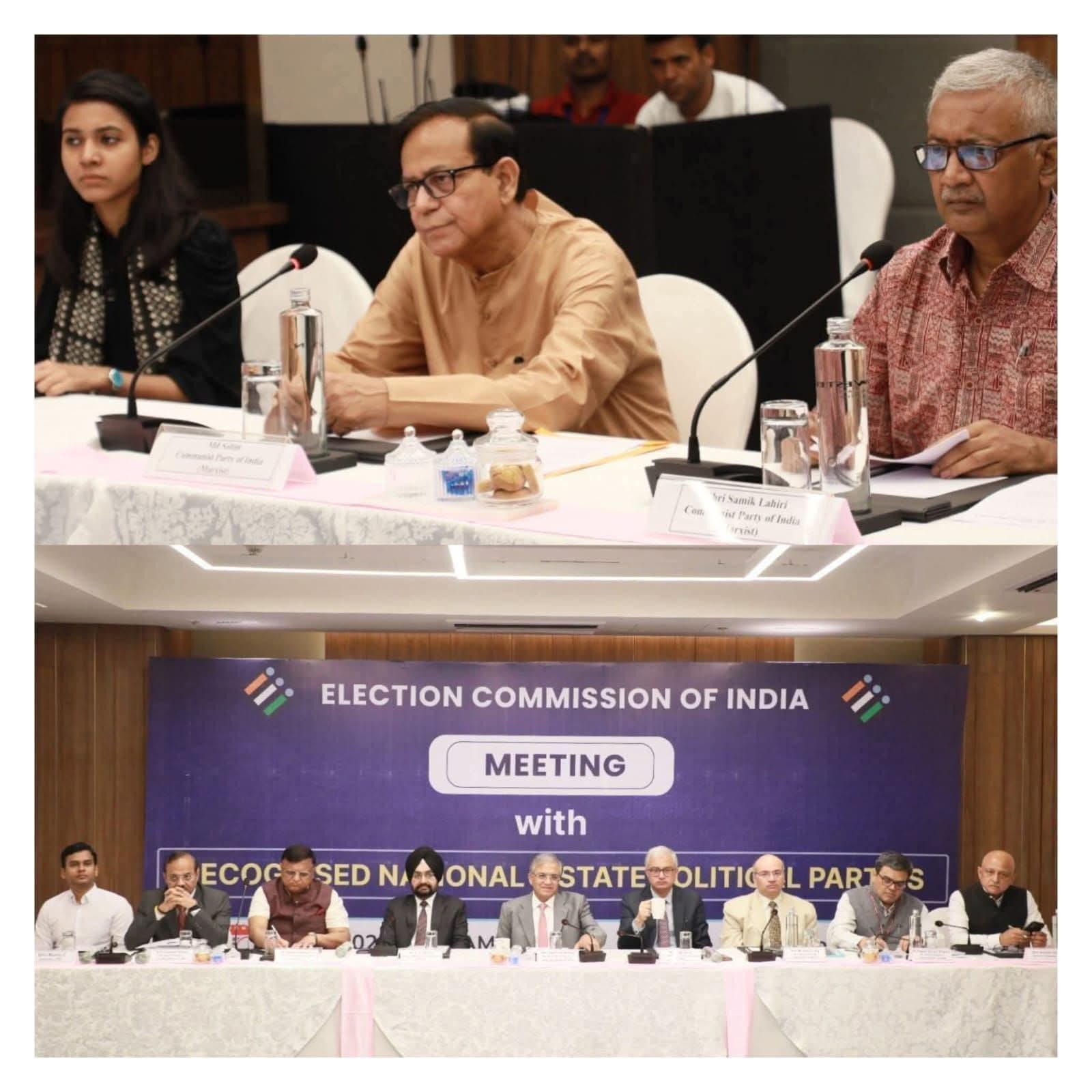
On March 9, a CPI(M) delegation led by State Secretary Mohammed Salim met the full bench of the ECI to submit a formal memorandum. The party demanded that those marked under "logical discrepancies" must not be deprived of government benefits and that the Commission provide a written explanation for every deletion. Salim noted that the Commission had admitted to "clerical errors" causing these issues. "We want the Commission to judge with its own eyes of wisdom, not through the biased lens of AI," Salim remarked.
The Left Front has issued a final ultimatum: no election can be held by excluding 60 lakh voters. They insisted that any disputes regarding these names be resolved after the polls, allowing citizens to exercise their franchise in the interim. Furthermore, to prevent state-sponsored booth-jamming, the CPI(M) proposed a condensed election schedule of one or two phases, arguing that a multi-phase process allows "TMC-aligned goons and police" to move across districts.
The delegation also raised the Commission’s silence regarding the death of Tamanna Khatun, killed by bombs during the Kaliganj by-election. Beyond security, the party demanded that representatives from all political parties be allowed access to CCTV control rooms in booths. The message remains unyielding: until a defect-free voter list is produced and the 60 lakh "adjudicated" voters are reinstated, the constitutional legitimacy of any upcoming election remains in tatters.


