Azhar Moideen
On April 8, 1929, Bhagat Singh and Batukeshwar Dutt threw two bombs into the chamber of the Central Legislative Assembly in the Council House (Old Parliament House) in Delhi as the Viceroy, Lord Irwin’s proclamation enacting the Public Safety Bill and the Trade Disputes Bill was to be made, despite the fact that the majority of members had rejected the two bills.
The leaflets thrown by the two revolutionaries following this act of protest began with the statement, “It takes a loud voice to make the deaf hear,” words which they attributed to the French anarchist Auguste Vaillant, who had used them in a courtroom speech following a similar act of throwing bombs into the French Chamber of Deputies in the Palais Bourbon, Paris. Vaillant’s act was in protest against what he called an ‘infamous society which permits a few individuals to monopolize all the social wealth, while there are hundreds of thousands of unfortunates… and while entire families are committing suicide for want of the necessities of life.’
Rising anger against anti-people policies
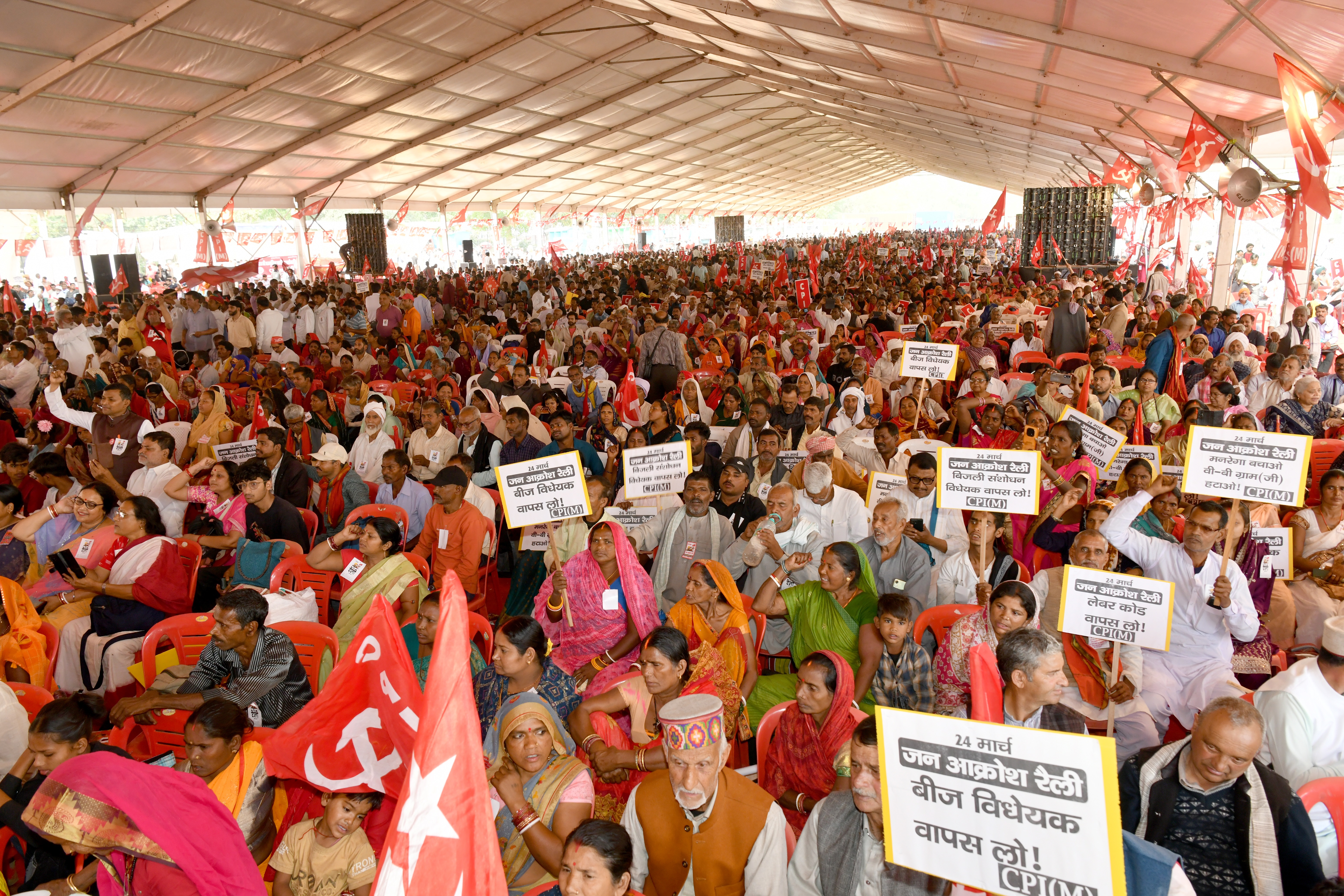
The misery of the labouring classes under the yoke of capital and the indifference of the ruling class, who remain deaf to the people’s needs and demands, formed the backdrop of the Jan Aakrosh Rally held by the Communist Party of India (Marxist) at Ramlila Maidan, New Delhi, on March 24, 2026.
The rally marked the culmination of a month-long mobilisation through Jan Aakrosh Jathas, which traversed all states in North India, stopping in both urban areas and remote villages, with the core objective of uniting workers, farmers, oppressed communities and marginalised groups to consolidate public opinion against the anti-people policies of the BJP-led NDA government. The jathas brought to the fore the widespread distress among working people under the present Modi administration.
A total of 33 jathas were conducted on the call of the Central Committee of the party between February 27 and March 20 across Jammu and Kashmir, Himachal Pradesh, Uttarakhand, Punjab, Haryana, Rajasthan, Gujarat, Madhya Pradesh, Uttar Pradesh, Chhattisgarh, Jharkhand and Bihar. From the inner Himalayas to the Gangetic plains, they covered a cumulative 213 days of campaigning. More than 1,000 public meetings were held as part of the jathas, with about 1.5 lakh people taking part and joining the discussions. The campaign also saw the distribution of 10 lakh leaflets and the sale of about 35,000 booklets. Cultural teams accompanied the jathas in various states, performing street plays and songs highlighting people’s issues.
The mobilisation was centred around a set of demands directed at the Union government, including the withdrawal of the four labour codes, scrapping of the VBGRAMG in favour of a strengthened MGNREGA, halting amendments to the Electricity Act, and opposing the Seed Bill and the India–US trade deal. The government is pushing ahead with the implementation of the labour codes, which are set to be made fully operational from April 1, despite their being rejected categorically by the vast majority of workers, who came out against them in huge numbers in the Nationwide General Strike on February 12. The simmering anger was palpable in the recent protests by workers in the oil refineries of Panipat, Surat and Barauni.
The Shaheedi Diwas of Bhagat Singh, Sukhdev, and Rajguru was commemorated in the same venue by the participants of the rally on March 23. It was evident that the overwhelming sentiment was that the present-day struggle is a continuation of the struggle of the immortal martyrs, who fought to reorganize society and to redeem humanity from the bondage of capitalism and imperial wars.
Red flag is Synonymous with Struggle
“The red flag is not something that can be erased; it represents the struggles of people. Wherever people stand up, the red flag will rise,” declared General Secretary MA Baby in the inaugural address. To thunderous applause, he stated that Prime Minister Narendra Modi and Home Minister Amit Shah who often say that the red flag has disappeared from India and only survives in Kerala, and that it would soon be eliminated even from there, should take a look at the sea of red in Ramlila Maidan.
Thousands thronged the venue in the capital city, coming from almost all districts of every state in the Hindi belt. People of different communities, from various sections, speaking different tongues and wearing different attire all held aloft the red flag and marched into Ramlila Maidan. Farmers, landless peasants and sharecroppers, adivasi and dalit landless agriculture workers, women scheme workers and students and youth took part in large numbers. Many brought with themselves stories of struggle under the red flag. They recounted their experiences and reposed their faith in the red flag and the courage that it gives them.
Among those present were the family of Junaid Khan, a resident of Khandawli village in Haryana’s Faridabad district, who was lynched in 2017 by Hindutva extremists aboard a Delhi–Mathura train while returning home with his brothers after purchasing items for Eid. Junaid’s mother, Saira Banu, and his brother Qasim attended the rally and met MA Baby and senior leaders Brinda Karat and Subhashini Ali. Speaking at the venue, Saira Banu said that in their long struggle for justice, the CPI(M) was the only political force that stood firmly with the family, extending solidarity and providing support ever since the killing and assisting in pursuing the legal case.
Also present was 12-year-old Dev, a Class 5 student from Hanumangarh district in Rajasthan, who had joined protests by farmers against an ethanol factory last December when police lathi-charged farmers and brutally assaulted him as well. The incident intensified the agitation, which eventually succeeded in forcing the government and the private company to halt the construction of the factory in farmland acquired for this purpose without the consent of the local residents.
CPI(M) Polit Bureau member Ashok Dhawale spoke about the recent long marches in Nashik and Palghar in Maharashtra, which brought the land struggle to the fore and showcased that the organised struggle of the people can break the will of administrations that have no qualms about taking repressive measures. Polit Bureau member Mariam Dhawale spoke of the commemoration marking the beginning of the 100th year of the historic Chavdar Tale Satyagraha in Mahad, when Dr BR Ambedkar and Comrade RB More defied unjust rules and asserted the equality of Dalits.
Polit Bureau member Tapan Sen shared the struggles of villagers who attended the jathas in Gujarat, who were resisting privatisation and opposing the Seed Bill. Central Committee member and AIAWU Joint Secretary Vikram Singh reminded the audience that the MGNREGA was won through struggles and would now have to be won back through further struggles. Polit Bureau member and AIKS General Secretary Vijoo Krishnan listed the achievements of the Left Democratic Front government in Kerala in securing people’s welfare and developing the state, keeping people’s interests paramount, while struggling against the discriminatory policies of the BJP-led central government. The red flag remains at the forefront of people’s struggles in India.
The Message is Loud and Clear: A Firestorm is Brewing
A common refrain among the speakers and participants at the rally was the deepening economic distress faced by the people, most evident in rising fuel and cooking gas prices, the shortage of LPG cylinders, the increasing costs of essential commodities, and the full or partial closure of businesses. MA Baby brought out the extent of the impact by referring to reports of the shutdown of the famous Annapurna Temple’s annakshetras, which had continued to feed thousands daily even during the peak of the COVID lockdown period.
The impact of the ongoing US–Israel war on Iran was flagged as contributing to inflationary pressures and disruptions affecting livelihoods. However, the Modi government is indifferent to the livelihood issues of the working people as it is beholden to the interests of capital, both domestic and foreign. The India–US trade deal will further break the back of Indian workers and farmers. The implementation of labour codes will take the country back to the dark days of slavery under British rule.
The massive Jan Aakrosh Rally made it clear that the people are intent on opposing the Corporate Raj of Ambanis and Adanis that the BJP is establishing while fanning communal flames. Central Committee member and CITU National President Sudip Dutta articulated the pain and hardship faced by working people and the hope that the red flag was giving them. But the people do not just want to just survive, he said; they want to live.
The will to live and free themselves from slavery will lead the fightback. Just as the message delivered by Bhagat Singh and his comrades signalled to the British that their rule would be challenged, the Jan Aakrosh Rally has delivered a resounding message to the triumvirate of Narendra Modi, Amit Shah, and Mohan Bhagwat, MA Baby said. If the disastrous anti-people policies are persisted with, a fiery storm will sweep them away.
Central Committee members Yusuf Tarigami, Lalan Chaudhary, Sukhwinder Singh Sekhon and Prem Chand were among the others who addressed the rally. The rally stressed the need for united action to defend livelihoods and rights and concluded with a call for intensified struggles across the country. The working people who joined the rally in large numbers have made it clear that they will hold the red flag high in these struggles.


