Vivek Monteiro
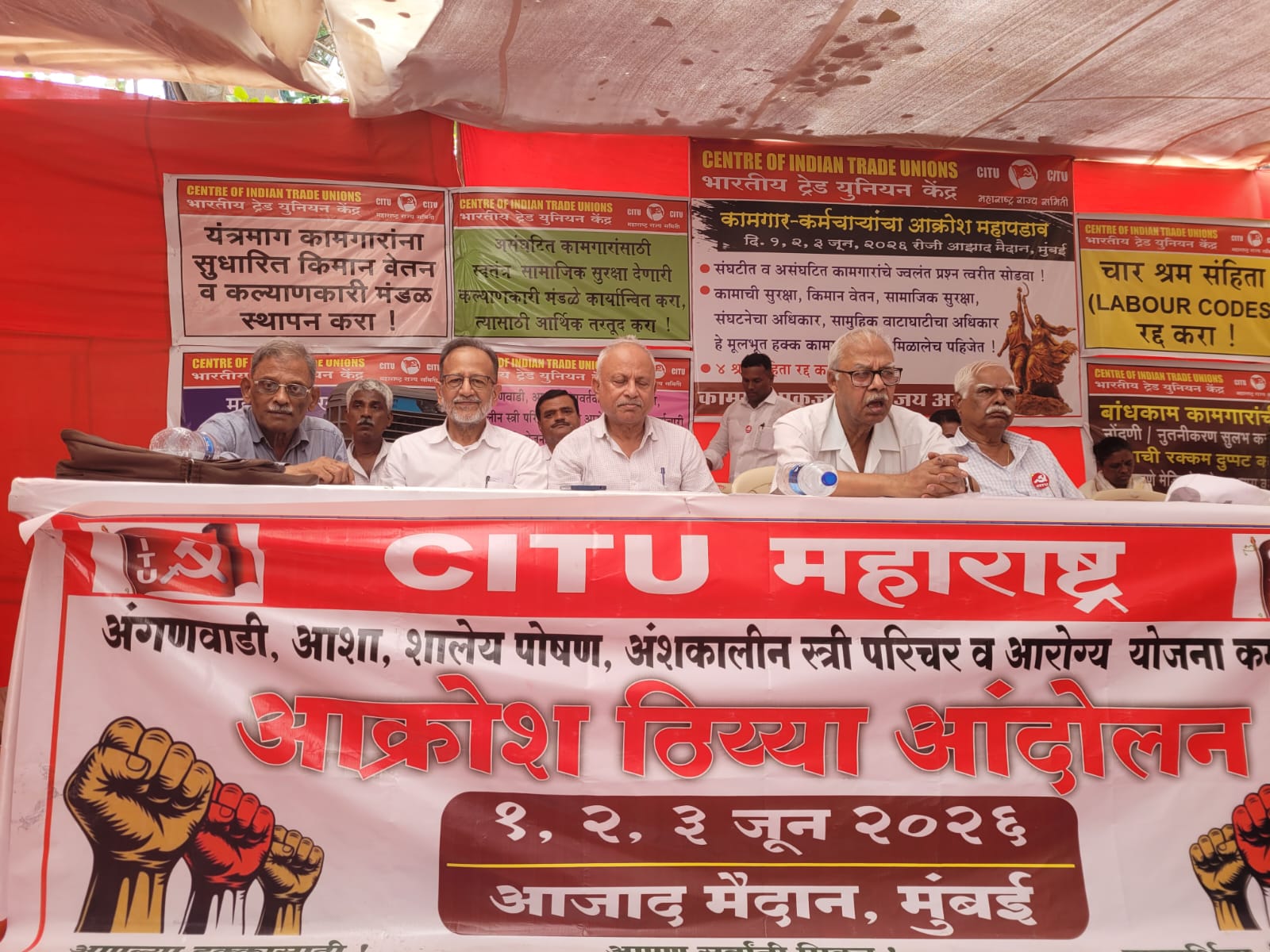
Over three days beginning 1ST June, the CITU Maharashtra State Committee successfully conducted a mass dharna at the historic Azad Maidan in Mumbai to raise demands of workers of both organised and unorganised sectors. These demands included a minimum wage of Rs 30,000 per month for 8 hours work, with overtime at the double rate; regularisation of the lakhs of contract, fixed term, casual, trainee workmen working in private enterprises, government and semi-government employments of regular nature, and till then equal wages for equal work, regularisation as government employees of Anganwadi, ICDS, ASHA workers and supervisors, midday meal workers, part-time medical attendants in public health services, 108 service ambulance drivers, attendants and doctors, their inclusion in the ESIC, provident fund and pension schemes. For unorganised sector workers the main demand was for formation and functioning of welfare boards, with due provision and allocation of funds for providing social security and welfare schemes. The principal demand was for not implementing in the state the 4 labour codes, and the scrapping of the four labour codes and Shram Shakti Niti of the Modi government.
On the first day, by 10.30 in the morning thousands of scheme workers had congregated and filled to capacity the huge mandap at Azad Maidan of 5,000 capacity. Thousands more participants kept pouring in carrying red CITU flags dressed in their distinctive pink, red, mauve uniforms and sarees. Though they had travelled hundreds of kilometres in packed train and bus services they were in high spirits. The three-day Mahapadhav was formally inaugurated by CITU all-India secretary and Anganwadi leader Usha Rani with a rousing and militant speech. The introductory speech explaining the programme demands and warning the state government of consequences if these were ignored was made by CITU state general secretary M H Shaikh. The meeting was greeted by AIDWA state general secretary Prachi Hativlekar and Vinod Sinh Patil.
The mahapadhav was addressed by economics professor and labour researcher Suchita Krishnamurthi who stressed that scheme workers have remained volunteers though they perform essential services to fulfil the constitutional duties of the government. Now they have put their issues centre stage due to their sustained struggles. It is high time that the governments recognised their role. Civil society must join hands with worker organisations to eliminate the dignity deficit. The mahapadhav was addressed on the first day by Anganwadi leaders Shubha Shamim and Sangeeta Kamble, ASHA union leaders Pushpa Patil, Anandi Awghade, Sheela Thakur, Midday Meal union leaders Ashok Thorat, A B Patil, Women medical attendant leader Mangala Meshram, CITU state treasurer K Raghu, Armaity Irani, and other leaders of the four major sector unions represented.
A highlight of the first day was the visit by renowned progressive kirtankar Shyamsundar Maharaj and his troupe to express support for the workers’ struggle. Despite the refusal of the local police to allow his musical instruments mridung, tal, and veena into the maidan enclosure, the kirtankar conducted his programme singing his message of equality and equity. Hundreds of women participants enthusiastically joined the song and dance and broke out into traditional dances like ‘fugdi’ in the background, transforming and heightening their morale for the fight ahead.
In discussions two days earlier with women and child development minister Aditi Thakre, the minister had assured the delegation of immediate attention to all pending grievances under her jurisdiction, though regularisation as government employees was a policy matter beyond her authority. On day one, the police arranged a meeting for discussion with the director of the department of health. Though the director assured timely payment of salaries, and addressing other issues the delegation was not satisfied with the discussion.
On the second day unorganised sector workers from powerloom sector, construction workers, sugarcane cutting workers, beedi workers, domestic workers came in groups of hundreds from distant districts like Solapur, Kohlapur, Nasik, Jalgaon, Pune to fill the mandap by 11 am. The introductory speech to focus on the day’s issues was presented by M H Shaikh. Noted scholar Sumangala Damodaran, who was part of the study team of the Arjun Sengupta Commission which prepared the famed 2007 Report on Enterprises in the Unorganised Sector, addressed the packed assembly. She spoke about the unprecedented protest strike of thousands of workers in Noida and NCR, which had compelled the Yogi Adityanath government in Uttar Pradesh to revise the minimum wage. But it had also arrested hundreds of workers under draconian provisions of law terming them anti-national. For conducting the struggles for basic worker rights the working class will also have to conduct a struggle for defending democratic rights of citizens, she said.
The assembly was addressed by renowned artist Sambhaji Bhagat, cultural activists Subodh More, Shahir Surendra Barve, and leaders of the unions in each sector.
Serious and extensive discussions were held on day two with the labour minister and officers of related ministries for more than an hour and a half on specific issues like minimum wages, the unsatisfactory state and functioning of welfare boards, etc. The minister expressed agreement and acceptance of demands on most issues raised by the delegation with assurance of positive redressal. D L Karad concluded the day’s proceedings with a detailed report on discussions with the labour minister and conveyed the CITU resolve of continued and unrelenting struggle until the satisfactory resolution of the issues raised.
On day three thousands of workers from organised sector industrial establishments, both permanent and contract workers, powerloom workers filled the venue. They came from Mumbai, Nashik, C. Sambahjinagar, Thane, Jalgaon Nanded and other industrial centres. Hundreds of contract workers from municipalities joined the assembly. In the afternoon session more than a thousand powerloom and beedi workers from Bhiwandi arrived at the packed venue. In recent weeks street vendors have come under sustained attack by the municipal authorities in Mumbai and other cities. They too came in large numbers. Vivek Monteiro commenced the proceedings by explaining the historic role of the Mumbai working class and Azad Maidan in shaping Indian politics.
A highlight of day three was the address by CITU vice president Tapan Sen who exhorted the workers to fight against the anti-labour four labour codes with unity and struggle of the working class and a physical resistance against their implementation. Economist Sanjeev Chandorkar congratulated the workers for highlighting that the state is responsible for ensuring basic needs, welfare and rights for all citizens. The working class must organise to direct and shape government policies so that the vast financial resources of the state are utilised for the benefits of the working people rather than for ensuring super-profits for the crony corporates. This is a political struggle, he said.
The afternoon session was addressed by All India Kisan Sabha president Ashok Dhawale, Janwadi Mahila Sangathana vice president Mariam Dhawale, AIKS state general secretary Ajit Nawale and CPI(M) MLA and CITU leader Vinod Nikole.
The Mumbai Police was informed in the morning that a meeting with the chief minister or the deputy chief minister should be held that day else the programme would conclude with a massive jail bharo agitation. With both the CM and the Dy CM being out of station this put the police in a quandary. Ultimately a meeting was convened with the special representative of the chief minister, Minister Girish Mahajan and the delegation led by Karad held an hour-long discussion, during which the minister also undertook to brief the CM and arrange a meeting with him before June 26.
In his concluding address, Karad announced that the pressure on the government will be maintained with mass CITU delegations in all districts to meet and discuss with local MLAs and MPs between 15TH and 21ST June. On August 10TH a statewide jail bharo would be held. In the first week of October a massive worker long march would be organised from Nashik to Mumbai.
The three-day Aakrosh Mahapadhav has activated the CITU organisation in all districts of Maharashtra. It has mobilised the main sections of the organised and unorganised workers in these districts. It is laying the foundations for broader mobilisation of the working class of Maharashtra for the struggles ahead.


