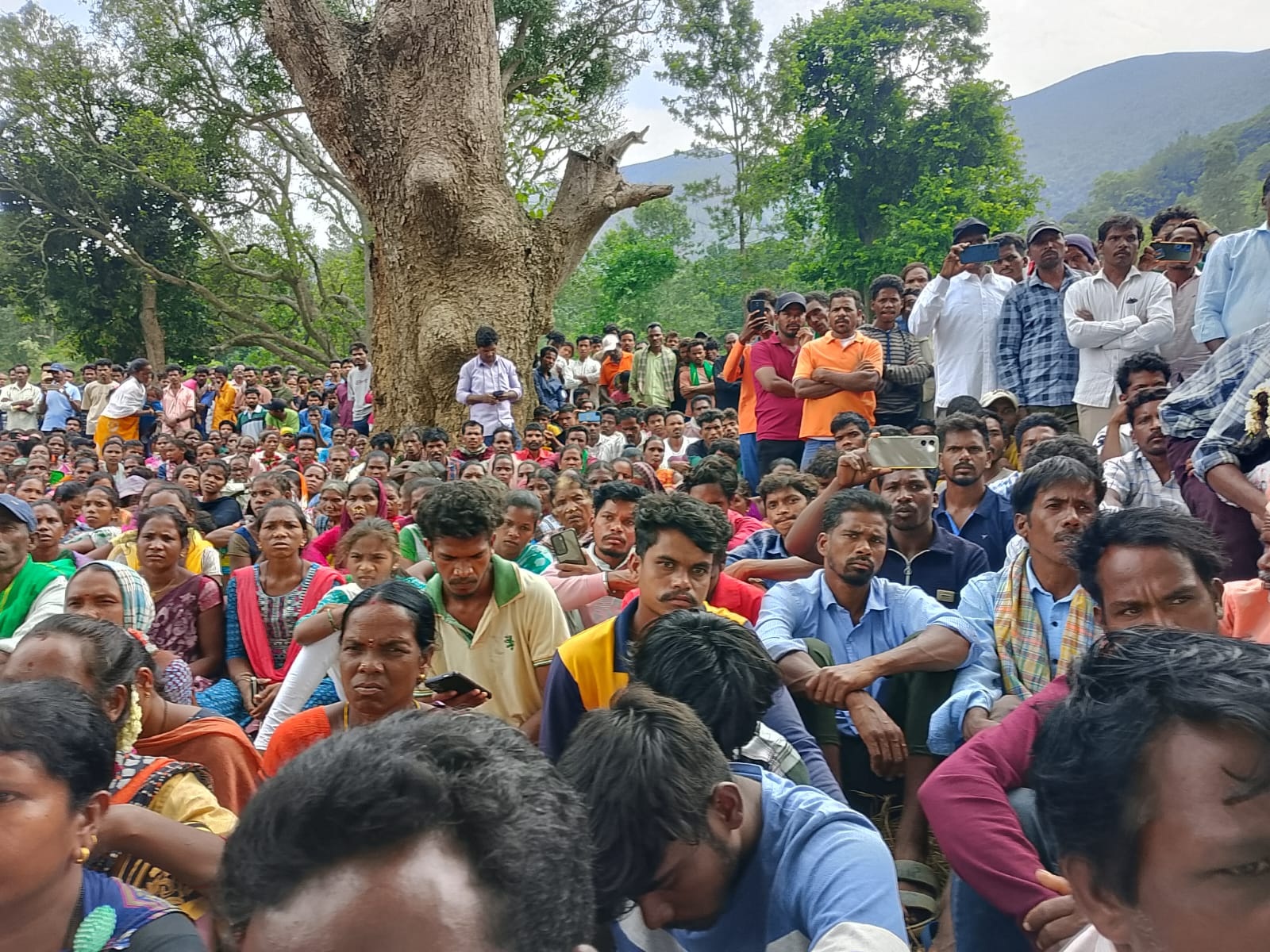
Villagers gathered in large numbers under the banner of the Anti-Hydropower Project Struggle Committee, organised by the Gram Sabha on June 8 in Majjivalasa village under Burja Panchayat, Alluri district of Andhra Pradesh, demanding the cancellation of the proposed hydropower project.
The Gram Sabha was conducted amid heavy police security and was attended by villagers, leaders of various public organisations, and government officials. The meeting, which began at 11 am, saw strong opposition from local residents, who demanded an immediate halt to the geological surveys being conducted by the Navayuga Company and the complete scrapping of the proposed hydropower project.
The villagers also demanded the immediate cancellation of all Joint Venture Orders (JVOs) related to the project. During the meeting, officials attempted to respond to the concerns raised by the villagers, but their explanations failed to satisfy the gathering. In protest, villagers surrounded the officials and raised slogans demanding that the District Collector visit the village and address their grievances directly.
A large number of women actively participated in the protest and voiced their opposition to the project. Tension prevailed for nearly half an hour before officials succeeded in pacifying the agitated villagers.
Addressing the Gram Sabha, CPI(M) Central Committee member K Lokanadham stressed the need to protect the natural resources and water wealth of the Agency area. He demanded that the government withdraw the hydropower projects, arguing that they would damage the environment and adversely affect the livelihoods of tribal communities. He called for the immediate cancellation of GOs 2, 13, and 51 related to the projects and urged the government to respect the sentiments and decisions of the local Adivasi people. He also warned that any attempt to exploit the region’s natural resources would be strongly resisted.
Speaking on the occasion, Killo Surendra, State General Secretary of the Adivasi Girijana Sangham (AP Unit of AARM) said that tribal communities would not remain silent if the government forcibly implemented the hydropower projects. CPI(M) District Secretary P Appalanarsa criticised the conduct of surveys in tribal villages, stating that such activities were creating fear and anxiety among local residents.
Officials informed the gathering that no surveys would be conducted until the concerns raised by the villagers were addressed. They assured the people that objections regarding the use of drones for survey purposes would be examined and appropriate action taken. Police officials were instructed to initiate legal action if drones were used illegally. The officials further stated that the objections and demands raised by the villagers would be brought to the notice of the government.
The meeting was presided over by Adivasi Tribal Association District Secretary P Baladev. Among those present were the Paderu RDO, the Hukumpeta Tahsildar, Circle Inspector, Revenue Inspector and Sub-Inspector, the CITU District Secretary Umamaheswara Rao, District President Chinnaiah Padal, ZPTC member Disari Gangaraju, CPI(M) Mandal Secretary Rama Rao, Tribal Association leaders T Baladev, T Krishna Rao, Dasharath, S Pothuraj, Siveri Kondala Rao, and a large number of villagers.
The proposed project near Majjivalasa in the Alluri Sitharama Raju (ASR) district is the Chittamvalasa Pumped Storage Project (PSP), a hydroelectric power generation plant.
It is located in the habitations between Majjivalasa and Dumbriguda in Hukumpeta mandal, ASR district, Andhra Pradesh. It is in deep forest. The proposed construction destroys not only forest but also many species would become extinct like bear, cheetah, big cats (gandubilli), and the birds would be thrown out. It woulf engulf forest produce like honey, jackfruit, tamarind, guava, mango, litchi and a variety of forest flowers. These are the livelihood of the Adivasis of the region.
The project is designed to draw 0.88 TMC of water from the nearby Raiwada reservoir. This reservoir was built for supply of drinking water to Visakhapatnam city and also for irrigation of agricultural land. With construction of this project, Visakhapatnam city will be deprived of water and the farmers agriculture will be in troubles.
The facility requires over 786 acres of land, including forest and non-forest areas, for its upper and lower reservoirs, including human hamlets also.
Concerns & Local Impact
The proposed initiative faces intense opposition from local Adivasi communities and environmental groups. Key concerns include the fact the lower reservoir is slated to submerge a significant area near Majjivalasa, threatening local habitations and agricultural lands.
Activists highlight potential violations of the PESA Act and the Forest Rights Act, as many residents claim the projects bypass mandatory Gram Sabha consent.
Concerns have been raised regarding the clearing of forest land and the diversion of natural water sources vital for local sustenance and farming.
The project remains highly contentious, with ongoing protests, village-level blockades, and demands for the outright cancellation of Government Orders (GOs) that sanction hydropower development in the Fifth Schedule tribal areas. Local leaders continue to push the district administration to halt geological surveys and prioritise the constitutional rights of the affected tribes.


