Rabikar Gupta
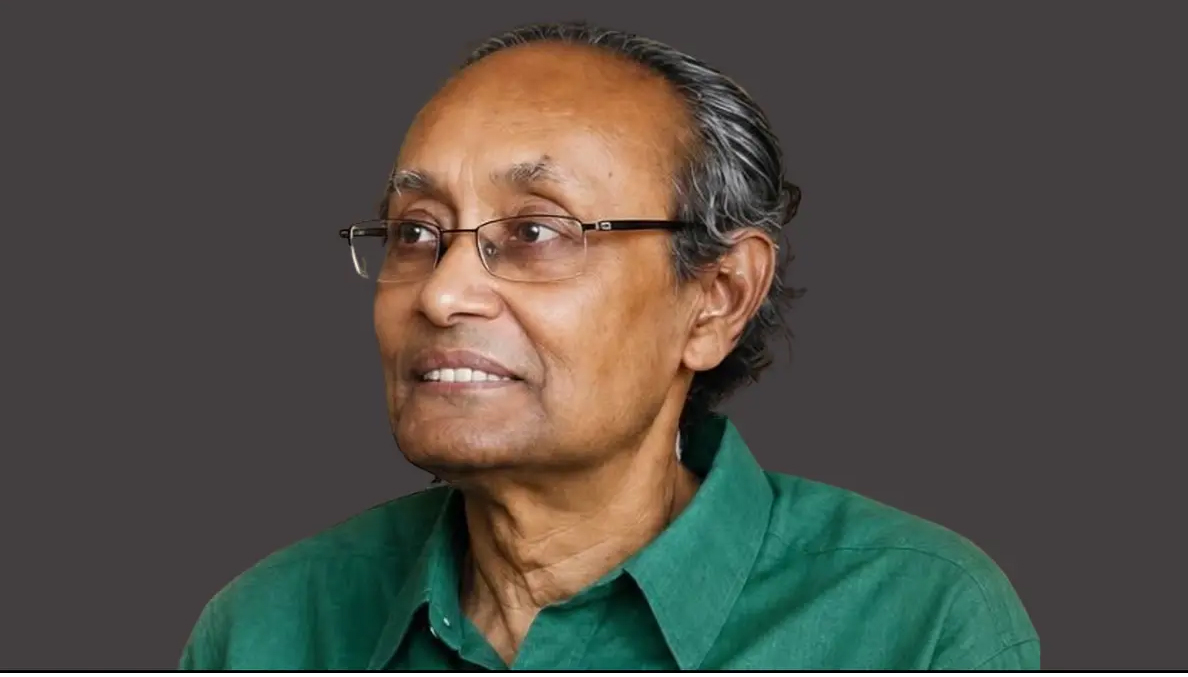
AUGUST 13, 2026, was a day when Cleo, muse of history, wept. For one of her greatest devotees, Professor Sumit Sarkar, foremost of the eminent historians of modern India, breathed his last. Eighty-seven years old, Prof. Sarkar lost his long battle with illness on that day. He is survived by his wife, eminent historian Tanika Sarkar, and his son, Aditya Sarkar. The loss of Prof. Sarkar is not merely the loss of a person. It is as if an institution whose constant presence we had taken for granted for so long a time suddenly crumbled. With his demise, the ever-vanishing ranks of those intellectuals who believe that the task of the intelligentsia is not limited to publishing papers and writing monographs for career advancement sitting in ivory towers thinned yet again.
Sumit Sarkar was born in 1939 to a Brahmo family in Calcutta. The conviction that powered much of his academic endeavor and non-academic activism was nurtured and shaped here. His father, Professor Susobhan Chandra Sarkar, taught history at Presidency College. He was one of the early pioneers of Marxist historical analysis and a longtime friend of the Communist Party of India. Sumit Sarkar followed in his father’s footsteps. He completed his post-graduation at Presidency College and earned his PhD from Calcutta University. He taught history for a time at Burdwan and Calcutta University before shifting to Delhi. Professor Sarkar started teaching history at Delhi University in 1974 and, despite every opportunity to move to greener pastures, gave this institution three decades of his life.
TEACHING HOW TO QUESTION
Prof. Sarkar taught in a manner that was revolutionary at that time (perhaps even now). The first half of his classes seemed like a typical lecture. He presented in front of the students a standard historical narrative about the topic of the day, supported by various facts. But halfway through the class, just when the students thought they grasped what the professor was driving at, Sarkar used to pivot. After painstakingly building up a narrative, he would then systematically demolish and deconstruct it using facts that were ignored, voices that were forgotten, and texts that could be reinterpreted in a different light. Like magic, the narrative rearranged itself, many times telling a completely different story than what the class initially thought it was going to be. Through this whole exercise, Professor Sarkar used to teach his students two crucial things: a) there is no dogma too entrenched, no narrative too unassailable, no event too holy to be deconstructed and reinterpreted in the light of new facts, and b) he inculcated among his students Marx’s favorite maxim, ‘De omnibus dubitandum’ or ‘doubt everything’.
Professor Sarkar, adhering to the dialectical view of history, saw it as something that is always in motion. He never believed in a neat, clean, and simplified version of events and always looked out for the various multifaceted historical tendencies and forces, with all their complexities and nuances, that always lurk beneath neat and tidy narrations. We can see this approach from his very first book, which was also his PhD thesis, The Swadeshi Movement in Bengal, 1903-1908, published in 1973. In this book, Sumit Sarkar takes a movement about which all had apparently been said and then drives a sledgehammer through that neat, clean, and tidy national narrative. Using various sources like newspaper articles, dramas, poems, and even unpublished memoirs, Sarkar reinterpreted the Swadeshi movement. He dragged history out of dusty archives and into the vibrant arena of culture and public memories. His revolutionary usage of these kinds of sources has now become standard practice, but only because he showed the way.
All events of the national movement until then were considered something of a hallowed ground where a historian could only step reverently. Professor Sarkar was nothing if not an irreverent iconoclast. His irreverent but impartial scrutiny parted the veil of national mythology surrounding the Swadeshi movement, exposing hitherto unnoticed and unanalysed limitations of the ‘Bhadralok’ leadership, who were always anxious to keep the movement within their control, the usage of Hindu symbols and specific cultural framing associated with the movement that were exploited by the British to keep the Muslim masses away from it, and militant labor mobilisations that created ‘pressure from below’.
HISTORY OF FREEDOM STRUGGLE
Sarkar then took the methods used in this book and applied them to a far larger frame—the whole period of the freedom struggle from the late 19th century until independence. The resulting work was perhaps Prof. Sarkar’s most famous book, Modern India, 1885-1947. This thick red book, beloved by millions of students of history across multiple generations, was the vehicle that took Sumit Sarkar’s approach to history even to the most remote of colleges. The aim of this book was not mere narration of facts, and the author makes it very clear from the get-go. Every other sentence contains Sarkar’s unique brand of analysis that systematically dismantled the myth of a neat, tidy, homogenous and unidirectional freedom struggle and revealed the various forces with vastly different agendas that drove the movement. Congress in Sumit Sarkar’s work emerges not as a party, but as a platform. The workers, the peasants, and the Adivasis leapt from the pages not as some helpless mass directed by ‘national leaders’, but as forces with their own agency and agendas that in many cases managed to create such huge pressure from below that the very direction of the freedom struggle was changed, with ‘national leaders’ scrambling to catch up to the people. 'Popular' Movements and 'Middle Class' Leadership in Late Colonial India is one of Prof. Sarkar’s more unique works. He demonstrates how 'Middle Class' leadership was always anxious to channelise the energy of 'Popular' movements toward their designated aim, but at the same time deeply feared any kind of social revolution generating from it. These novel analyses were backed by Sarkar’s effortless command of a mind-bogglingly huge range of subjects. How widely he read can be understood by reading his Writing Social History, a collection of his essays, where he deals with subjects as varied as E.P. Thompson's relevance in Indian history writing to the intellectual and social world of Vidyasagar.
NEW LOOK AT MODERN INDIA
One of the greatest traits of Prof. Sarkar was that his own works were not immune to his method of iconoclastic, skeptical, and irreverent analysis. According to him, there is no final say in history. Historical questions of the day change with time, and so does the analysis of history. At the end of his career, when most academicians rest on their laurels, Sumit Sarkar looked back and found his most influential work, Modern India, 1885-1947, had become grossly outdated and could no longer provide answers to contemporary questions. His solution was completely rewriting the book from the ground up. The resulting work, Modern Times: India 1880s-1950s, incorporated and touched on various topics as diverse as gender, environment, and cinema. The whole framing of the book shifted. There are very few examples of such a radical revision of a book by any historian. This same constant skepticism of one’s own work was behind his questioning of the direction taken by the ‘Subaltern Group’ in the late '80s, a group as part of which he spent a considerable amount of his time and contributed substantially.
Professor Sarkar believed that his duty did not end with the analysis of 'pressure from below' and writing about subaltern classes whose voices had been suppressed by the powerful. His convictions time and again led him to abandon the ivory towers of academia and join the masses in the street. Prof. Sarkar, like all things, did not see people as something sacred, infallible, and always right. But he believed that it was always his duty to stand with the people. He was something of an old Russian Narodnik in this matter. He participated in mass movements with the attitude of a student and never presumed because of his erudition that he knew more than the industrial worker he was walking beside. He always tried to harness the fire of mass movements and inculcate the same spirit inside academia. His enthusiastic and active participation in the protests of the Delhi University Teachers' Association (DUTA) underscored this effort.
Prof. Sarkar always revisited and revised his views. But there was one thing that was constant in his thinking: that was his uncompromising opposition to the RSS-BJP and ‘Hindutva’ as a political ideology. His opposition was grounded in the same deep analytical thinking that was his hallmark. His contributions to two edited volumes, namely Khaki Shorts and Saffron Flags: A Critique of the Hindu Right and Fascism: Essays on Europe and India, should be read and re-read by anyone who wants to understand the all-pervasive force that is now ruling India.
Prof. Sumit Sarkar is no more. But his skeptical and irreverent outlook, his disdain for neat, tidy, and simplified narratives, and his brilliant method of identifying underlying forces by deconstructing events live on among hundreds and thousands of his direct and indirect students. So does his commitment to a sovereign, socialist, secular, democratic republic and his endless faith toward its people. As long as the methods championed and ideals cherished by him are still alive among so many souls, his spirit will live on.


