Awadhesh Kumar / Vinod Kumar
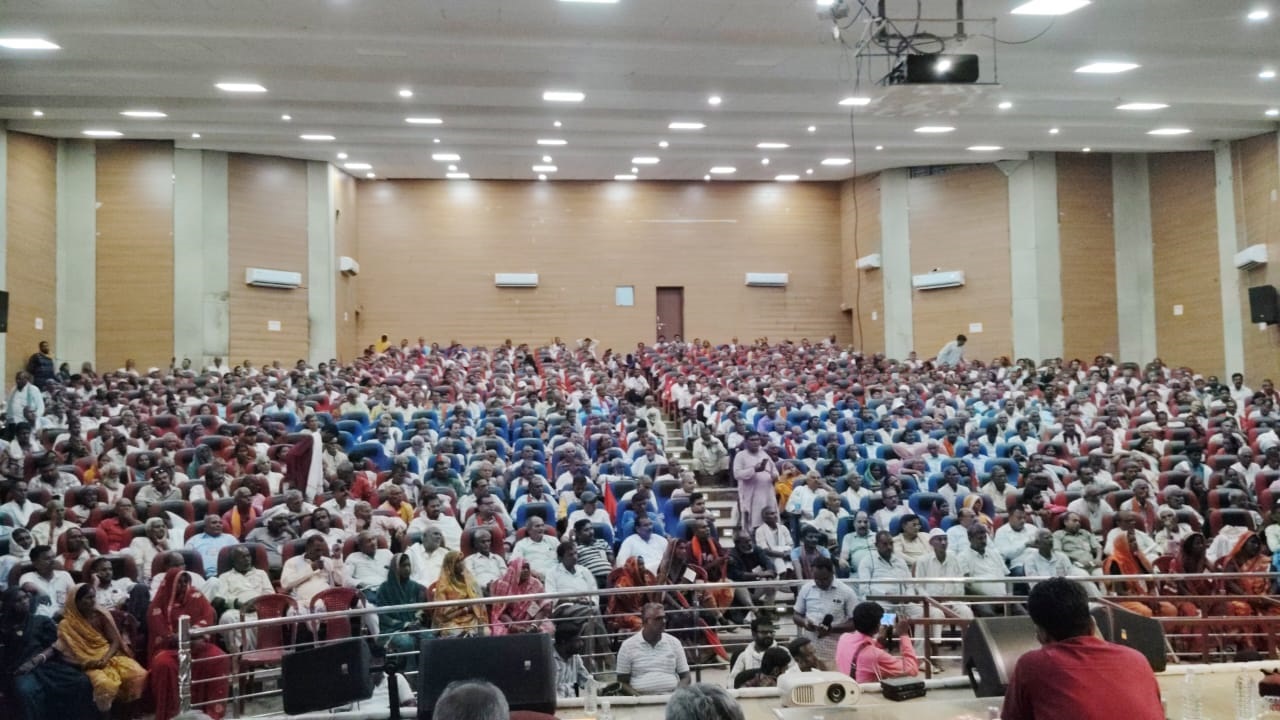
A state-level Land Rights Conference was jointly organised by the Bihar AIKS and the Bihar AIAWU on September 30, 2026 at Darbhanga. Around 800 delegates from all districts of the state participated. The convention began with the hoisting of the flag by AIKS national president Ashok Dhawale, followed by floral tributes at the martyrs’ memorial.
INAUGURAL ADDRESS
The conference was presided over by Rajendra Prasad Singh, state vice-president of the AIKS, and Ranglal Paswan, state president of the AIAWU.
Inaugurating the convention, Dhawale traced the origin of landlessness in India. As per Brahminical scriptures, more than 80 per cent of the population belongs to the Shudra and Ati-Shudra category, which has historically always been denied the right to own land. The Manusmriti, too, has imposed similarly abhorrent rules over the past 2,000 years. He said that the BJP-RSS government in power today seeks to run the country on the basis of the Manusmriti. But he declared that AIKS, AIAWU and other progressive forces would never allow the Manusmriti to be imposed on the country. The impact of feudalism is still rampant in Bihar and many other states. He paid homage to the hundreds of leaders and activists of the Red Flag who had been martyred while fighting militant land struggles of Bihar.
Referring to the glorious 90-year history of the All India Kisan Sabha, Dhawale said that one of its prime objectives during the freedom struggle included liberating the country from British rule, ensuring land to the tiller, and ending landlord and moneylender exploitation. Remembering the legendary peasant leader Swami Sahajanand Saraswati, he said that inspiration must be drawn from the historic peasant movements fought across Bihar and other parts of the country against feudal exploitation and over the question of land. Today, the greatest need is to unite and strengthen the struggle against the anti-farmer and pro-corporate policies of the Modi regime and for intensifying resistance at every level against the government-corporate-led land grab. He also called for a powerful and consistent struggle against the communal and casteist ‘divide and rule’ policies of the RSS-BJP regime.
MAIN RESOLUTION
The main resolution was placed before the convention by Vinod Kumar, general secretary of the Bihar AIKS. It was seconded by Ramashray Mahto, general secretary of the Bihar AIAWU.
The resolution stated that, under pressure from the peasant movement, land reform legislation was enacted in 1950, followed by ceiling legislation in 1955. Further amendments were made in 1970, again under the pressure of the movement. But by March 1983, only 3.59 lakh acres of land had been acquired under the ceiling laws, of which just 2.49 lakh acres had been distributed among the landless. At present, approximately 43,000 cases concerning more than one lakh acres of land acquired and distributed under the ceiling laws are pending in various courts. Meanwhile, evictions of beneficiaries holding land titles (parchas), including those who have occupied ceiling-surplus land for decades, have increased.
D BANDYOPADHYAY LAND COMMISSION
Discussing the constitution, report and recommendations of the D Bandyopadhyay Land Commission established by the Nitish Kumar government, the resolution stated that the Commission had recommended legal recognition, protection and rights for sharecroppers.
According to its survey report, approximately 22 lakh acres of land had been illegally occupied by powerful individuals, land mafias and landlords. The Commission recommended freeing this land from illegal occupation and providing 10 decimals of land each to homeless families for housing, along with one acre of cultivable land to every landless family.
Under pressure from the landlord lobby, the Nitish Kumar government consigned the Land Commission to cold storage. Now, the government led by the BJP's Chief Minister Samrat Choudhary is conducting a bulldozer drive in the name of removing encroachments, and demolishing the homes of the poor without making alternative arrangements for their rehabilitation. The state government has repeatedly offered empty promises through its Basera housing scheme or by promising Rs 1 lakh for residential land. Nothing has been given.
Meanwhile, the arbitrary directive to conduct land surveys across 45,000 revenue villages has created an atmosphere of extortion and corruption in rural areas. According to the Revenue Department, land records for around 8,000 revenue villages and records pertaining to around 23 lakh beneficiaries of land allotments have gone missing from government offices.
LOOT OF AGRICULTURAL LAND
Over the past few years, thousands of acres of farmers' land have been acquired in the name of various public and private projects in Bihar, including new expressways, six-lane and four-lane roads, national highways, air corridors, mega parks, airports, solar parks, high-tension power lines, religious tourism, nuclear power plants and road-widening projects. These acquisitions have proceeded by flouting the Land Acquisition Act, 2013.
Recently, the Samrat Choudhary government announced the acquisition of approximately four lakh acres of land across 11 districts under a land-pooling policy for the construction of 12 satellite townships. Restrictions have been imposed on the purchase and sale of agricultural land and on any construction on it.
The resolution pointed out the government's double standards: while pleading a lack of available land to provide residential plots to the poor, it has handed over 1,050 acres of land at Pirpainti in Bhagalpur district to Gautam Adani for a power plant. A proposal has also been made to acquire around 800 acres in Banka for a nuclear power plant.
Agriculture is the principal source of livelihood for 77 per cent of Bihar's rural population. The acquisition of thousands of acres of land for corporate interests will not only create a food security crisis but also lead to displacement, migration and environmental disaster.
Through the Land Rights Convention, the delegates resolved to launch a renewed and vigorous statewide movement around land-related issues. The convention called for united mass resistance against the BJP regime’s policy of using bulldozers aimed at evicting the poor who have occupied thousands of acres of land, as well as against indiscriminate land grab in the interests of corporations.
Addressing the convention, Vikram Singh, national joint secretary of the AIAWU, said that people were being dispossessed of their land and that they must defend it through intense struggles. Awadhesh Kumar, national joint secretary of the AIKS, and Shyam Bharti, vice-president of the Bihar AIKS, also addressed the gathering.
The convention concluded with a call to organise land rights conventions in every district, collect applications concerning land-related grievances, and mobilise for a massive statewide rally in Patna in March 2027.
KEY DEMANDS ADOPTED BY THE CONVENTION
1. Implement the recommendations of the D Bandyopadhyay Land Reform Commission in full and without dilution;
2. Stop the eviction of beneficiaries holding land allotments under ceiling-surplus, Bhoodan and government land schemes, and restore possession to those who have been evicted;
3. Provide 10 decimals of residential land to every landless and homeless family. Issue residential land titles to landless families residing on privately owned or government land;
4. Stop demolishing the homes of the poor in the name of removing encroachments without making alternative arrangements for their rehabilitation;
5. Stop forcible land acquisition. Strictly implement the Right to Fair Compensation and Transparency in Land Acquisition, Rehabilitation and Resettlement Act, LARR Act of 2013;
6. Strictly implement the Forest Rights Act (FRA) and the Panchayats (Extension to Scheduled Areas) Act, 1996 (PESA);
7. Stop the plunder of farmers' cultivable land in the name of greenfield satellite cities and withdraw the land-pooling policy;
8. Guarantee the rights of cultivating tenants and occupants of bakasht, topland and Bettiah Raj lands. Stop their eviction;
9. Distribute ceiling-surplus, Bhoodan and other undistributed government land among the landless. Establish special tribunals to expedite the disposal of court cases on such land;
10. Stop irregularities and corruption in the name of land surveys.


