Azhar Moideen
THE INDIA Bloc’s campaign to defend voting rights and democratic institutions reached a significant moment in New Delhi on October 31 and November 1, 2026, with a symbolic public impeachment of Chief Election Commissioner (CEC) Gyanesh Kumar followed by a massive rally at Ramlila Maidan. The two programmes formed part of a coordinated political campaign, with the first placing the charges against the CEC before a public forum and the second taking the demand for accountability to the streets.
Opposition leaders called for the CEC’s removal, an end to the Special Intensive Revision (SIR) of electoral rolls and a sustained struggle against the manipulation of the electoral process. The massive turnout at the rally served as a testament to the widespread anger over the disenfranchisement of voters under the guise of SIR, as well as the repression of protests through the deployment of the entire state machinery and Sangh Parivar goons. Support from a broad spectrum of society, including student and youth organisations, civil society groups and prominent personalities, showed that the struggle has expanded beyond the INDIA Bloc to become a people’s movement.
PUBLIC IMPEACHMENT PUTS CEC UNDER SCRUTINY
On October 31, INDIA Bloc leaders, Opposition MPs, civil society representatives, student leaders and citizens whose names have been wrongly deleted from electoral rolls assembled at the official residence of Leader of the Opposition in the Rajya Sabha, Mallikarjun Kharge. Former Lok Sabha Speaker Meira Kumar presided over the proceedings, which followed a format modelled on parliamentary proceedings.
Kharge moved a resolution listing six charges against Gyanesh Kumar. These included complicity in a criminal conspiracy orchestrated by the ruling party to manipulate elections; the arbitrary and illegal deletion of over 13 crore legitimate voters from the electoral rolls without following due process; unilateral alteration of voter registration protocols and rewriting of Form 6 without parliamentary oversight; illegal centralisation of control over electoral rolls to enable digital manipulation; exclusion of fellow Election Commissioners from core institutional decision-making; and abandonment of constitutional independence to act as an extended arm of the executive, at the behest of the Prime Minister and the Home Minister.
The resolution was unanimously adopted by a show of hands, giving public expression to the Opposition’s charges after earlier motions in Parliament seeking Gyanesh Kumar’s removal had been rejected by the Rajya Sabha Chairman and Lok Sabha Speaker without assigning specific reasons, despite having the required support in both houses. Even as opposition leaders and civil society activists brought out the manner in which voter rolls are being tampered with, the participation of citizens who have been excluded from the rolls brought the consequences of SIR directly into the proceedings and delivered a searing indictment of the Election Commission and the man at its helm.
Speaking during the proceedings, Rajya Sabha MP John Brittas described the public impeachment as a manifestation of the aspirations and concerns of the people and a verdict on a man who had lost the moral and legal authority to remain in constitutional office. He said that universal adult franchise was being systematically hollowed out in the name of cleansing and purification of electoral rolls, and argued that this was part of a wider pattern in which legislative and executive measures were being used to shrink democratic space, concentrate power and prepare the ground for permanent political control. Recounting that even he, as a sitting MP, had to attend two formal hearings to establish his eligibility as a voter, he asked what chance ordinary workers and migrant labourers had of protecting their voting rights.
CPI MP P Santhosh Kumar said that universal adult franchise was a foundational promise of the Republic, ensuring every citizen, irrespective of social or economic background, the right to choose their representatives. However, under the present Election Commission, this principle was being turned on its head, with the government effectively selecting its voters instead of being elected by the people. He called for the intensification of the collective struggle against vote theft and urged people to carry the resistance to the streets and across the country.
THE STREETS HAVE NO FEAR
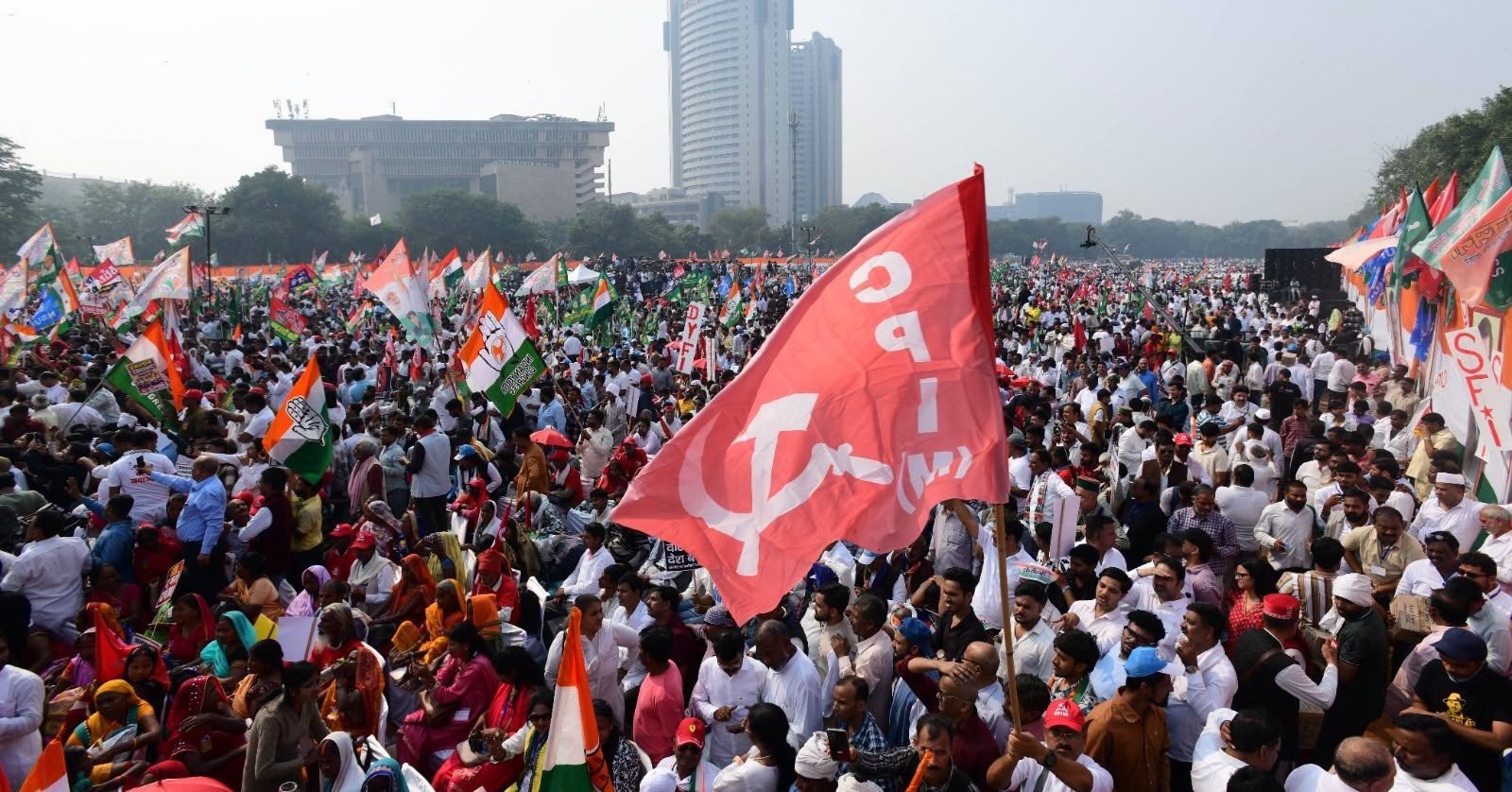
The following day, the campaign moved from the symbolic parliamentary setting to the streets of central Delhi. The INDIA Bloc’s “Vote Bachao, Desh Bachao” rally at Ramlila Maidan brought together a massive mobilisation of political parties, mass organisations, civil society groups and citizens from different sections of society. Tens of thousands assembled at Minto Road before the arrival of Opposition leaders, with student, youth and women’s organisations, farmers’ groups and even citizens who had not previously been involved in demonstrations lining the route as the leaders travelled towards Ramlila Maidan in open vehicles.
CPI(M) General Secretary M A Baby called the gathering a powerful expression of people speaking in one voice against the attempts to undermine democracy, and a stern warning to Prime Minister Narendra Modi and Home Minister Amit Shah that their fascistic tactics will not work. Characterising the present struggle as a “Second Freedom Struggle”, this time against the RSS and its Manuvadi politics, he affirmed that the CPI(M) and the red flag would remain at the forefront of the movement.
CPI(ML) Liberation General Secretary Dipankar Bhattacharya described SIR as a “surgical strike on democracy”, warning that it threatened both the right to vote and the freedom of expression and dissent. Leader of Opposition in Lok Sabha Rahul Gandhi told the gathering that the movement was not the protest of any one party or leader, but a united struggle representing the voice of India. He warned Narendra Modi and Amit Shah that they too would be held accountable for vote theft and would not be allowed to escape the law, referring to BJP’s “Modi Kahin Nahi Jayega” campaign.
CPI(M) Polit Bureau member and AIKS General Secretary Vijoo Krishnan declared that the “logical discrepancy” in a democracy is the dictator sitting on his throne, and that the time has come to end the dictatorship. Recalling the sacrifices of farmers to ensure the victory of the historic farmers’ struggle, he called on the people to strengthen the movement. Invoking Pash’s words that the most dangerous thing in the world is the death of our dreams, Krishnan asserted that the rally had made it clear that the dreams of the people are alive and well. He ended with Tamil poet and freedom fighter Subramania Bharati’s lines “On the acme of my head, if the sky did crash and plummet down / There is no fear, there is no fear, nothing like fear.”
THE BJP IS RATTLED
The two programmes placed the protection of every eligible citizen’s right to vote, transparency in the electoral process, and accountability of the Election Commission as essential for functioning of our democratic republic. Even as the BJP has taken jabs at the mock parliament proceedings and questioned the turnout at the rally, the way the party has launched an aggressive counter-campaign comprising public meetings, padyatras, and mock parliament sessions by their own civil society groups, shows that it has been rattled by the show of opposition unity and public support. The Left parties, the INDIA Bloc, and the wider groups that now make up the people’s movement have their work cut out.


