Samprikta Bose
AN elderly man, his hands trembling not in fear but in anguish, desperately held the arm of an agitated youth, entreating him with quiet dignity: “Please don’t destroy the books. Come here, have a look at them.” Indifferent to this humane appeal, the youth and his cohort brazenly tore down the display counter, hurling volumes into the dust of the road. These were not merely texts of Marx, Engels, and Lenin, but literary masterpieces of Sarat Chandra Chattopadhyay, trampled underfoot in the dirt.
The disturbing visuals of this targeted vandalism, unfolding at a Left-wing bookstall at Nagerbazar during Durga Puja, sent a chill across the nation. Such incidents unfolded to varying degrees at nearly 289 bookstalls across the state, not just in Kolkata. While RSS-backed outfits like the Hindu Jagran Manch carried out assaults in certain areas and the BJP in others, wherever their presence was lacking, the administration under Suvendu Adhikari directly mobilised police forces to dismantle the stalls. Over the past fifteen years, the working masses of West Bengal have borne witness to a protracted regime of socio-political decadence, systemic graft, institutional hollowing, and lumpenised syndicate raj. Yet, even among those hardened to the state’s political decay, few anticipated that the political drift would sink to the outright barbarism of book-banning mobs running amok on festive streets.
DEFIANCE OF A SEPTUAGENARIAN
The septuagenarian at the centre of the Nagerbazar storm was Bipul Dasgupta, affectionately known across the movement as Buju kaku (uncle). A CPI(M) whole-timer who has tended to the Nagerbazar bookstall since 1979, Buju kaku’s serene courage in the face of muscle-flexing lumpens became an immediate catalyst for democratic resistance. Dismissing his bravery with characteristic modesty as "nothing extraordinary—simply what had to be done to defend books," Buju kaku’s quiet act of defiance ignited an outpouring of collective indignation across Bengal.
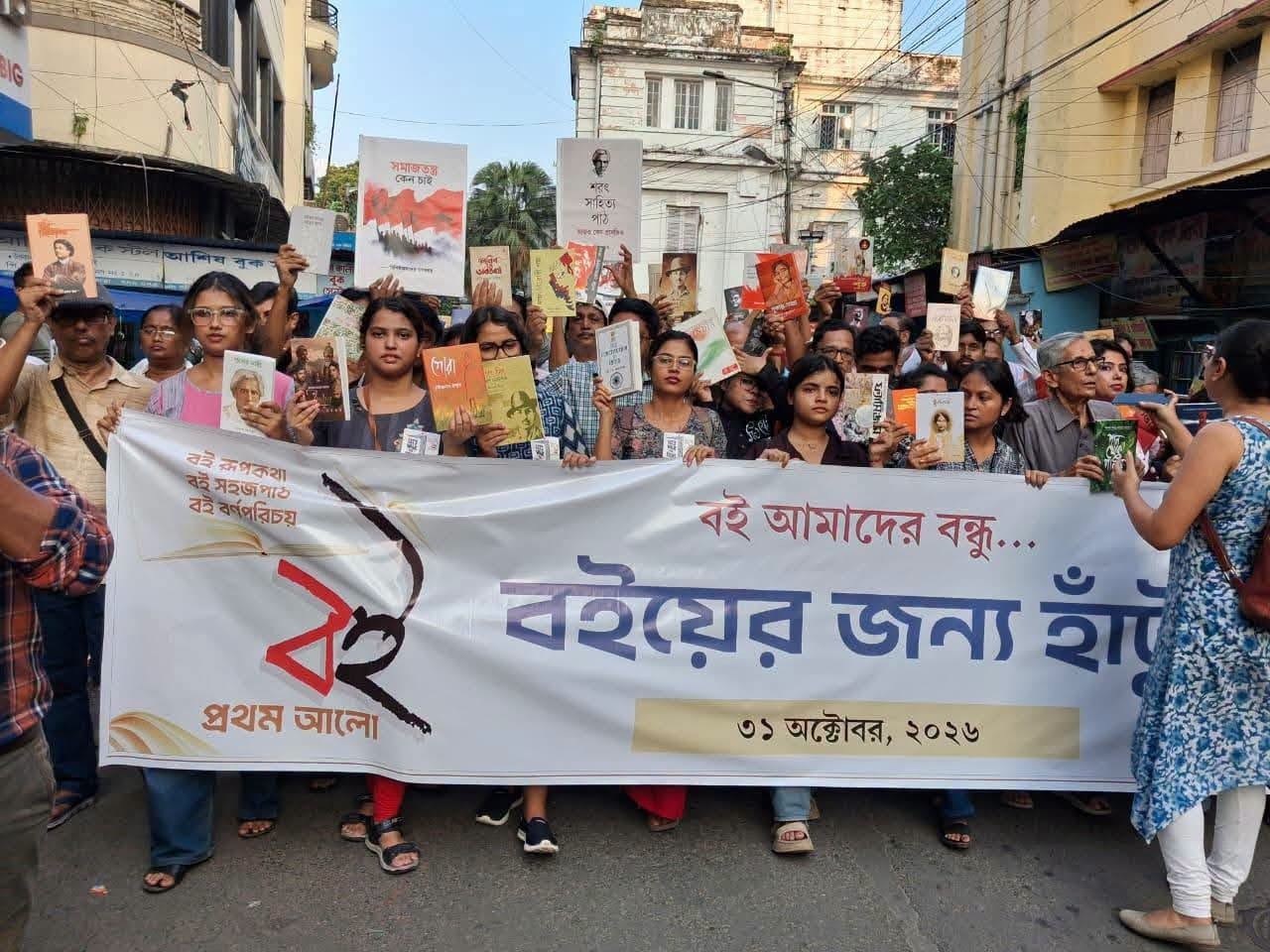
On October 31, that solitary stand against reaction transformed into an immense mass mobilisation. Dasgupta himself stepped out at the head of the historic 'Walk for Books' (Boi-er Jonno Hatun), leading thousands through the historic arterial heart of Bengal’s intellectual life — College Street. What began as a defensive response to reactionary vandalism rapidly blossomed into an assertive ideological offensive in defence of human knowledge, secular democratic culture, and the inviolable right to free thought.
CONFLUENCE ACROSS GENERATIONS
Gathering at the feet of Ishwar Chandra Vidyasagar’s statue at College Square — the enduring symbol of Bengal’s intellectual renaissance, student activism, and rich cultural heritage — the massive procession snaked through the historic book district before returning to its starting point. The demonstration dissolved generational and sectarian divisions, assembling an extraordinary vanguard of the democratic intelligentsia.
Renowned educationists, littérateurs, and cultural critics such as Pabitra Sarkar and Shamik Bandyopadhyay joined the march alongside veteran legal luminaries, retired administrative heads, and parliamentarians including Bikash Bhattacharya, Jawhar Sircar, and academic Ashoknath Basu. The procession was flagged off by Sukanta Chaudhuri, eminent Indian literary scholar and Professor Emeritus of English at Jadavpur University, Kolkata. Senior communist leaders, including Left Front Chairman Biman Basu, CPI(M) West Bengal State Secretary Md Salim, and Central Committee member Sujan Chakraborty, walked shoulder to shoulder with waves of university students, schoolteachers, doctors, civil rights activists, and spontaneous passersby who laid aside their purchases on College Street to join the ranks.
Defying the grimness of the threat, the march was sustained by cultural defiance. Resonant voices carried the anti-imperialist, emancipatory verses of Rabindranath Tagore, Kazi Nazrul Islam, and Bhupen Hazarika, woven seamlessly into proletarian anthems and Bengal's rich tradition of radical folk music.
THE WEAPON OF KNOWLEDGE
The defining material characteristic of the march was that every participant arrived armed — not with weapons of coercion but with books. The sheer breadth of literature held aloft laid bare the fraudulence of the reactionaries' cultural panic.
The assembly did not march under a narrow, dogmatic reading list. Participants carried the anti-colonial and renaissance heritage of Bengal, holding aloft Tagore’s Raktakarabi, Gora, Crisis in Civilization, and Gitanjali; Vidyasagar’s Barnaparichay; Sukumar Ray’s Abol Tabol; Upendrakishore Ray Chowdhury’s Tuntunir Boi; and Sarat Chandra Chattopadhyay’s banned anti-imperialist masterpiece Pather Dabi. Alongside these stood testimonies of democratic humanism and anti-fascist memory, from Anne Frank’s The Diary of a Young Girl to the works of Fyodor Dostoevsky and the subversive mystic songs of Lalon Fakir.
The cornerstone theoretical works of Karl Marx, Friedrich Engels, and V I Lenin were displayed in equal measure alongside independent little magazines, working-class journals, ancient epics such as the Ramayana and the Mahabharata, the Bhagavad Gita, and the egalitarian teachings of Swami Vivekananda.
This boundless range exposed the fundamental lie of authoritarian reaction: the democratic Left does not fear human heritage in any form. It embraces the entire inheritance of human thought, confident that a scientific and critical engagement with history is the greatest enemy of clerical fascism and political lumpenism.
A striking testament to this dialectical approach was a volume carried by CPI(M) State Secretary Md Salim: Swami Vivekananda: Studies in Soviet Union. Published in 1987 by the Ramakrishna Mission Institute of Culture, Calcutta, and translated from the original Russian by Harish C Gupta, this compilation chronicles the serious materialist and philosophical engagement by Soviet academics with one of India's pre-eminent anti-colonial spiritual figures. Held high alongside Lenin’s tracts and Bengali classic novels, it offered a visual rebuff to the manufactured polarisation of our times, reminding the masses that genuine intellectual enquiry recognises no chauvinistic walls.
THE BATTLE LINE IS DRAWN
Addressing the packed assembly, veteran cultural critic Shamik Bandyopadhyay sounded an urgent ideological warning: the attacks on bookstalls are not random street-corner brawls, but part of a systematic, nationwide offensive against public education, secular reason, and human emancipation. “Bengal will not be permitted to become a killing ground for culture,” he declared, calling upon all democratic platforms to forge an unyielding cultural resistance against fascist creep.
Congratulating the thousands who reclaimed the streets, Biman Basu emphasised that this mobilisation must not remain an episodic commemoration, but must transform into an organised, sustained campaign reaching every neighbourhood, campus, and factory floor. Against the encroaching shadows of terror, censorship, and political decay, the message ringing from the academic pavements of Kolkata was unequivocal: Books cannot be silenced, reason cannot be intimidated, and the collective mind of a conscious working class can never be bulldozed.


